
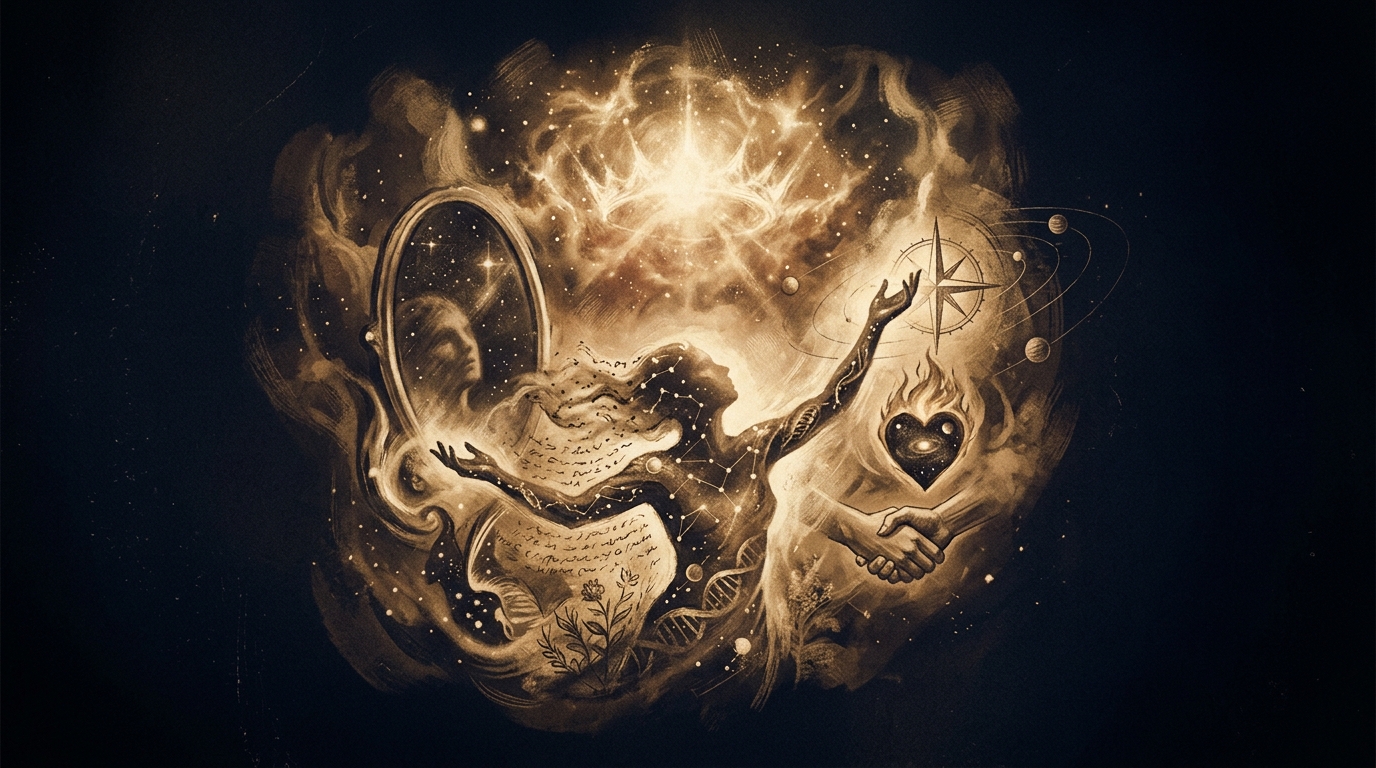
 Codex Illustration
The Image of God (Imago Dei)
The declaration that humanity is made 'in the image of God' (Genesis 1:26–27) stands as one of Scripture's most consequential and contested claims, shaping millennia of theology, philosophy, ethics, and cosmology. Its meaning reaches far beyond metaphor, touching questions of divine representation, royal function, spiritual identity, and the very nature of human uniqueness.
Overview
The phrase imago Dei appears first in Genesis 1:26–27, where God declares, 'Let us make mankind in our image, after our likeness.' Three Hebrew terms anchor the concept: tselem (image, often used of physical statues or cult representations), demut (likeness, suggesting resemblance), and the plural 'us,' which has generated centuries of interpretive controversy. In ancient Near Eastern royal ideology, the image of a god referred specifically to a king who functioned as the deity's authorized representative on earth — a vicegerent who embodied divine authority in a particular territory. The Genesis text democratizes this concept radically, applying it not to a single monarch but to all humanity, male and female alike.
The Ancient Near Eastern context is decisive for interpretation. In Mesopotamian texts such as the Enuma Elish and in Egyptian royal inscriptions, statues of gods (tselems) were placed in temples and in conquered territories to assert divine presence and dominion. When a Pharaoh was called 'the image of Ra,' this was functional, not merely metaphorical — it meant he governed and acted in the name of the deity. Michael Heiser and other scholars in the tradition of Comparative Semitics argue that Genesis 1 deliberately appropriates and universalizes this royal-representative framework, asserting that every human being participates in a dignity previously reserved for monarchs. This is simultaneously a profound theological statement and a subversive political one within its ancient context.
Christian theological tradition developed multiple competing interpretations of what the image entails. The substantive view (held by many early Church Fathers and medieval scholastics, including Thomas Aquinas) located the image in a particular faculty — reason, rationality, or moral consciousness. The relational view, prominent in twentieth-century Protestant theology (Karl Barth in particular), argued the image is not a property humans possess but a relational orientation toward God and toward other persons, rooted in the divine 'I–Thou' dynamic. The functional view, strongly supported by contemporary Old Testament scholarship (including Heiser, J. Richard Middleton, and John Walton), insists the image describes what humans do — represent and administer divine rule over creation — more than what they inherently are.
The implications of imago Dei extend well beyond academic theology. The doctrine grounds human dignity and equality across gender, ethnicity, and social class in a way that was genuinely revolutionary in antiquity. It stands as the biblical foundation for ethics, human rights discourse, and the sanctity of life. The New Testament deepens the concept by identifying Jesus Christ as the perfect, unmediated image of the invisible God (Colossians 1:15; 2 Corinthians 4:4), casting the redemptive mission as a restoration and fulfillment of the original image-bearing vocation. Questions about whether the image was lost or distorted at the Fall, how it relates to the soul, and what it implies for artificial intelligence and transhumanism ensure that imago Dei remains a living theological frontier.
Timeline
Evidence
Multiple Perspectives
Biblical Lens
Scripture Threads
Sources & Further Study
Questions to Explore
Follow the Thread
Continue the Investigation
You’ve reached the Full Archive portion of this Case File.
Ask the Archivist
about this fileSign in to ask the Archivist
Create a free account to ask the Archivist 1 grounded question each day, cited straight from the CODEX case files.
Discussion
0Share findings, questions, and evidence with fellow Seekers. Be respectful and cite sources where you can.
No comments yet. Be the first to open this thread.