
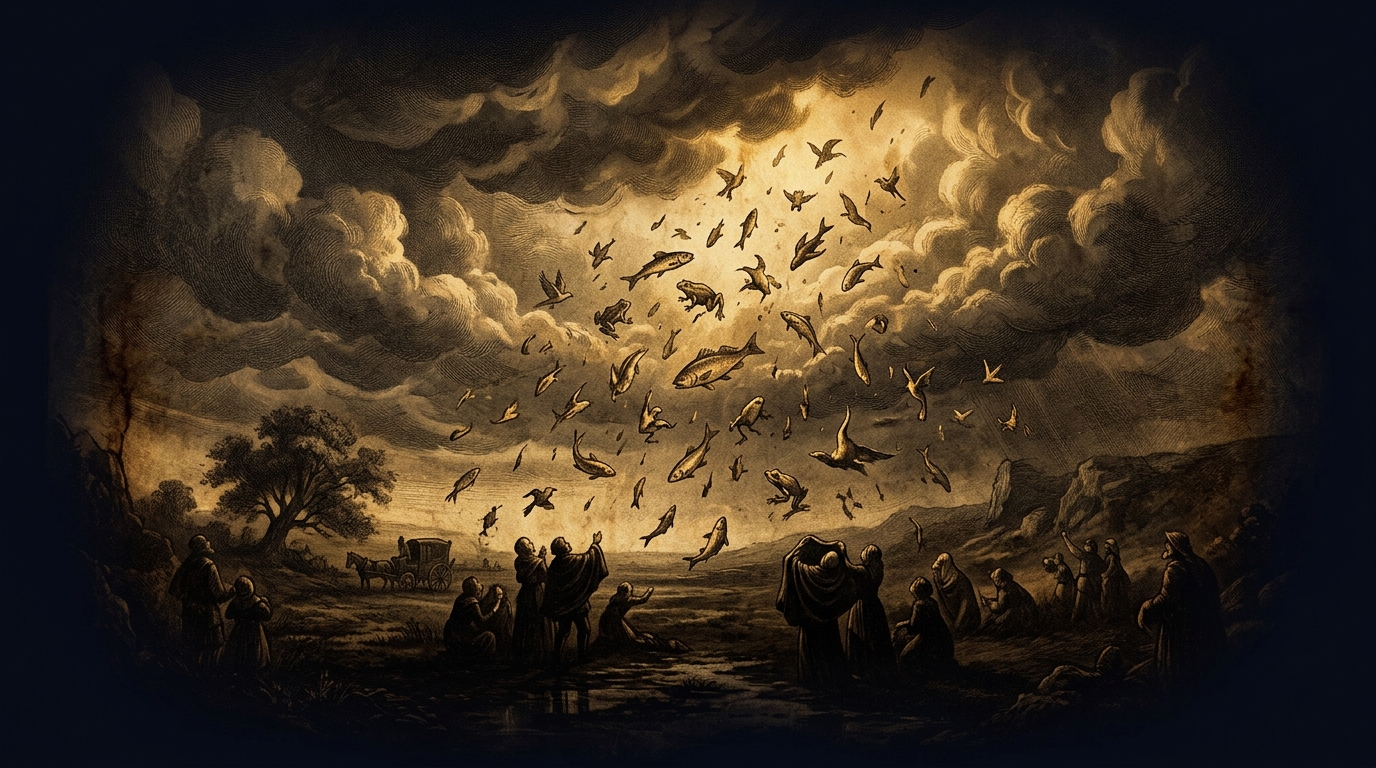
 Codex Illustration
Raining Animals
Across centuries and continents, credible witnesses — farmers, soldiers, journalists, and scientists — have reported animals falling from the sky: fish, frogs, birds, worms, and stranger things still. The phenomenon is historically attested, scientifically plausible in outline, and yet persistently unsettling in its particulars.
Overview
The image of animals raining from the sky occupies a peculiar position in the archive of unexplained phenomena: it is simultaneously one of the most thoroughly documented classes of high-strangeness events and one of the least understood in its mechanical details. Reports span at least two millennia, appearing in the naturalist writings of Pliny the Elder, the chronicles of medieval Europe, the journals of nineteenth-century American newspapers, and the meteorological records of the twentieth century. Unlike many anomalies that rest primarily on secondhand testimony or embellished folklore, a significant number of animal-rain events have been witnessed by multiple independent observers, corroborated by physical evidence — the animals themselves — and in some cases documented by local or national press within hours of occurrence.
The most commonly proposed scientific explanation invokes the waterspout or the tornado: a rotating column of air descends over a body of water or a low-lying terrain, scoops up organisms concentrated there, carries them aloft to altitudes where the temperature and air pressure are radically different from ground level, transports them horizontally for distances ranging from meters to kilometers, and then releases them when the vortex dissipates or the organisms' weight overcomes the updraft. This mechanism, broadly accepted among meteorologists, does account for many well-documented cases — particularly those involving small aquatic animals such as fish and frogs. It receives indirect support from the observation that falling animals are often of a single species, sometimes of a single size class, which would be consistent with a sorting mechanism operating during their aerodynamic transport. Yet the hypothesis carries unresolved difficulties: waterspouts capable of the necessary lift have rarely been observed in direct proximity to reported falls, and the survival rate of falling animals — many arrive alive — demands conditions gentler than a violent vortex would seem to permit.
The historical record is rich with specific, named events. In 1794, soldiers of the French army near Lalain reportedly watched toads fall during a violent storm, a report published in the scientific press of the period. In 1877, a rain of snakes was reported in Memphis, Tennessee, and covered in the Scientific American of that year. In 1894, jellyfish reportedly fell on Bath, England. The Honduran town of Yoro has long claimed an annual or semi-annual rain of fish — a tradition with genuine meteorological documentation behind it — and was the subject of a National Geographic investigation in the 1970s. In 2010, small fish fell on Lajamanu, a remote Australian outback town, an event witnessed and photographed by residents and reported to the Bureau of Meteorology. The pattern across these events is surprisingly consistent: the falls are local and brief, the animals are often alive, and they belong overwhelmingly to species that congregate in shallow freshwater environments.
At the boundary of the naturalistic explanation, however, lie a handful of cases that resist easy categorization. Reports of falling meat (Kentucky, 1876), alligators (South Carolina, 1877 per Scientific American correspondence), and living squid in apparently landlocked areas strain the waterspout model, either because of the animals' size or because of the absence of a credible nearby source body of water. Charles Fort, the early twentieth-century cataloguer of anomalous data, assembled hundreds of such accounts in his book The Book of the Damned (1919), approaching them not as a debunker or a true believer but as a meticulous archivist of the scientifically inconvenient. Fort's database, while editorially unsystematic by modern standards, remains a foundational reference for any serious treatment of the subject. The honest position the archive must hold is this: the core phenomenon — animals transported by atmospheric mechanisms and deposited by precipitation events — is well-attested and physically credible; the outlying cases invite continued scrutiny rather than dismissal.
Key Claims
Timeline
Evidence
Multiple Perspectives
Biblical Lens
Scripture Threads
Sources & Further Study
Questions to Explore
Go Deeper Path
Follow the Thread
Continue the Investigation
You’ve reached the Full Archive portion of this Case File.
Ask the Archivist
about this fileSign in to ask the Archivist
Create a free account to ask the Archivist 1 grounded question each day, cited straight from the CODEX case files.
Discussion
0Share findings, questions, and evidence with fellow Seekers. Be respectful and cite sources where you can.
No comments yet. Be the first to open this thread.