
 Codex Illustration
Real Animals That Sound Mythological
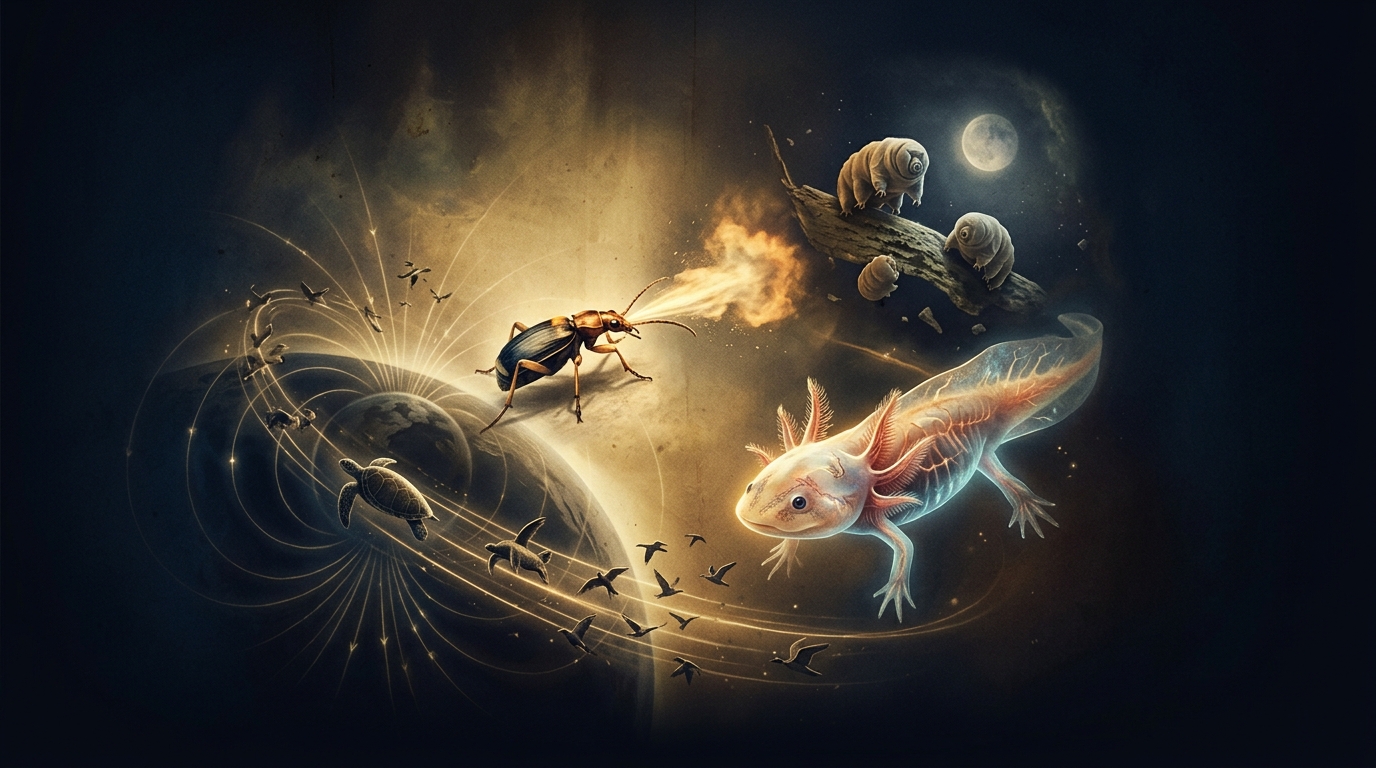
Across every continent, living creatures have been documented by science that defy ordinary intuition — animals that breathe fire-like chemicals, regenerate from near-death, survive the vacuum of space, or navigate by sensing the Earth's magnetic field — raising the quiet question of where natural history ends and myth begins.
Overview
There is a persistent assumption in popular thinking that the monstrous, the miraculous, and the inexplicable belong to ancient fable rather than the natural world. That assumption dissolves on closer inspection. The mantis shrimp strikes with a force that generates cavitation bubbles reaching temperatures approaching those of the sun's surface; the bombardier beetle synthesizes and detonates a boiling chemical spray from twin abdominal chambers; the mimic octopus replicates the body language of lionfish, flatfish, and sea snakes in real time. These are not exaggerations or folklore — they are peer-reviewed, instrumentally measured biological realities, documented in journals ranging from Nature to the Journal of Experimental Biology. The natural world, it turns out, has been running experiments in the extraordinary for hundreds of millions of years.
Some of the most remarkable cases concern resilience that reads almost as supernatural. The tardigrade — a microscopic, eight-legged water-dweller first described by Johann August Ephraim Goeze in 1773 — has been confirmed by documented laboratory and space-mission experiments to survive desiccation, radiation doses lethal to most organisms, pressure extremes, and even the unshielded vacuum of low Earth orbit during the 2007 FOTON-M3 mission. The axolotl (Ambystoma mexicanum), a neotenic salamander native to the lake system beneath Mexico City, regenerates severed limbs, portions of its heart, and segments of its spinal cord — a capacity studied extensively by developmental biologists and now subject to active research into stem-cell and regenerative medicine applications. These are not isolated curiosities; they represent entire taxa that challenge received intuitions about biological limits.
The line between the mythological and the zoological has been historically thin. Many creatures now held in natural history collections were, within living cultural memory or within the last few centuries of European natural history, dismissed as traveler's fantasy. The platypus, whose preserved specimen was sent to British naturalist George Shaw in 1799, was initially suspected to be a taxidermist's hoax — a beaver's body stitched to a duck's bill. The okapi, a forest-dwelling relative of the giraffe, was known only through African oral tradition and fragmentary European reports until P.L. Sclater formally described it in 1901. The giant squid (Architeuthis dux) existed in the realm of maritime legend — as the Norse kraken, as classical sea-monster accounts — until specimens began washing ashore in the nineteenth century and live individuals were first filmed in their deep-sea habitat in 2006. The dragon-like Komodo monitor, the gliding lizard Draco volans, and the deep-sea anglerfish with its bioluminescent lure are further examples of creatures that, encountered without prior taxonomic preparation, would read as invented.
From a broader perspective, this phenomenon invites a serious epistemological question: how much of the world's mythological bestiary may encode genuine, if imprecisely described, zoological observation? Scholars including Adrienne Mayor (in her peer-reviewed work Fossil Legends of the First Americans and The First Fossil Hunters) have argued that some ancient monster traditions may preserve folk memory of genuine encounters with rare or now-extinct animals, or with fossil remains interpreted through a pre-scientific framework. This does not collapse myth into documentary realism, but it does suggest that the boundaries between natural history, cultural transmission, and imaginative elaboration are far more porous than modernist epistemology has typically acknowledged. The natural world, in its own unhurried way, continues to produce creatures that sound like they were invented.
Key Claims
Timeline
Evidence
Multiple Perspectives
Biblical Lens
Scripture Threads
Sources & Further Study
Questions to Explore
Go Deeper Path
Follow the Thread
Continue the Investigation
You’ve reached the Full Archive portion of this Case File.
Ask the Archivist
about this fileSign in to ask the Archivist
Create a free account to ask the Archivist 1 grounded question each day, cited straight from the CODEX case files.
Discussion
0Share findings, questions, and evidence with fellow Seekers. Be respectful and cite sources where you can.
No comments yet. Be the first to open this thread.