
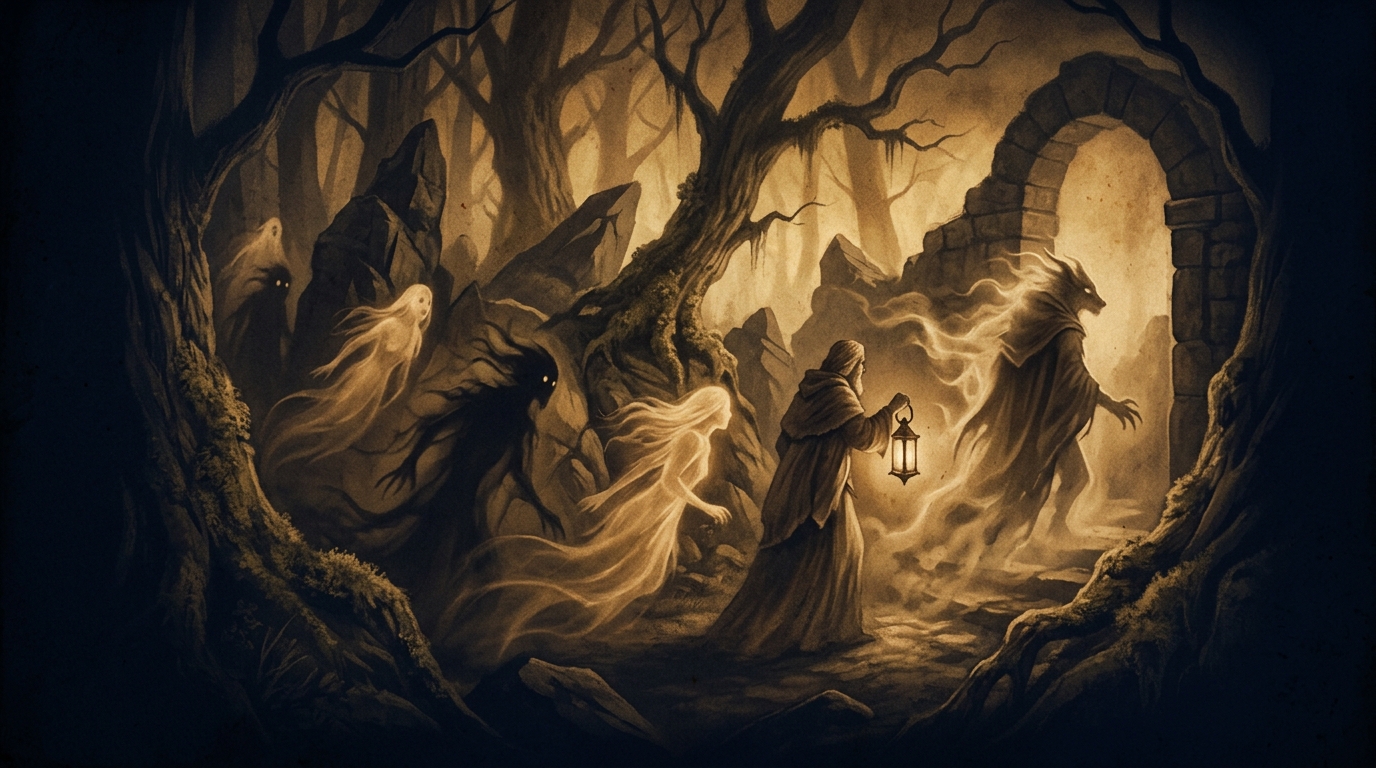
 Codex Illustration
Folklore and the Supernatural
Across every human culture and historical period, folklore has preserved accounts of beings and forces that exceed ordinary natural explanation — spirits, demons, shape-shifters, and liminal creatures that haunt the boundaries between the visible and invisible worlds. Whether these traditions encode genuine encounters with non-human intelligence, inherited memory of ancient cosmological events, or projections of the human psyche remains one of the most enduring and genuinely contested questions in the study of religion, anthropology, and the humanities.
Overview
Folklore, in its broadest scholarly definition, encompasses the oral, customary, and material traditions transmitted within communities — including legends, myths, fairy tales, proverbs, rituals, and belief narratives. The supernatural strand of folklore is arguably its oldest and most universal thread. From the animistic traditions of Paleolithic hunter-gatherers to the fairy lore of medieval Europe, from the djinn of Arabian tradition to the oni of Japanese mythology, nearly every recorded human culture has maintained structured belief in beings that inhabit a realm adjacent to — or deeply interpenetrating — the material world. Folklorists such as Jacob and Wilhelm Grimm in the nineteenth century were among the first to systematically collect and analyze these traditions, recognizing that behind the embellishments of oral transmission lay structures of belief with deep cultural and possibly historical roots.
The academic study of supernatural folklore developed in earnest during the Romantic era and gained disciplinary rigor through the twentieth century. Scholars such as Vladimir Propp, who analyzed the morphological structure of folktales in his foundational 1928 work, and later Claude Lévi-Strauss, who applied structural anthropology to myth, demonstrated that supernatural narratives are not random inventions but follow consistent deep grammars. The functionalist school, represented by Bronisław Malinowski, argued that such narratives serve social cohesion and psychological needs. More recently, cognitive anthropologists including Pascal Boyer have investigated why supernatural agent concepts arise so predictably across unrelated cultures, suggesting that human cognitive architecture has a natural tendency to generate and retain beliefs in counterintuitive beings — beings that violate ordinary category expectations (such as objects that are both dead and alive, or persons who pass through walls) in ways that make them memorable and culturally transmissible.
A persistent and contested question is the relationship between folklore and historical event. Some scholars, notably Adrienne Mayor in her work on fossil discoveries and monster legends, have argued that certain creature traditions preserve genuine observational data misinterpreted through a pre-scientific framework — giant bones interpreted as giants, extinct megafauna remembered in dragon lore. Others, particularly in the tradition of comparative mythology exemplified by scholars such as Georges Dumézil and Jaan Puhvel, have traced supernatural beings across Indo-European and Near Eastern linguistic families, suggesting that some traditions are extraordinarily ancient, possibly preserving cosmological ideas from the proto-Indo-European period or earlier. The debate between 'euhemerism' (the view that mythological beings derive from historical persons or events) and 'naturist' or 'psychological' interpretations has never been fully resolved.
The intersection of folklore with religious studies adds another layer of complexity. Supernatural beings in folklore are frequently not mere narrative devices but are integrated into living cosmologies — systems that locate spirits, demons, fairies, or ancestors in specific relationship to human society and divine order. Theological traditions from Judaism to Christianity to Islam to indigenous animisms have had to negotiate their orthodox doctrines with the persistent folklore of their populations, sometimes condemning folk beliefs as demonic, sometimes absorbing them as lesser spiritual beings within a broader hierarchy, and sometimes leaving them ambiguously unclassified. This negotiation between official theology and popular supernatural belief is itself one of the richest areas of religious history, and understanding it requires both folkloric and theological literacy.
Timeline
Evidence
Multiple Perspectives
Biblical Lens
Scripture Threads
Sources & Further Study
Questions to Explore
Follow the Thread
Continue the Investigation
You’ve reached the Full Archive portion of this Case File.
Ask the Archivist
about this fileSign in to ask the Archivist
Create a free account to ask the Archivist 1 grounded question each day, cited straight from the CODEX case files.
Discussion
0Share findings, questions, and evidence with fellow Seekers. Be respectful and cite sources where you can.
No comments yet. Be the first to open this thread.