
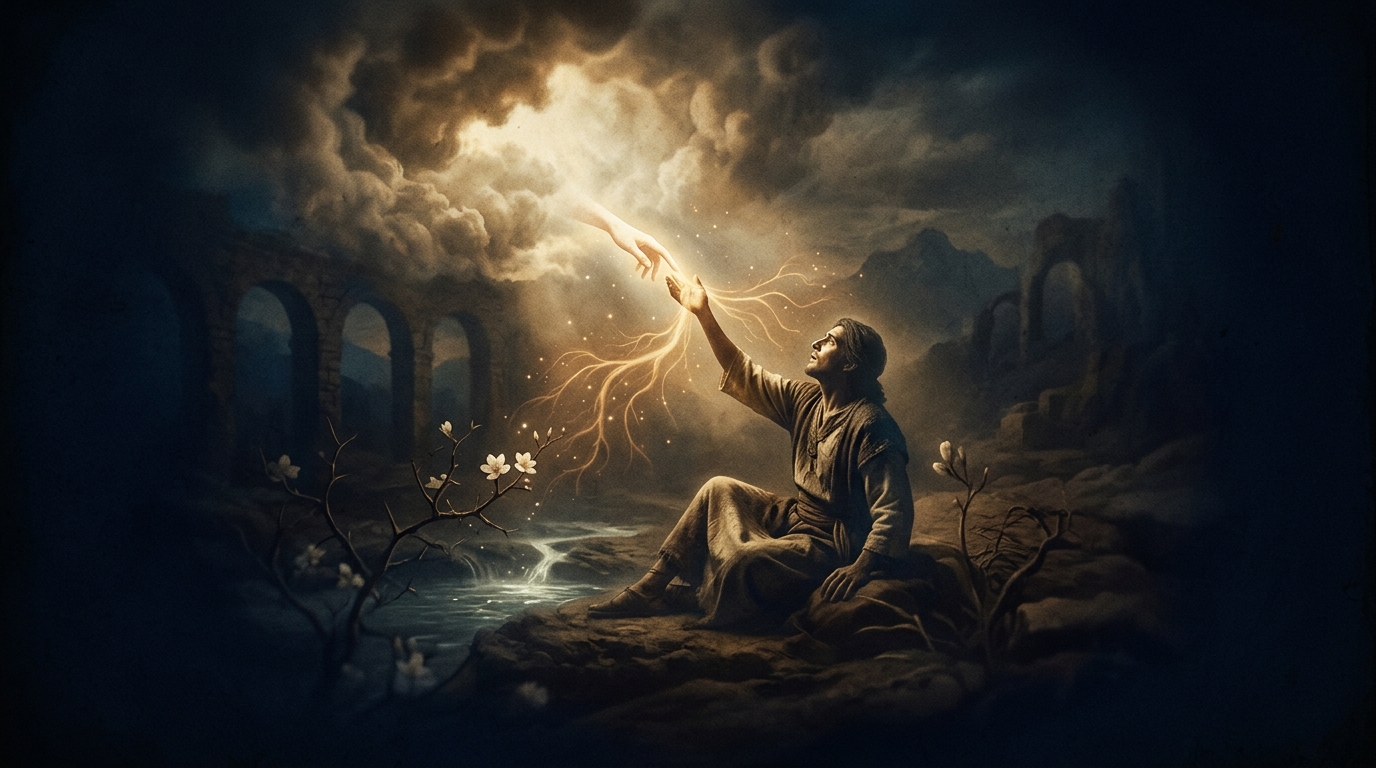
 Codex Illustration
Miracles
Across every culture and century, human beings have reported events that seem to rupture the ordinary fabric of nature—healings, resurrections, visions, and interventions attributed to divine agency. The question of miracles sits at the intersection of theology, philosophy, history, and science, demanding rigorous engagement from every direction.
Overview
A miracle, in its classical definition, is an event that transcends or contravenes the regularities of nature and is attributed to direct divine action. The concept appears universally across religious traditions—Hebrew Scripture, the New Testament, the Quran, Hindu epics, and indigenous oral histories all preserve accounts of the gods or God acting within the created order in extraordinary ways. The philosophical challenge, articulated most influentially by David Hume in his 1748 Enquiry Concerning Human Understanding, holds that no testimony for a miracle can ever be sufficient, since the uniform experience of natural law always outweighs individual reports. Yet this argument has been challenged repeatedly by philosophers of religion such as C.S. Lewis, Alvin Plantinga, and Richard Swinburne, who argue that Hume's case is question-begging: it assumes naturalism to disprove supernatural events.
From a historical standpoint, the evidence base for miracle claims is remarkably varied. Some claims, such as the healing miracles documented in Lourdes, France, have been subjected to rigorous medical review by a Vatican-appointed commission—the Bureau Médical de Lourdes—since 1858. Of thousands of purported healings, roughly seventy cases have been formally certified as medically inexplicable after exhaustive investigation. This does not constitute scientific proof of divine causation, but it does document the existence of cases that resist ordinary medical explanation. Similarly, peer-reviewed studies on intercessory prayer (notably those published in journals such as the Southern Medical Journal) have produced contested but non-trivial data, while near-death experience research at institutions like the University of Virginia's Division of Perceptual Studies continues to generate anomalous findings.
Within the biblical canon, miracles function as signs (Hebrew: 'ot; Greek: sēmeion) pointing to divine identity and covenantal purpose rather than as mere demonstrations of power. The plagues of Egypt, the crossing of the Red Sea, Elijah's contest on Mount Carmel, and the resurrection of Jesus all serve narrative and theological functions that embed them deeply within Israel's story of redemption. Michael Heiser and other scholars of the Ancient Near East emphasize that the biblical miracle tradition must be read against its wider cultural context: Egypt, Mesopotamia, and Canaan all had their own accounts of divine intervention, and the biblical miracles often function as polemical demonstrations of YHWH's supremacy over rival heavenly beings—what Heiser calls the divine council worldview.
In the modern era, debates about miracles have intensified rather than diminished. Charismatic and Pentecostal Christianity—now the fastest-growing religious movement globally—makes healing and supernatural gifts central to its theology and practice, generating vast anecdotal literature and some documentary evidence. Meanwhile, neuroscience and quantum physics have both been invoked (with varying scholarly credibility) to explain or reframe apparently anomalous events. The honest intellectual position requires acknowledging that: (1) the prior probability of miracles depends entirely on one's metaphysical commitments; (2) some well-documented cases genuinely resist ordinary explanation; and (3) the category of miracle is not inherently anti-scientific but rather presupposes an agent capable of acting within and upon natural systems.
Timeline
Evidence
Multiple Perspectives
Biblical Lens
Scripture Threads
Sources & Further Study
Questions to Explore
Follow the Thread
Continue the Investigation
You’ve reached the Full Archive portion of this Case File.
Ask the Archivist
about this fileSign in to ask the Archivist
Create a free account to ask the Archivist 1 grounded question each day, cited straight from the CODEX case files.
Discussion
0Share findings, questions, and evidence with fellow Seekers. Be respectful and cite sources where you can.
No comments yet. Be the first to open this thread.