
 Codex Illustration
Ancient Acoustic Technology
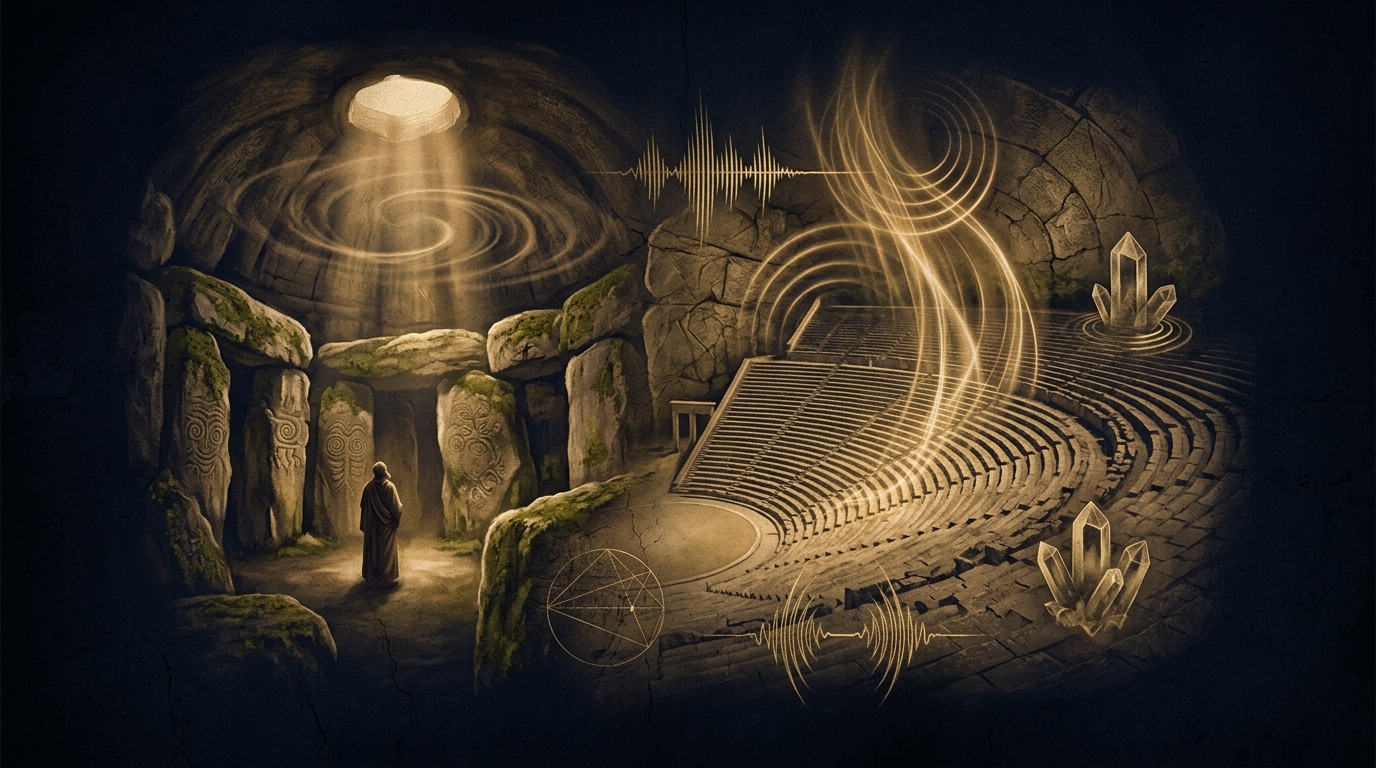
From the resonant chambers of Newgrange to the whispering galleries of Epidaurus, accumulating evidence suggests that ancient builders possessed a sophisticated, if not fully understood, knowledge of acoustic principles — knowledge that shaped the design of sacred spaces, monuments, and ritual environments across the ancient world.
Overview
The study of sound in ancient built environments — a field now formally called archaeoacoustics — has matured significantly since the 1990s into a recognized, if contested, interdisciplinary discipline. Researchers including Iegor Reznikoff and Michel Dauvois published landmark findings in the Bulletin de la Société Préhistorique Française (1988) demonstrating a statistically significant correlation between the placement of Paleolithic cave art at sites such as Lascaux and Font-de-Gaume and the points of greatest acoustic resonance within those caves. Independently, ethnomusicologist Rupert Till and colleagues have documented remarkable acoustic properties at Stonehenge, including a 'repetition effect' caused by the spacing of the sarsen stones that may have functioned as a form of rhythmic amplification during ritual use. Whether these acoustic properties were engineered deliberately or represent a convergence of aesthetically sensitive builders with naturally favorable geology remains genuinely debated among specialists.
The evidence broadens considerably when ancient structures beyond prehistoric Europe are examined. The Hypogeum of Hal Saflieni in Malta — a subterranean temple complex dating to roughly 3600–2500 BC and among the oldest freestanding stone structures on earth — contains a chamber known as the Oracle Room, whose walls produce a drone resonance near 110 Hz when a male voice is directed into a carved niche. Acoustician Paolo Debertolis and neuropsychologist Nick Jentsch have reported, in conference proceedings, that this frequency range influences certain brain-wave states, raising the possibility that the chamber's builders calibrated it for altered perceptual experience during ritual. Similarly, the ancient Greek theatre at Epidaurus — designed c. 340 BC and attributed by ancient sources to the architect Polykleitos the Younger — achieves near-perfect acoustic distribution that continues to astonish modern acoustic engineers. Documented analysis by Nico Declercq and Cindy Dekeyser (Journal of the Acoustical Society of America, 2007) identified the limestone seating as a surprisingly effective low-frequency filter, suppressing crowd noise while preserving speech and musical tones.
Among the most provocative claims in this field is the hypothesis that certain ancient structures were built not merely to accommodate sound but to weaponize, sanctify, or otherwise harness it as a transformative force. In Mesoamerica, the El Castillo pyramid at Chichén Itzá produces a chirped echo from a handclap that, acoustician David Lubman has argued, resembles the call of the quetzal bird — a sound of deep ritual significance in Maya culture. Researchers Nico Declercq and colleagues have examined this phenomenon empirically, and while the acoustic effect is measurable and real, the question of whether it was deliberately engineered or an emergent consequence of the staircase geometry remains open. More speculatively, some researchers have proposed that the Great Pyramid of Giza contains resonance chambers tuned to specific frequencies, though these claims remain largely outside mainstream Egyptological consensus and have been taken up more enthusiastically in alternative archaeology than in peer-reviewed literature.
At the furthest edge of the field sits a cluster of claims that belong more to speculative history than to archaeoacoustics proper: the proposition that sound was used in antiquity as a levitation mechanism for moving megalithic stones, drawing on traditions from ancient Egypt, Tibet, and the legendary Coral Castle built by Edward Leedskalnin in Florida. These claims, while fascinating and persistent, lack physical plausibility under known acoustic physics — the acoustic radiation pressures required to levitate objects of megalithic scale would exceed the output of any known natural or mechanical ancient source by many orders of magnitude. Contemporary acoustic levitation is a documented laboratory phenomenon (see: Journal of Applied Physics), but operates on microgram-to-gram scales, not multi-ton limestone blocks. The archive notes this boundary between the scientifically testable and the currently implausible without prejudice toward future inquiry.
Key Claims
Timeline
Evidence
Multiple Perspectives
Biblical Lens
Scripture Threads
Sources & Further Study
Questions to Explore
Go Deeper Path
Follow the Thread
Continue the Investigation
You’ve reached the Full Archive portion of this Case File.
Ask the Archivist
about this fileSign in to ask the Archivist
Create a free account to ask the Archivist 1 grounded question each day, cited straight from the CODEX case files.
Discussion
0Share findings, questions, and evidence with fellow Seekers. Be respectful and cite sources where you can.
No comments yet. Be the first to open this thread.