
 Codex Illustration
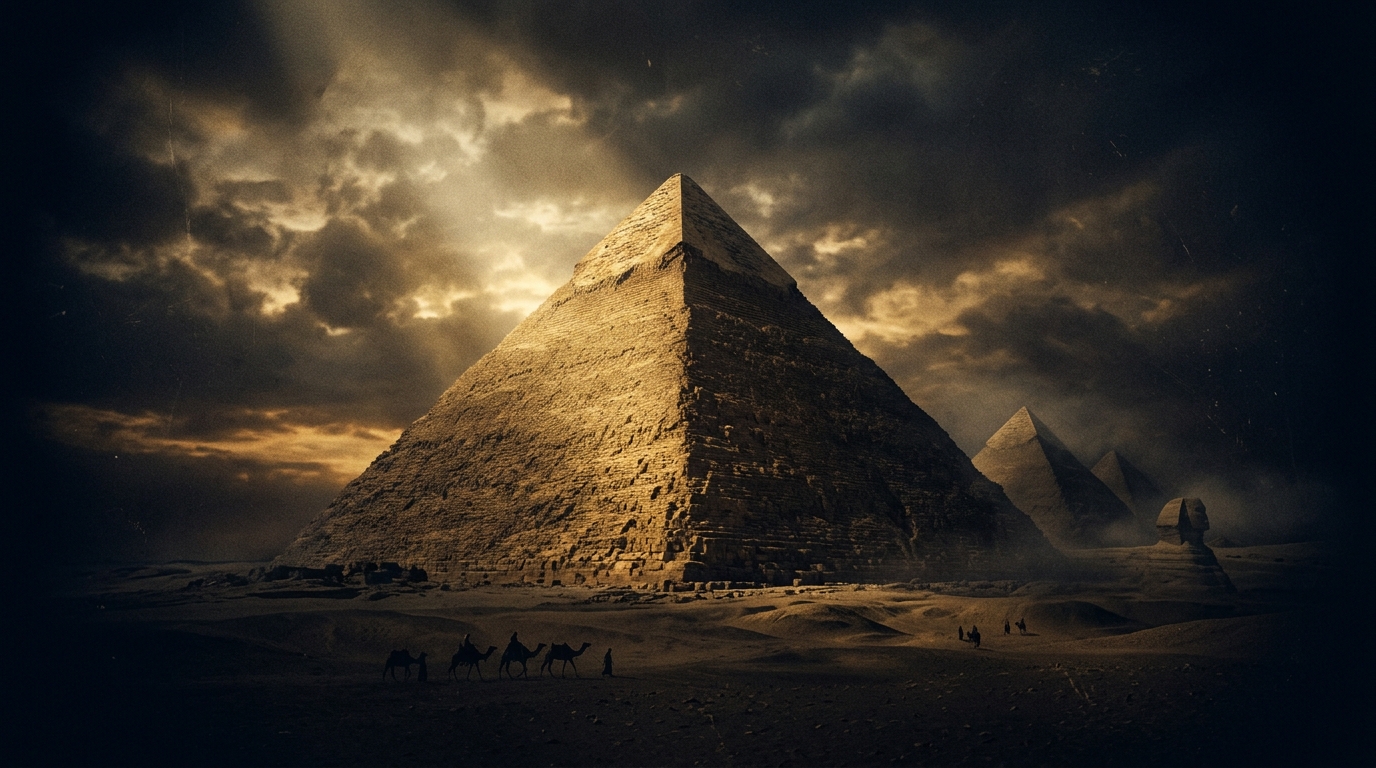
The Great Pyramid of Giza
The Great Pyramid of Giza, built c. 2560 BC as a tomb for Pharaoh Khufu, is the oldest of the Seven Wonders of the Ancient World and the only one still largely intact—a monument that continues to challenge modern engineers, historians, and theologians alike. Its precision, scale, and symbolic resonance have generated centuries of scholarly debate and an enduring undercurrent of mystery.
Overview
The Great Pyramid stands on the Giza Plateau, west of modern Cairo, rising to an original height of approximately 146.6 meters (481 feet). It was built during the Fourth Dynasty of the Old Kingdom, attributed to Pharaoh Khufu (also known by his Greek name Cheops), who reigned c. 2589–2566 BC. Constructed from an estimated 2.3 million limestone and granite blocks—some weighing up to 80 tons—the structure's internal chambers, relieving voids, and precise cardinal alignment continue to astonish structural engineers and archaeologists. The Giza complex also includes the pyramids of Khafre and Menkaure, the Great Sphinx, and numerous subsidiary structures and worker villages uncovered through modern excavation.
Mainstream Egyptology, supported by extensive archaeological and documentary evidence, holds that the pyramid was built by a large, organized workforce of skilled laborers—not slaves—using ramps, sledges, and copper tools over a period of roughly twenty years. The discovery of the Wadi al-Jarf papyri in 2013 provided direct textual evidence of the logistics involved, including the transport of white limestone casing blocks, offering the most detailed first-hand account of pyramid construction yet found. Graffiti in relieving chambers naming a worker gang as 'Friends of Khufu' corroborates the royal attribution. The architectural sophistication reflects a mature tradition of pyramid building stretching back through Djoser's Step Pyramid and the Bent and Red Pyramids at Dahshur.
The pyramid's geodetic and astronomical precision has attracted persistent scholarly curiosity. Its base is level to within 2.1 centimeters across its 230-meter sides, oriented to true north within 0.05 degrees—a feat remarkable by any era's standards. The descending and ascending passages align with circumpolar stars, and the so-called 'air shafts' in the King's and Queen's Chambers point toward astronomically significant stars at the time of construction, including Orion's Belt and Thuban. These features are well-documented and have been subjected to rigorous archaeoastronomical analysis, though interpretations of their ritual purpose vary. Symbolic associations between the pyramid's form, solar theology, and the concept of resurrection are deeply embedded in Egyptian religious texts such as the Pyramid Texts, the earliest known corpus of religious writing.
Beyond credentialed scholarship lies a long tradition of alternative interpretation. Nineteenth-century 'pyramidologists' such as John Taylor and Charles Piazzi Smyth proposed that the pyramid encoded prophetic measurements pointing to biblical chronology and the Second Coming of Christ—claims that mainstream science and biblical scholarship have since thoroughly refuted. The twentieth century brought theories linking the pyramid to Atlantis, advanced pre-flood civilizations, acoustic levitation, and extraterrestrial engineering. While these claims circulate widely in popular culture, they lack credible evidentiary support. A more philosophically interesting question—how a Bronze Age civilization achieved such precision with attested tools and methods—remains the subject of ongoing, productive archaeological investigation.
Timeline
Evidence
Multiple Perspectives
Biblical Lens
Scripture Threads
Sources & Further Study
Questions to Explore
Follow the Thread
Continue the Investigation
You’ve reached the Full Archive portion of this Case File.
Ask the Archivist
about this fileSign in to ask the Archivist
Create a free account to ask the Archivist 1 grounded question each day, cited straight from the CODEX case files.
Discussion
0Share findings, questions, and evidence with fellow Seekers. Be respectful and cite sources where you can.
No comments yet. Be the first to open this thread.