
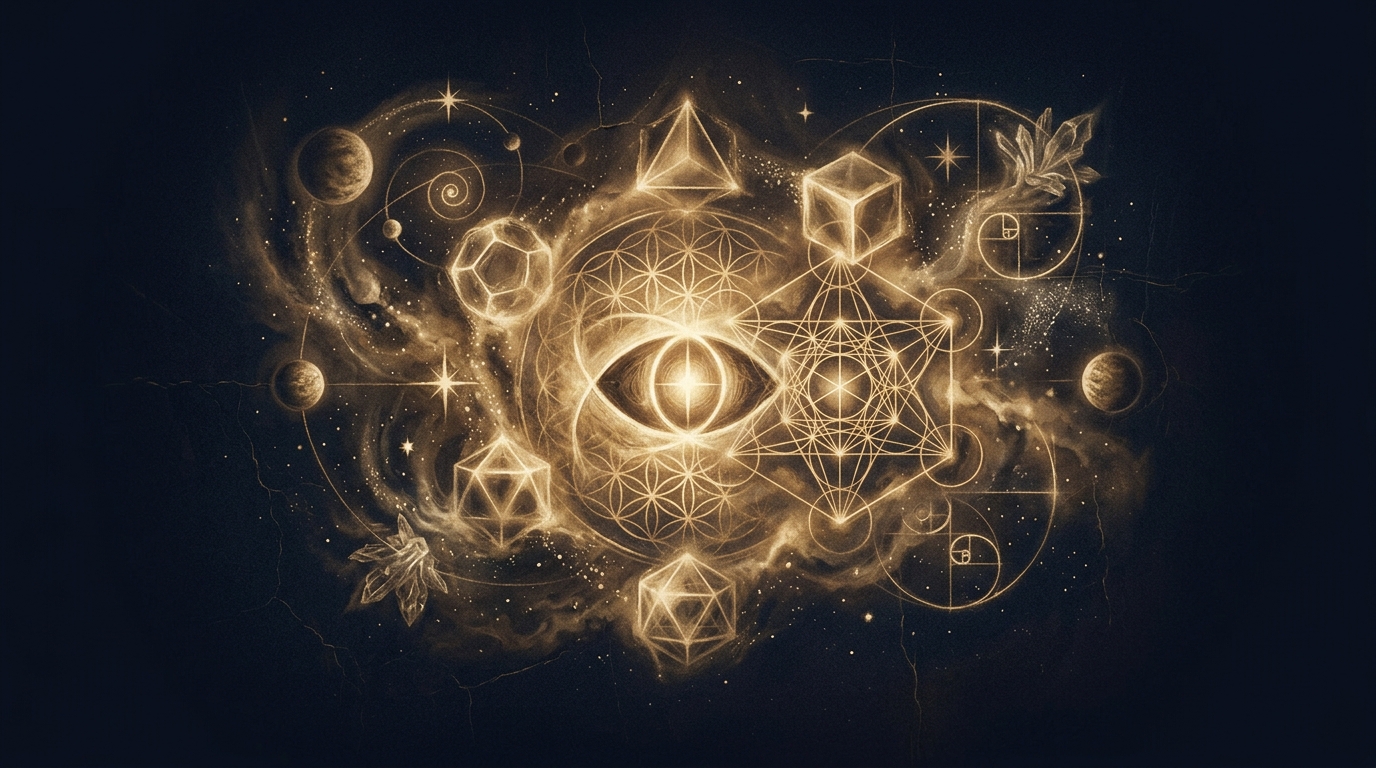
 Codex Illustration
Sacred Geometry
Across millennia and civilizations, certain geometric forms—the golden ratio, the Platonic solids, the vesica piscis—have been treated not merely as mathematical abstractions but as windows into the structural logic of the cosmos itself. Sacred geometry asks whether the universe is, at its foundation, a language of proportion, pattern, and divine order.
Overview
Sacred geometry refers to the study of geometric patterns, ratios, and forms that have been accorded spiritual, religious, or cosmological significance across diverse cultures and historical periods. The discipline encompasses both demonstrable mathematical relationships—such as the golden ratio (φ ≈ 1.618), the Fibonacci sequence, and Platonic solids—and the interpretive frameworks that cultures have built around them. From the temples of ancient Egypt and Greece to the Gothic cathedrals of medieval Europe and the mosques of the Islamic world, architects and theologians alike have encoded specific proportional systems into sacred architecture as an expression of divine order. The premise is not inherently mystical: proportional harmony in architecture and art is a documented historical practice with traceable transmission through written sources.
The mathematical foundations of sacred geometry are real and subject to rigorous analysis. The golden ratio appears in the proportions of the Parthenon, the nautilus shell, and the arrangement of seeds in a sunflower—though scholars caution that many such correspondences are overstated or retrofitted through selective measurement. Euclidean geometry, Pythagorean number theory, and Platonic philosophy each contributed formal intellectual traditions that were later absorbed into both Neoplatonism and Christian theological aesthetics. Figures such as Vitruvius in Rome, al-Kindi in the Islamic world, and the architects of Chartres Cathedral systematically applied geometric proportion as a theological act, believing that beauty in form reflected the rational structure of the Creator's mind.
The concept has deep roots in ancient religious cosmology. In Egypt, the concept of ma'at—cosmic order, truth, and balance—was architecturally expressed in temple orientation and proportion. In ancient Mesopotamia, the ziggurat's stepped form encoded cosmological symbolism linking earth to the heavens. The Pythagorean school, which blurred philosophy, mathematics, and religion, taught that number was the arché—the fundamental substance—of reality, and that certain geometric forms (particularly the tetrahedron, cube, octahedron, dodecahedron, and icosahedron, later codified by Plato in the Timaeus) corresponded to elemental and cosmic principles. This tradition was transmitted through Neoplatonism into early Christian theology, influencing Augustine's discussions of number and beauty in De Musica and De Ordine.
In the modern era, sacred geometry has experienced a significant revival through the New Age movement, popular esoteric publishing, and internet culture—often stripped of its historical and mathematical nuance. Claims such as the geometric encoding of alien blueprints in the Great Pyramid, or the embedding of DNA structure in ancient symbols, represent speculative popular extrapolation well beyond what evidence supports. Nevertheless, the core historical observation—that ancient and medieval cultures deliberately employed specific geometric proportions in religious contexts—is a matter of documented scholarly consensus. The challenge for the careful researcher is to distinguish this documented architectural and philosophical tradition from later layers of occult and esoteric elaboration.
Timeline
Evidence
Multiple Perspectives
Biblical Lens
Scripture Threads
Sources & Further Study
Questions to Explore
Follow the Thread
Continue the Investigation
You’ve reached the Full Archive portion of this Case File.
Ask the Archivist
about this fileSign in to ask the Archivist
Create a free account to ask the Archivist 1 grounded question each day, cited straight from the CODEX case files.
Discussion
0Share findings, questions, and evidence with fellow Seekers. Be respectful and cite sources where you can.
No comments yet. Be the first to open this thread.