
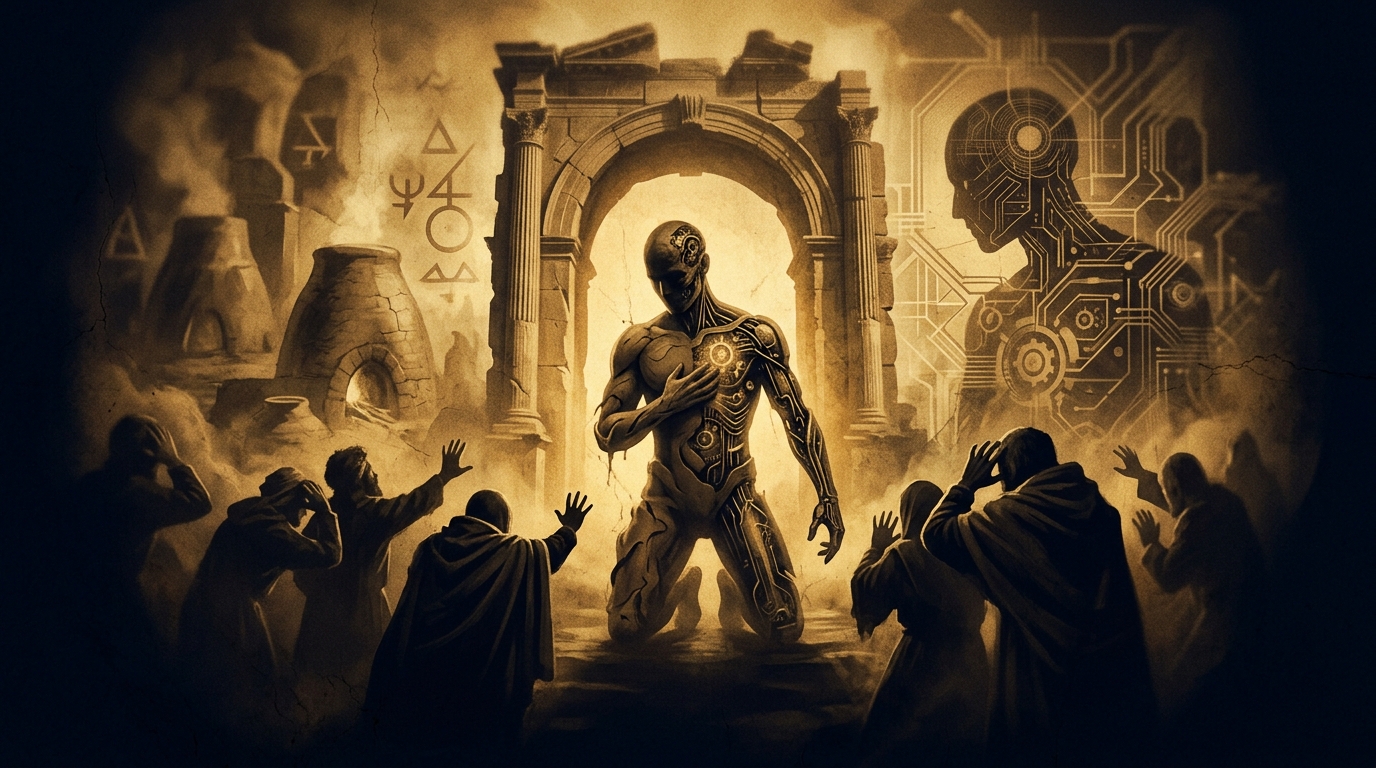
 Codex Illustration
Artificial Humans and Human Fear
From clay golems to silicon androids, humanity has long dreamed of—and recoiled from—the prospect of creating beings in its own image. The fear is not merely technological; it reaches into ancient questions about what it means to be human, who holds the power to create life, and what obligations arise when creation begins to look back.
Overview
The instinct to build artificial humans is among the oldest recorded ambitions of civilization. Ancient Greek mythology described Hephaestus forging golden automata to serve the gods; Talos, the bronze giant of Crete, was conceived as a mechanical guardian. Medieval Jewish tradition speaks of the golem—a humanoid figure animated by sacred inscription—as both a protective servant and a cautionary emblem of overreach. These are not merely charming folk stories: they encode something structurally consistent across cultures, namely the intuition that manufacturing a human-like being crosses a threshold of a peculiar moral kind. The philosopher Philip Galanter has noted that these ancient archetypes anticipate what cognitive scientists now study empirically: the discomfort humans feel when artificial beings approach, but do not quite reach, genuine humanity.
The modern scientific study of this discomfort begins with the roboticist Masahiro Mori, whose 1970 essay in the journal Energy introduced the concept he called bukimi no tani—rendered in English as the 'uncanny valley.' Mori observed, based on informal experimentation rather than rigorous controlled trials at the time, that human emotional affinity for robots increases as their appearance becomes more human-like, but drops sharply—into aversion, unease, even revulsion—at a point just before full human realism, before rising again as the figure becomes indistinguishable from a real person. This curve was long treated as a descriptive heuristic rather than a falsifiable scientific hypothesis, but subsequent empirical work has largely supported it. A 2011 study by Mathur and Reichling published in Cognition provided quantitative validation, and neuroimaging research has suggested that uncanny figures activate brain regions associated with threat detection and disgust rather than the social recognition pathways engaged by genuine human faces. The fear, it appears, is not irrational—it may be deeply wired.
Explanatory frameworks for the uncanny valley phenomenon range from the evolutionary to the philosophical. One hypothesis, associated with the work of Karl MacDorman, is that near-human but imperfect artificial faces trigger pathogen avoidance responses—the same cognitive system that produces disgust at signs of disease or disfigurement. A second framework, rooted in Terror Management Theory (developed by Jeff Greenberg, Sheldon Solomon, and Tom Pyszczynski from Ernest Becker's foundational work The Denial of Death), proposes that artificial humans disturb us because they blur the categorical boundary between the living and the non-living, destabilizing the psychological defenses humans erect against mortality awareness. A third account, explored by philosophers such as Daniel Dennett and Andy Clark, frames the discomfort as a failure of predictive inference: our minds model other humans through elaborate social cognition systems, and when an artificial face sends mismatched signals—visually human, behaviorally wrong—the resulting prediction error registers as wrongness rather than novelty. None of these frameworks is definitively established; each draws on genuine research traditions but involves extrapolation beyond their empirical cores.
As artificial intelligence and robotics advance into domains once considered exclusively human—conversation, creative expression, emotional responsiveness—the stakes of these questions have escalated from philosophical to urgently practical. The emergence of photorealistic AI-generated faces, humanoid robots capable of nuanced expression (such as those developed by Hanson Robotics and Boston Dynamics), and large language models that sustain extended, contextually coherent dialogue has renewed debate about the nature of mind, the moral status of artificial entities, and the societal consequences of human-like machines deployed at scale. Researchers at institutions including MIT's Media Lab, Carnegie Mellon's Robotics Institute, and Oxford's Future of Humanity Institute have begun to formalize what was once largely intuition: that the human response to artificial humans is not a quirk to be engineered away, but a signal worth interrogating carefully. Whether that signal reflects something profound about the nature of consciousness, something contingent about evolved psychology, or something theological about the image in which humans were made—remains, as of this writing, genuinely open.
Key Claims
Timeline
Evidence
Multiple Perspectives
Biblical Lens
Scripture Threads
Sources & Further Study
Questions to Explore
Go Deeper Path
Follow the Thread
Continue the Investigation
You’ve reached the Full Archive portion of this Case File.
Ask the Archivist
about this fileSign in to ask the Archivist
Create a free account to ask the Archivist 1 grounded question each day, cited straight from the CODEX case files.
Discussion
0Share findings, questions, and evidence with fellow Seekers. Be respectful and cite sources where you can.
No comments yet. Be the first to open this thread.