
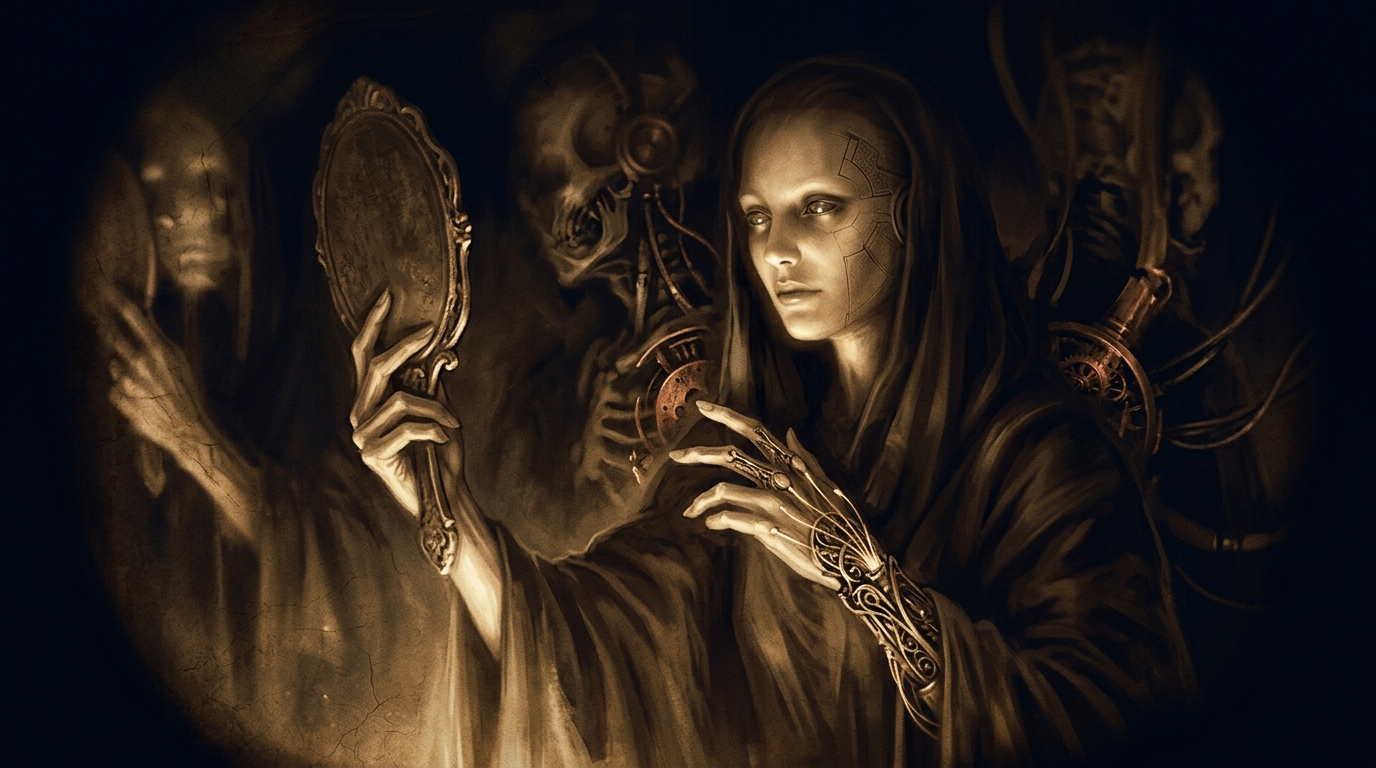
 Codex Illustration
Uncanny Valley
When a humanoid figure becomes almost-but-not-quite human, something in the observer recoils — a phenomenon the roboticist Masahiro Mori named the 'uncanny valley' in 1970, and which has since become one of the most debated and theoretically fertile ideas at the intersection of robotics, evolutionary psychology, and artificial intelligence. What that instinctive revulsion reveals about the boundaries of human identity may be far stranger than the robots themselves.
Overview
In 1970, Japanese roboticist Masahiro Mori published a short but consequential essay in the journal Energy in which he proposed a relationship between a robot's degree of human likeness and the emotional response it provokes in human observers. As a machine's appearance approaches human normalcy, Mori argued, affinity rises — until a threshold is crossed at which near-perfect but imperfect human likeness triggers a sudden, steep drop into unease, eeriness, or outright revulsion. He called this dip the 'uncanny valley' (bukimi no tani in Japanese), borrowing the German concept of das Unheimliche — the uncanny — that Sigmund Freud had explored in 1919 in the context of literature and psychology. Mori's essay was largely overlooked in the West for decades, receiving renewed attention only after translations became widely available in the early 2000s, just as photorealistic CGI and humanoid robotics were advancing rapidly enough to make the problem viscerally real.
The scientific status of the uncanny valley has been extensively debated since its rediscovery. Cognitive scientists, evolutionary psychologists, and roboticists have proposed a range of explanatory mechanisms. One prominent hypothesis, associated with researchers such as Sherry Turkle and later formalized in studies by Mathur and Reichling (2016, published in Cognition), frames the effect as a conflict in categorical perception: the human visual system is finely tuned to detect deviations from normal human appearance as potential signals of disease, injury, neurological impairment, or death — cues that historically warranted avoidance. A near-human face that fails to resolve cleanly as either 'human' or 'non-human' generates a kind of perceptual dissonance, activating threat-detection circuitry. A related but distinct proposal draws on the concept of 'categorical conflict' in facial processing: the brain applies both human-face and object-recognition schemas simultaneously to an ambiguous stimulus, creating a disturbing oscillation rather than a stable percept.
Empirical research has produced genuinely intriguing, if mixed, results. A 2011 study by MacDorman and Chattopadhyay provided behavioral and physiological evidence that uncanny stimuli elevate anxiety responses measured by skin conductance, lending modest physiological grounding to what had been a largely theoretical construct. Neuroimaging studies, including work by Saygin and colleagues (2012, published in Social Cognitive and Affective Neuroscience), found distinctive patterns of activation in regions associated with action prediction and biological motion when subjects viewed androids rather than either humans or robots — suggesting that the brain's predictive machinery is specifically disrupted by the near-human. However, the robustness of these findings across cultures, stimulus types, and experimental paradigms remains an active area of debate; some researchers, notably Angela Tinwell, have argued the effect is real and measurable, while others have questioned whether 'the valley' is a single unified phenomenon or a family of loosely related discomfort responses.
Beyond cognitive science, the uncanny valley has acquired a broader cultural and philosophical gravity. As humanoid robots, AI-generated faces, digital avatars, and synthetic voices proliferate, the question of what boundary separates the recognizably human from a disturbing simulacrum has moved from academic robotics into law, art, and theology. Deepfake technology, conversational AI systems, and hyperrealistic digital humans in film and gaming have all provoked versions of the uncanny valley response in mass audiences — and have also forced designers, ethicists, and policymakers to grapple with the question of whether there is something irreducibly significant about authentic human presence that resists technical replication. The valley, in this light, is not merely a design problem to be engineered around; it may function as a perceptual guardian at the threshold of what we instinctively regard as genuine personhood.
Key Claims
Timeline
Evidence
Multiple Perspectives
Biblical Lens
Scripture Threads
Sources & Further Study
Questions to Explore
Go Deeper Path
Follow the Thread
Continue the Investigation
You’ve reached the Full Archive portion of this Case File.
Ask the Archivist
about this fileSign in to ask the Archivist
Create a free account to ask the Archivist 1 grounded question each day, cited straight from the CODEX case files.
Discussion
0Share findings, questions, and evidence with fellow Seekers. Be respectful and cite sources where you can.
No comments yet. Be the first to open this thread.