
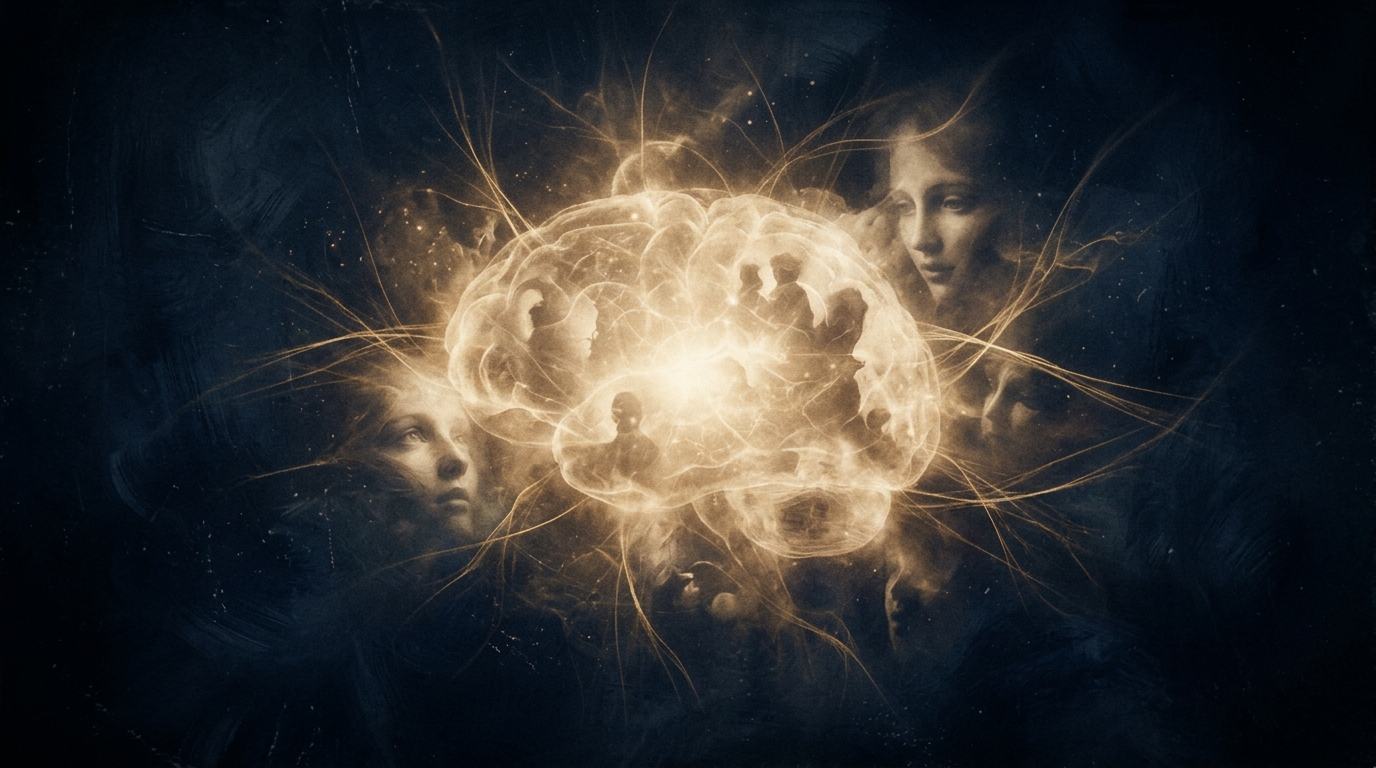
 Codex Illustration
Consciousness
Consciousness—the fact that there is something it is like to be you—remains the deepest unsolved problem in science and philosophy, resisting every materialist explanation while inviting theological, mystical, and even quantum interpretations.
Overview
Consciousness is the irreducible first-person experience of existence: the redness of red, the ache of grief, the quiet awareness that underlies every thought. Philosophers call this the 'hard problem'—distinguishing it from the comparatively tractable 'easy problems' of explaining cognitive functions like attention, memory, and reportability. David Chalmers crystallized the hard problem in 1995, arguing that even a complete neuroscientific account of brain processes would leave unexplained why those processes are accompanied by subjective experience at all. This explanatory gap has not narrowed in the decades since; it has, if anything, deepened as neuroscience has grown more sophisticated without producing a consensus theory.
Historically, the nature of mind and awareness has been a central preoccupation of every major intellectual tradition. Ancient Greek philosophers distinguished between the pneuma (breath-spirit) animating the body and the rational soul capable of abstract thought. Descartes formalized this intuition into substance dualism, positing an immaterial res cogitans distinct from the physical res extensa—a position that created the so-called 'mind-body problem' in its modern form. Materialist and idealist traditions have contested this territory ever since, with functionalists, eliminativists, panpsychists, and property dualists each claiming explanatory priority. The twentieth century brought behaviorism, then cognitive science, then the neuroscience revolution, yet the hard problem survived all of them intact.
Contemporary scientific approaches include Integrated Information Theory (IIT), developed by Giulio Tononi, which proposes that consciousness is identical to a mathematically expressible property called phi (Φ)—the degree to which a system integrates information irreducibly. Global Workspace Theory (GWT), associated with Bernard Baars and Stanislas Dehaene, locates consciousness in the broadcast of information across a global neuronal workspace. Quantum approaches, notably the Orchestrated Objective Reduction (Orch-OR) hypothesis of Roger Penrose and Stuart Hameroff, suggest that quantum processes within neuronal microtubules may underlie conscious experience. None of these frameworks has achieved consensus, and critics argue that IIT in particular risks being unfalsifiable.
Beyond the laboratory, consciousness intersects with some of the most contested questions in human history: the survival of personal identity after death, the veracity of near-death and mystical experiences, the nature of the soul in religious traditions, and the implications of artificial minds. Parapsychological research, though largely marginalized in mainstream science, has accumulated a contested empirical literature—reviewed by bodies such as the Princeton Engineering Anomalies Research (PEAR) lab and the Division of Perceptual Studies at the University of Virginia—suggesting phenomena that resist purely local brain-based explanations. Whether these anomalies demand new physics, new biology, or simply more rigorous skepticism remains genuinely unresolved.
Timeline
Evidence
Multiple Perspectives
Biblical Lens
Scripture Threads
Sources & Further Study
Questions to Explore
Follow the Thread
Continue the Investigation
You’ve reached the Full Archive portion of this Case File.
Ask the Archivist
about this fileSign in to ask the Archivist
Create a free account to ask the Archivist 1 grounded question each day, cited straight from the CODEX case files.
Discussion
0Share findings, questions, and evidence with fellow Seekers. Be respectful and cite sources where you can.
No comments yet. Be the first to open this thread.