
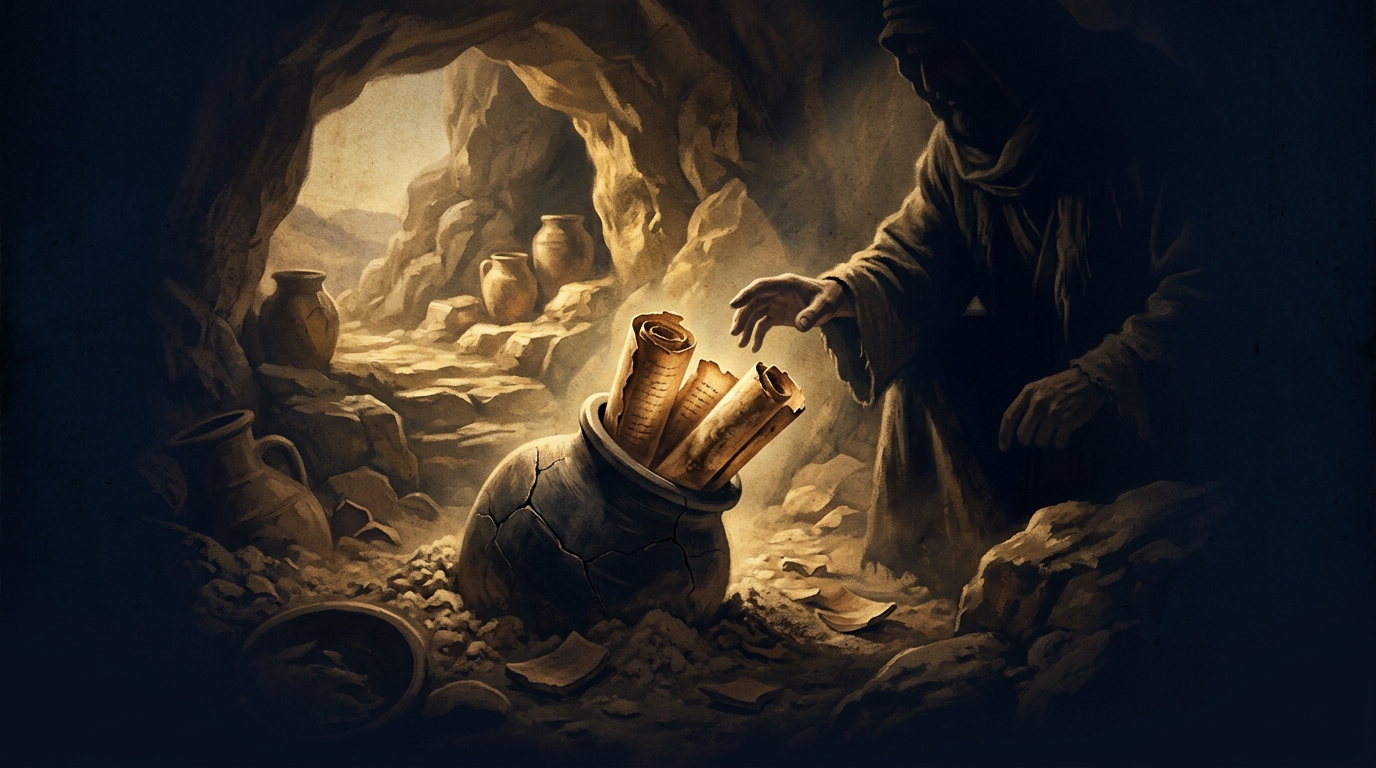
 Codex Illustration
The Dead Sea Scrolls
Discovered by Bedouin shepherds in the caves of Qumran between 1947 and 1956, the Dead Sea Scrolls represent the oldest surviving manuscripts of the Hebrew Bible and a treasure trove of Second Temple Jewish literature that has permanently reshaped our understanding of early Judaism, the formation of the biblical canon, and the religious world into which Christianity was born.
Overview
The Dead Sea Scrolls comprise roughly 900 manuscripts found in eleven caves near Khirbet Qumran on the northwestern shore of the Dead Sea. Dating from approximately the third century BC to the first century AD, they include every book of the Hebrew Bible except Esther, along with sectarian documents, biblical commentaries (pesharim), liturgical texts, legal codes, and works previously known only in translation or not at all. The physical collection is extraordinary: some texts survived as nearly complete scrolls, while others exist only as charred or fragmentary scraps pieced together over decades by an international team of scholars. The Great Isaiah Scroll (1QIsa-a), measuring over seven meters in length and predating previously known Hebrew manuscripts by a full millennium, stands as one of the most significant manuscript discoveries in the history of scholarship.
The community most closely associated with the scrolls is widely identified with a sectarian Jewish movement, likely the Essenes—though this identification remains debated. The Qumran community appears to have separated from mainstream Second Temple Judaism, possibly over disputes about the Temple calendar, priestly succession, and ritual purity. Their sectarian texts—most notably the Community Rule (1QS), the Damascus Document, the War Scroll (1QM), and the Thanksgiving Hymns (1QH)—reveal a group that understood itself as a righteous remnant living in the last days, preparing for an eschatological war between the Sons of Light and the Sons of Darkness. These documents illuminate a strand of Judaism marked by apocalypticism, strict communal discipline, and a developed theology of angels, demons, and cosmic dualism.
For biblical theology, the scrolls' most consequential contribution may be their preservation of texts that expand and sometimes reframe the canonical narrative. Works such as the Book of Giants, the Genesis Apocryphon, and multiple copies of 1 Enoch demonstrate that traditions surrounding the Watchers, the Nephilim, and the divine council were not marginal curiosities but mainstream theological currency within at least some circles of Second Temple Judaism. Michael Heiser and other scholars have argued that understanding this literature is essential for grasping the conceptual background of New Testament authors, who inherited a cosmos populated by fallen divine beings, territorial spirits, and an ongoing supernatural conflict—categories largely obscured by post-Enlightenment readings of Scripture.
The scrolls also bear directly on textual criticism and the history of the biblical canon. Variants found at Qumran—including a longer version of Jeremiah and Psalms arranged in a different order—confirm that the Hebrew text was not fully standardized before the first century AD, challenging assumptions about the uniformity of the Old Testament text prior to the Masoretic tradition. Scroll scholarship has matured considerably since the controversial delays of the original editorial committee; by the 1990s, full access was granted to scholars worldwide, and the publication of the Discoveries in the Judaean Desert series brought the corpus into the public domain. Today, institutions such as the Israel Antiquities Authority and the Leon Levy Dead Sea Scrolls Digital Library make high-resolution images freely accessible, ensuring that this ancient archive continues to generate new scholarship for generations to come.
Timeline
Evidence
Multiple Perspectives
Biblical Lens
Scripture Threads
Sources & Further Study
Questions to Explore
Follow the Thread
Continue the Investigation
You’ve reached the Full Archive portion of this Case File.
Ask the Archivist
about this fileSign in to ask the Archivist
Create a free account to ask the Archivist 1 grounded question each day, cited straight from the CODEX case files.
Discussion
0Share findings, questions, and evidence with fellow Seekers. Be respectful and cite sources where you can.
No comments yet. Be the first to open this thread.