
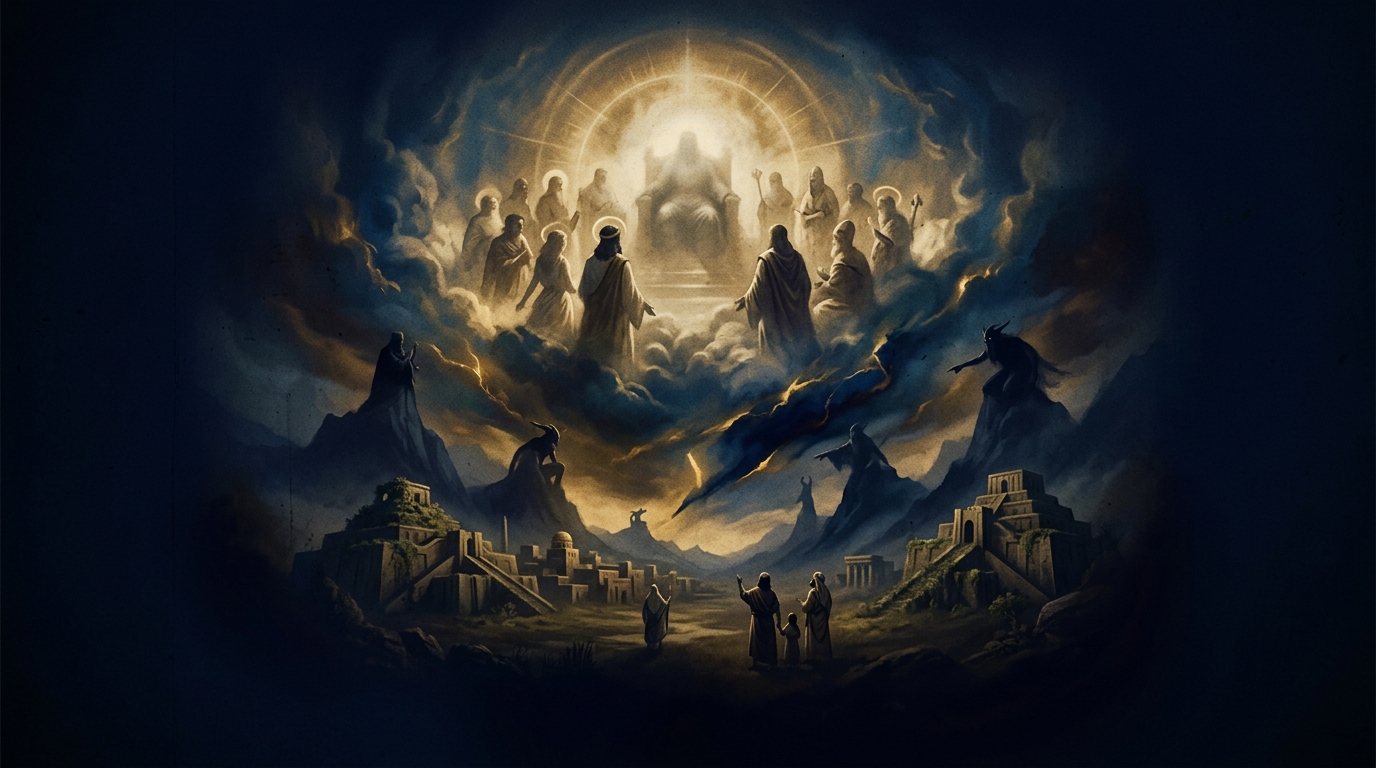
 Codex Illustration
Michael Heiser & the Unseen Realm
Scholar Michael S. Heiser argued that the Bible's supernatural worldview—populated by divine councils, territorial spirits, and cosmic conflict—has been systematically domesticated by modern theology, and that recovering its ancient Near Eastern context transforms how Christians read Scripture.
Overview
Michael S. Heiser (1963–2023) was a biblical scholar with a Ph.D. in Hebrew Bible and Semitic Languages from the University of Wisconsin–Madison, who served for many years as a scholar-in-residence at Faithlife/Logos Bible Software. His most influential work, The Unseen Realm: Recovering the Supernatural Worldview of the Bible (2015), argued that Western Christianity has read the Bible through a Greco-Roman philosophical filter that strips away a genuinely supernatural cosmology present in the text itself. Heiser insisted that biblical authors inhabited a worldview in which multiple divine beings—elohim—populated a tiered heavenly court, and that understanding this context is not speculation but exegetical necessity.
Central to Heiser's framework is what he termed the Divine Council worldview, drawn from careful analysis of passages such as Deuteronomy 32:8–9 (where the Dead Sea Scrolls reading 'sons of God' rather than 'sons of Israel' is textually significant), Psalm 82, and Genesis 6:1–4. He contended that these texts describe a coherent ancient cosmology: Yahweh presides over a council of divine beings; some of those beings rebelled at specific historical junctures (the Genesis 6 transgression, the Babel episode, Psalm 82's judgment); and the narrative of redemption is partly the story of Yahweh reclaiming what was forfeited to rebellious divine administrators. This reading, Heiser insisted, is not drawn from extrabiblical mythology but is demanded by the Hebrew text and illuminated by Ancient Near Eastern comparative material such as the Ugaritic texts from Ras Shamra.
Heiser was deliberately positioned as a popular scholar—writing for educated laypeople rather than exclusively for academic specialists—and his reach was amplified by his podcast Naked Bible, which ran for hundreds of episodes, and by a more accessible companion volume, Supernatural (2015). He engaged critically with both evangelical theology (which he felt was too quick to flatten the divine council into angelology) and popular alternative-history claims (he systematically refuted the ancient astronaut theory in his book Debunking the 9 Planets Theory and elsewhere). His influence on evangelical and broadly Protestant discussions of spiritual warfare, demonology, and eschatology has been substantial, and his framework has been taken seriously—if sometimes critically—by professional biblical scholars including John Walton, Peter Gentry, and others.
Heiser's legacy is complex. His core claim—that the divine council motif is a structuring feature of biblical theology rather than a marginal curiosity—rests on well-documented philological and textual evidence, particularly the Ugaritic parallels and the Dead Sea Scrolls variants. Where his work is more contested is at the level of systematic integration: critics note that he sometimes moves from exegetical observation to theological synthesis with less caution than professional biblical theology demands, and that his popular-level writing occasionally presents as settled what remains debated among specialists. Nevertheless, his contribution to making Ancient Near Eastern scholarship accessible to a general audience, and to insisting that the supernatural worldview of the biblical authors deserves serious intellectual engagement, is widely acknowledged.
Timeline
Evidence
Multiple Perspectives
Biblical Lens
Scripture Threads
Sources & Further Study
Questions to Explore
Follow the Thread
Continue the Investigation
You’ve reached the Full Archive portion of this Case File.
Ask the Archivist
about this fileSign in to ask the Archivist
Create a free account to ask the Archivist 1 grounded question each day, cited straight from the CODEX case files.
Discussion
0Share findings, questions, and evidence with fellow Seekers. Be respectful and cite sources where you can.
No comments yet. Be the first to open this thread.