
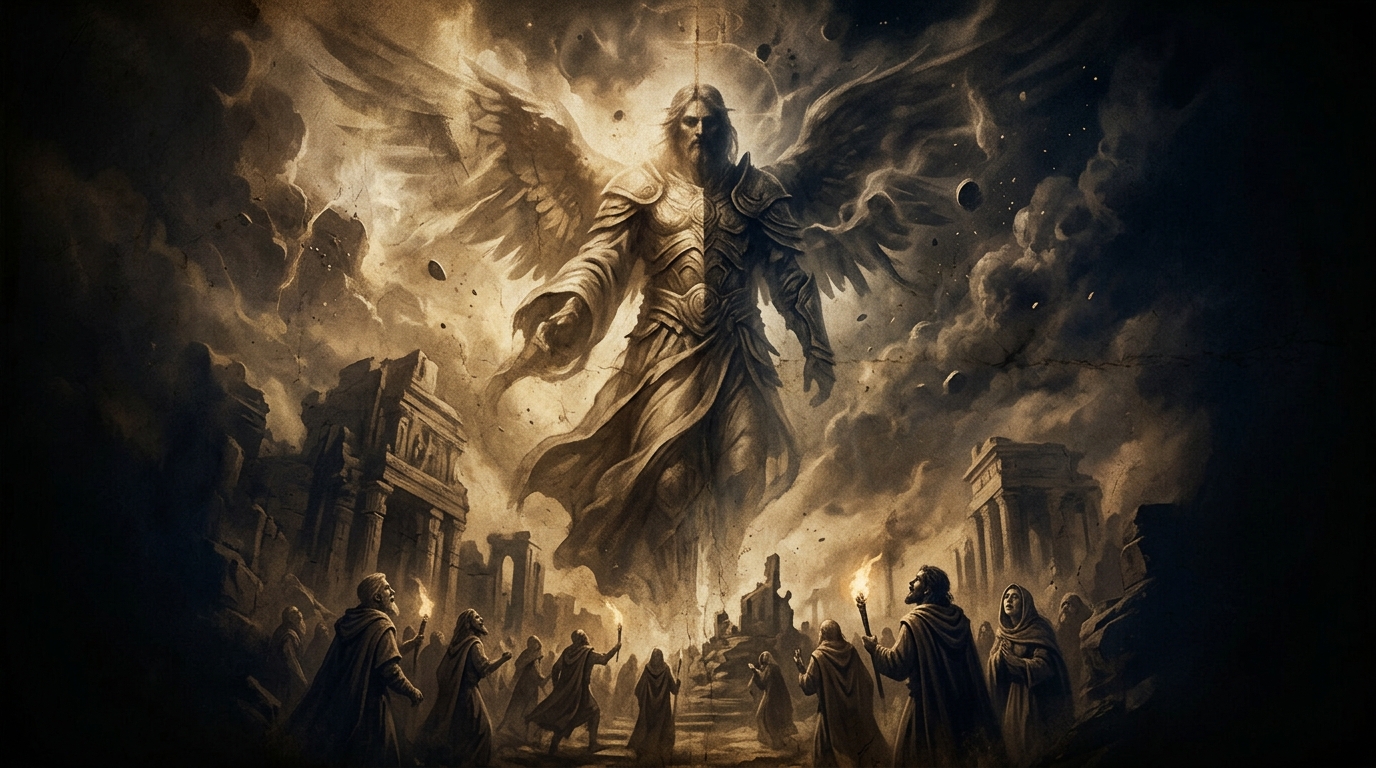
 Codex Illustration
Complete Full Archive investigation, open to every Explorer.
The Nephilim
The Nephilim—mysterious figures appearing at the intersection of divine transgression and human history—have provoked theological controversy, scholarly debate, and popular fascination for millennia, standing at the heart of questions about the nature of spiritual beings, the corruption of humanity, and the purpose of the Flood.
Overview
The Nephilim are introduced in Genesis 6:1–4 in a passage of remarkable brevity and interpretive density: 'When human beings began to increase in number on the earth and daughters were born to them, the sons of God saw that the daughters of humans were beautiful, and they married any of them they chose... The Nephilim were on the earth in those days—and also afterward—when the sons of God went to the daughters of humans and had children by them. They were the heroes of old, men of renown.' The Hebrew term nephilim (נְפִילִים) has itself been contested: some derive it from the root naphal ('to fall'), suggesting 'fallen ones,' while others connect it to an Aramaic root meaning 'giants' or 'mighty ones.' The Septuagint translates the term as gigantes, meaning 'earth-born' in classical Greek but later understood simply as 'giants,' a reading that heavily influenced subsequent Christian and Jewish tradition.
Three major interpretive traditions have wrestled with the identity of the 'sons of God' whose union with human women produced the Nephilim. The oldest and most widely attested in Second Temple Judaism—represented in 1 Enoch, the Book of Jubilees, and the Damascus Document from Qumran—holds that these were supernatural beings, members of the divine council who transgressed the boundary between heaven and earth. A second tradition, championed by Julius Africanus and later patristic writers seeking to demythologize the text, identifies the sons of God as the godly line of Seth and the daughters of humans as the corrupt line of Cain. A third, less common reading—associated with Celsus, some Gnostic interpreters, and certain modern scholars—identifies the sons of God as earthly kings or dynasts whose despotism warranted divine judgment. Scholarly consensus, shaped considerably by the recovery of ancient Near Eastern comparative literature and the Dead Sea Scrolls, has largely returned to the supernatural interpretation as the most contextually coherent reading.
The Nephilim reappear in Numbers 13:33, where the twelve Israelite spies report encountering the 'descendants of Anak' in Canaan, claiming 'we seemed like grasshoppers in our own eyes, and we looked the same to them.' The text explicitly identifies these Anakites as Nephilim. Whether this reflects a genuine second eruption of the phenomenon ('and also afterward,' as Genesis 6:4 anticipates) or is a hyperbolic rhetorical device employed by terrified scouts has been debated by commentators ancient and modern. The Rephaim, Anakim, Emim, Zamzummim, and related groups catalogued in Deuteronomy and Joshua appear in the scholarly literature as potential 'giant clans' whose destruction is presented as a recurring divine mandate—what Michael Heiser and others have called the 'giant-killing' thread woven through the conquest narratives.
Beyond the biblical text, the Nephilim tradition exercised enormous influence on post-biblical literature, Jewish apocalypticism, early Christian demonology, and Gnostic cosmology. The Book of Enoch elaborates the story into a cosmic drama: the Watchers, led by Semyaza and Azazel, descend on Mount Hermon, impart forbidden knowledge to humanity, and father the Nephilim, whose disembodied spirits become the demons that afflict humanity after the Flood. This framework was known to and partially endorsed by several Church Fathers, including Justin Martyr, Tertullian, Athenagoras, and Origen, before the Sethian interpretation gradually displaced it in mainstream Christianity. In the modern period, the Nephilim have become a focus of popular interest ranging from serious scholarly biblical archaeology to sensationalist claims about ancient alien intervention, extraterrestrial DNA, and government conspiracies—claims that scholarship, both secular and theological, uniformly regards as unsupported by evidence.
Timeline
Evidence
Multiple Perspectives
Biblical Lens
Scripture Threads
Sources & Further Study
Questions to Explore
Carry the Investigation
Field gear inspired by this Codex case file.
Follow the Thread
Ask the Archivist
about this fileSign in to ask the Archivist
Create a free account to ask the Archivist 1 grounded question each day, cited straight from the CODEX case files.
Discussion
0Share findings, questions, and evidence with fellow Seekers. Be respectful and cite sources where you can.
No comments yet. Be the first to open this thread.