
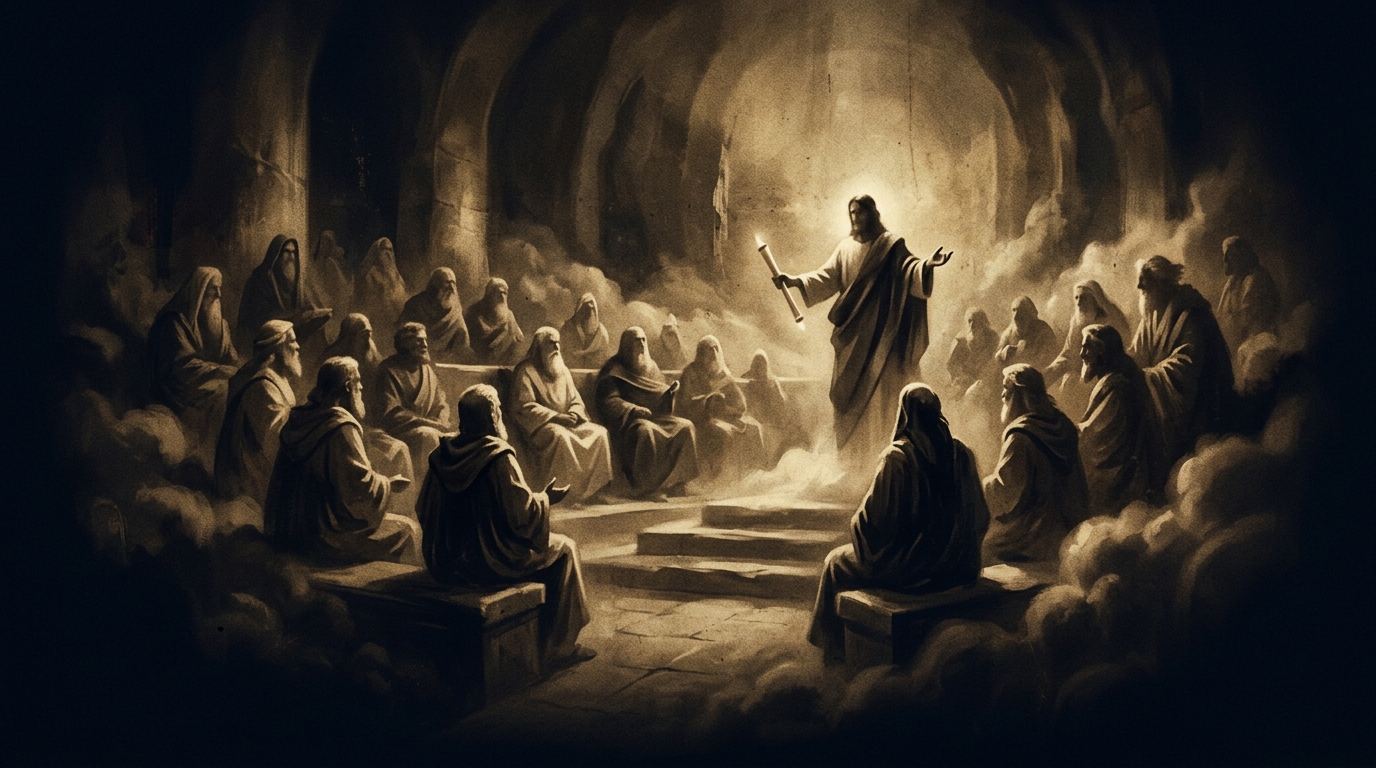
 Codex Illustration
Psalm 82 and the Council of El
Psalm 82 depicts the God of Israel standing in the divine assembly and pronouncing judgment upon a council of elohim who have corrupted their stewardship over the nations—a text that sits at the explosive intersection of Israelite monotheism, Canaanite mythology, and ancient cosmology. Its eight spare verses have generated centuries of interpretive controversy and continue to challenge assumptions about what the Hebrew Bible actually claims about the nature of God, lesser divine beings, and cosmic justice.
Overview
Psalm 82 opens with a declaration that elohim (God) has taken his place in the 'adat-el—the assembly or congregation of El—and proceeds to render judgment upon the other elohim gathered there. The condemned beings are accused of judging unjustly, showing partiality to the wicked, and failing to defend the poor and oppressed. This framing closely parallels the divine council traditions found throughout the ancient Near East, particularly in Ugaritic literature from the city of Ras Shamra, where the high god El presides over an assembly of lesser deities. The linguistic and conceptual overlap is not coincidental; Israel shared a cultural and linguistic world with its Canaanite neighbors, and its poets drew on shared idioms even while insisting on Yahweh's supremacy.
The most theologically charged verse is the sixth: 'I said, you are gods (elohim), and all of you are sons of the Most High (bene Elyon).' Jesus himself quotes this line in John 10:34 when defending his claim to deity before his opponents, an exegetical move that has puzzled and fascinated interpreters from antiquity to the present. The psalm concludes in verse 7 with the divine sentence—that these beings 'shall die like men and fall like one of the princes'—implying that their immortality is conditional and revocable, a concept foreign to most later theological frameworks but well-attested in ancient cosmological thought. The final verse is a petition: 'Arise, O God, judge the earth, for you shall inherit all nations,' linking the psalm to the broader biblical narrative of Yahweh reclaiming cosmic sovereignty.
In the framework of scholarship associated with Michael S. Heiser, Psalm 82 functions as one of the clearest biblical attestations that the Hebrew Bible presupposes a populated supernatural realm—a genuine divine council of elohim under Yahweh, not merely a poetic fiction or a council of angels in the diminished later theological sense. Heiser argues in The Unseen Realm and in his academic work that elohim is a functional category denoting inhabitants of the spirit realm, not an ontological claim about equality with Yahweh. This reading resolves the apparent polytheistic tension without resorting to what Heiser calls 'the grammatical gymnastics' of interpreting the elohim as merely human judges. The text, on this reading, narrates a cosmic judgment scene in which Yahweh reasserts authority over divine beings who, like those described in Deuteronomy 32:8–9, had been allotted authority over the nations after the Tower of Babel event.
The scholarly conversation around Psalm 82 intersects multiple disciplines: comparative religion, form criticism, ancient Near Eastern studies, Second Temple Jewish literature, and New Testament exegesis. Its reception history stretches from the Septuagint translators through the Dead Sea Scrolls community, the Church Fathers (several of whom found in it a basis for theosis or deification theology), the medieval Jewish commentator Rashi (who read the elohim as human judges), and into contemporary evangelical and mainline academic scholarship. The psalm is a lens through which one can trace the evolution of Israelite religion, the relationship between Yahweh and El, and the long contested question of what kind of monotheism the Hebrew Bible actually teaches.
Timeline
Evidence
Multiple Perspectives
Biblical Lens
Scripture Threads
Sources & Further Study
Questions to Explore
Follow the Thread
Continue the Investigation
You’ve reached the Full Archive portion of this Case File.
Ask the Archivist
about this fileSign in to ask the Archivist
Create a free account to ask the Archivist 1 grounded question each day, cited straight from the CODEX case files.
Discussion
0Share findings, questions, and evidence with fellow Seekers. Be respectful and cite sources where you can.
No comments yet. Be the first to open this thread.