
 Codex Illustration
Mount Shasta Legends
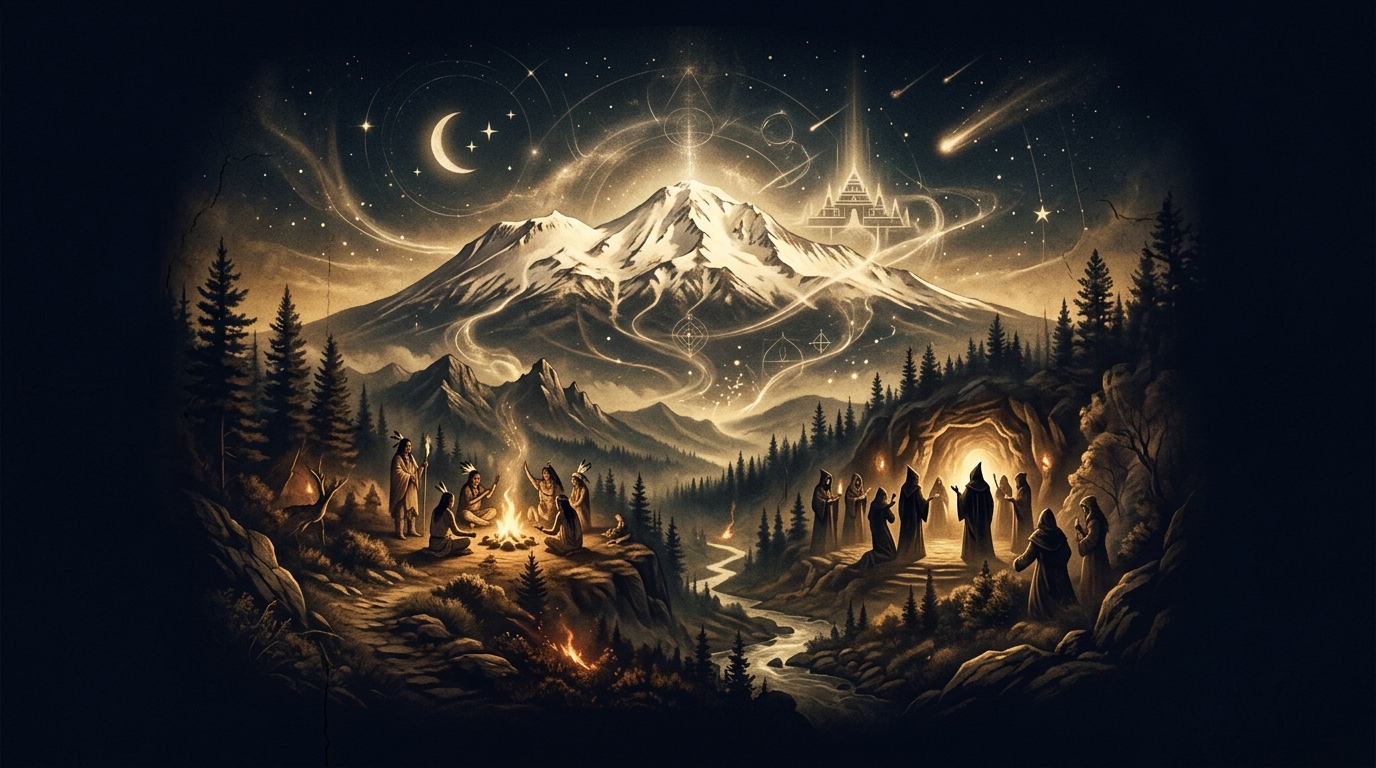
Rising nearly 14,200 feet above the Cascade Range in northern California, Mount Shasta has accumulated one of the most layered mythologies in North America — a palimpsest of Indigenous sacred tradition, nineteenth-century occultism, Theosophical cosmology, New Age channeling, and modern UFO lore that continues to attract pilgrims, researchers, and curious observers.
Overview
Mount Shasta is a stratovolcano of documented geological significance, a Cascade peak whose last major eruptive activity is estimated to have occurred around 1786. That physical reality, however, has done little to contain the extraordinary claims that have accumulated around it for over a century. Indigenous peoples of the region — notably the Shasta, Modoc, Karuk, and Wintu tribes — have long regarded the mountain as sacred ground, associating it with creation narratives, spirit beings, and the dwelling place of the Great Spirit. These traditions, though often incompletely documented by outside scholars, represent the oldest continuous layer of Shasta's mystical geography and deserve serious ethnographic attention rather than the casual appropriation they have frequently received in New Age circles.
The modern mythology of Mount Shasta in Western popular culture can be traced in large part to a widely circulated 1899 article by Frederick Spencer Oliver (published posthumously in 1905 as 'A Dweller on Two Planets'), which introduced the concept of a hidden civilization dwelling within or beneath the mountain. The text, which Oliver claimed was channeled from a disincarnate Atlantean master, described tunnels, advanced technology, and an immortal brotherhood inhabiting the mountain's interior. Though the book is properly classified as esoteric fiction or channeled literature, it proved enormously generative: subsequent decades layered upon it the Theosophical concept of Lemuria — a hypothetical lost continent — relocating its survivors beneath Shasta's volcanic chambers. By the 1930s, popular magazine articles described encounters with tall, white-robed figures near the mountain, reportedly conducting mysterious transactions in gold and moving through the town of Mount Shasta with uncanny composure. These accounts, published in newspapers of the era, were taken seriously enough to generate a minor cultural sensation, though no corroborating physical evidence was produced.
The twentieth century added further strata. The Rosicrucian and 'I AM' movements, the latter founded by Guy Ballard following his claimed 1930 encounter with an ascended master on the mountain's slopes, institutionalized Shasta as a metaphysical power center. Ballard's account, published as 'Unveiled Mysteries' (1934) under the pen name Godfré Ray King, presented a detailed initiatory narrative involving the figure of Saint Germain — itself a remarkable convergence with European esoteric traditions. Simultaneously, UFO lore migrated into the Shasta complex: numerous witnesses have reported luminous aerial phenomena near the peak, and some investigators have connected these to the broader UAP phenomenon rather than to the metaphysical traditions already in place. Whether these represent atmospheric effects, misidentification of conventional aircraft, geophysical luminescence, or something less categorizable remains an open question.
What makes Mount Shasta uniquely valuable as a CODEX subject is not the truth or falsity of any particular claim, but the mountain's function as a cultural and spiritual attractor. Geographically isolated, visually commanding, volcanically active, and positioned at the edge of wilderness, it satisfies many of the psychological conditions that produce sacred space across cultures. The convergence of Indigenous sacred tradition, Western occultism, New Age spirituality, and UAP reporting at a single location raises genuine questions about the relationship between landscape, human perception, and the categories we use to describe unusual experience. Whether Shasta is a portal, a refuge for hidden beings, a focus of geomagnetic anomaly, or simply an exceptionally dramatic mountain that human imaginations have found irresistible — the archive must hold the question open.
Key Claims
Timeline
Evidence
Multiple Perspectives
Biblical Lens
Scripture Threads
Sources & Further Study
Questions to Explore
Go Deeper Path
Follow the Thread
Continue the Investigation
You’ve reached the Full Archive portion of this Case File.
Ask the Archivist
about this fileSign in to ask the Archivist
Create a free account to ask the Archivist 1 grounded question each day, cited straight from the CODEX case files.
Discussion
0Share findings, questions, and evidence with fellow Seekers. Be respectful and cite sources where you can.
No comments yet. Be the first to open this thread.