
 Codex Illustration
Immortality Legends
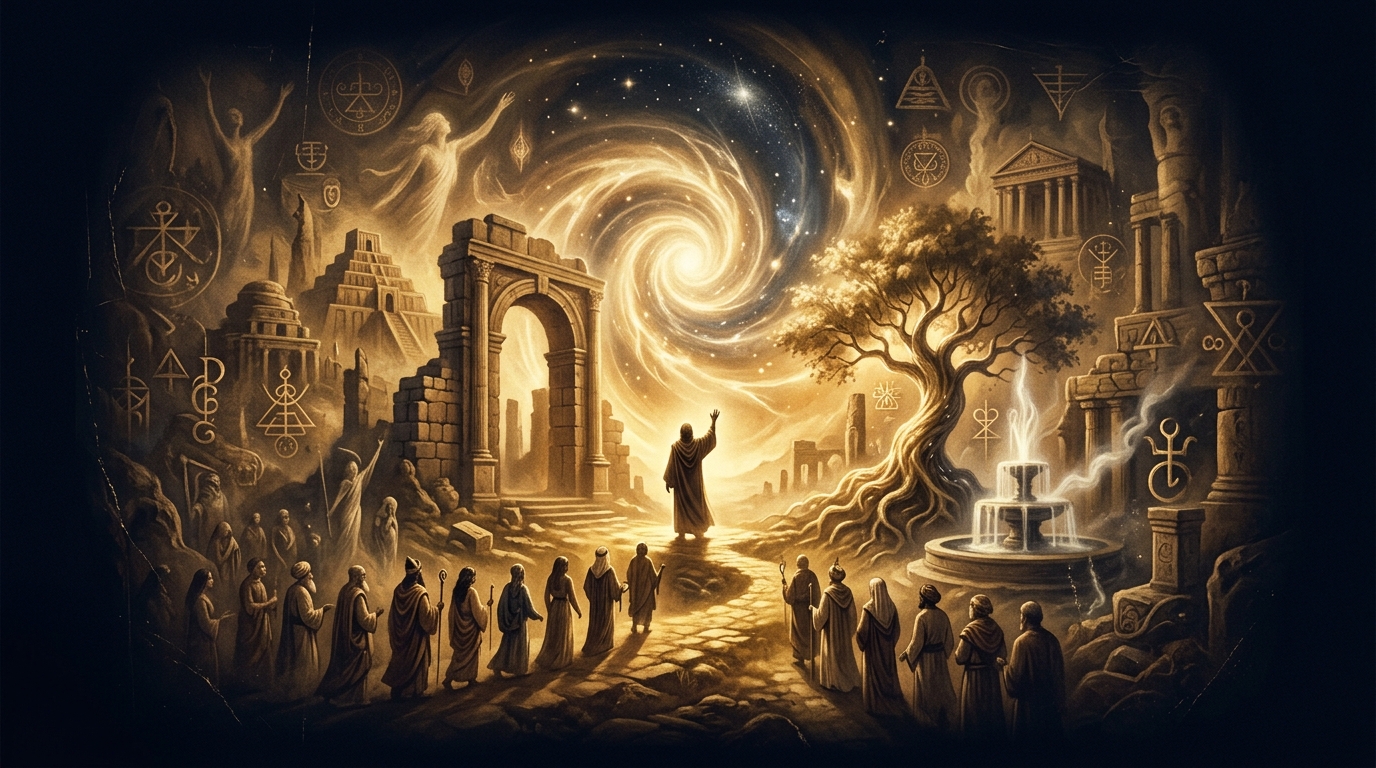
Across every known civilization, human beings have pursued, imagined, or claimed to possess the secret of deathlessness — a desire so universal and so ancient that it may reveal something fundamental about the structure of human consciousness, or something even stranger about the nature of existence itself.
Overview
The quest for immortality is not a modern fantasy. It predates writing, predates organized religion in its institutional forms, and appears in the oldest literary texts humanity has yet recovered. The Epic of Gilgamesh — composed in Mesopotamia well before 2000 BC and recognized by scholars such as Andrew George as the earliest surviving masterpiece of world literature — centers entirely on a king's desperate search for a plant that confers endless life, a search that ends in failure and an acceptance of mortality. That a civilization's foundational narrative is structured around the impossibility of escaping death is not incidental. It is, many scholars argue, a deliberate theological statement: immortality belongs to the gods, not to humans. Yet the desire does not disappear. It recurs in Taoist alchemy, in Egyptian funerary religion, in the Indian concept of amrita, in Greek myths of ambrosia and the gods' nectar, in the medieval European pursuit of the Philosopher's Stone — as if the longing itself were somehow built into the species.
The historical record preserves a number of figures who have been credited, by their contemporaries or by later traditions, with having achieved extraordinary longevity or actual deathlessness. The Count of Saint-Germain — an eighteenth-century European courtier whose true origins remain historically obscure — was claimed by multiple contemporaries, including Horace Walpole and Voltaire, to possess knowledge of an extraordinary order, and later traditions accumulated around him the reputation of being centuries old. The Wandering Jew is a medieval Christian legend of a man cursed to walk the earth until the Second Coming. In Chinese tradition, the Eight Immortals (Baxian) are figures who achieved xian — a state of transcendence — through Taoist cultivation. In each case, the legend clusters around a real cultural anxiety: what would it actually mean to live forever, and would it be a blessing or a curse? The literary tradition, from Swift's immortal but decaying Struldbruggs in Gulliver's Travels to modern horror fiction, has repeatedly answered that question with a qualified horror.
In the twentieth and twenty-first centuries, the pursuit of immortality has migrated from alchemy and mysticism into biology, neuroscience, and technology. Geroscientists such as Aubrey de Grey (of the SENS Research Foundation) and David Sinclair (Harvard Medical School) have made serious, peer-reviewed arguments that aging is not an inevitable biological destiny but a disease that may be treatable — or even reversible — within the coming century. Ray Kurzweil's concept of the Singularity posits that the merging of human consciousness with artificial intelligence will eventually render biological death optional. Meanwhile, cryonics organizations such as Alcor preserve human remains in the hope that future technology will permit revival. These are not fringe positions in the sense of being untestable in principle; they are contested scientific and philosophical claims being actively debated in serious academic venues. The question of whether they are realistic is a matter of legitimate scientific uncertainty, not settled consensus in either direction.
What is perhaps most striking about immortality legends, viewed across their full cultural and historical range, is their moral complexity. Almost no tradition — ancient or modern — treats the attainment of immortality as straightforwardly good. Gilgamesh fails and is consoled. The Wandering Jew suffers. The alchemist who drinks the Elixir in legend tends toward obsession, isolation, or madness. Modern transhumanist discourse wrestles earnestly with the social, philosophical, and ethical consequences of radical life extension: Who would have access? What would it do to meaning, to love, to the experience of time itself? The legends seem to encode a persistent intuition that the boundary between mortality and immortality is not merely biological but existential — and that crossing it carries costs that are difficult to fully anticipate.
Key Claims
Timeline
Evidence
Multiple Perspectives
Biblical Lens
Scripture Threads
Sources & Further Study
Questions to Explore
Go Deeper Path
Follow the Thread
Continue the Investigation
You’ve reached the Full Archive portion of this Case File.
Ask the Archivist
about this fileSign in to ask the Archivist
Create a free account to ask the Archivist 1 grounded question each day, cited straight from the CODEX case files.
Discussion
0Share findings, questions, and evidence with fellow Seekers. Be respectful and cite sources where you can.
No comments yet. Be the first to open this thread.