
 Codex Illustration
Shamanism and Altered States
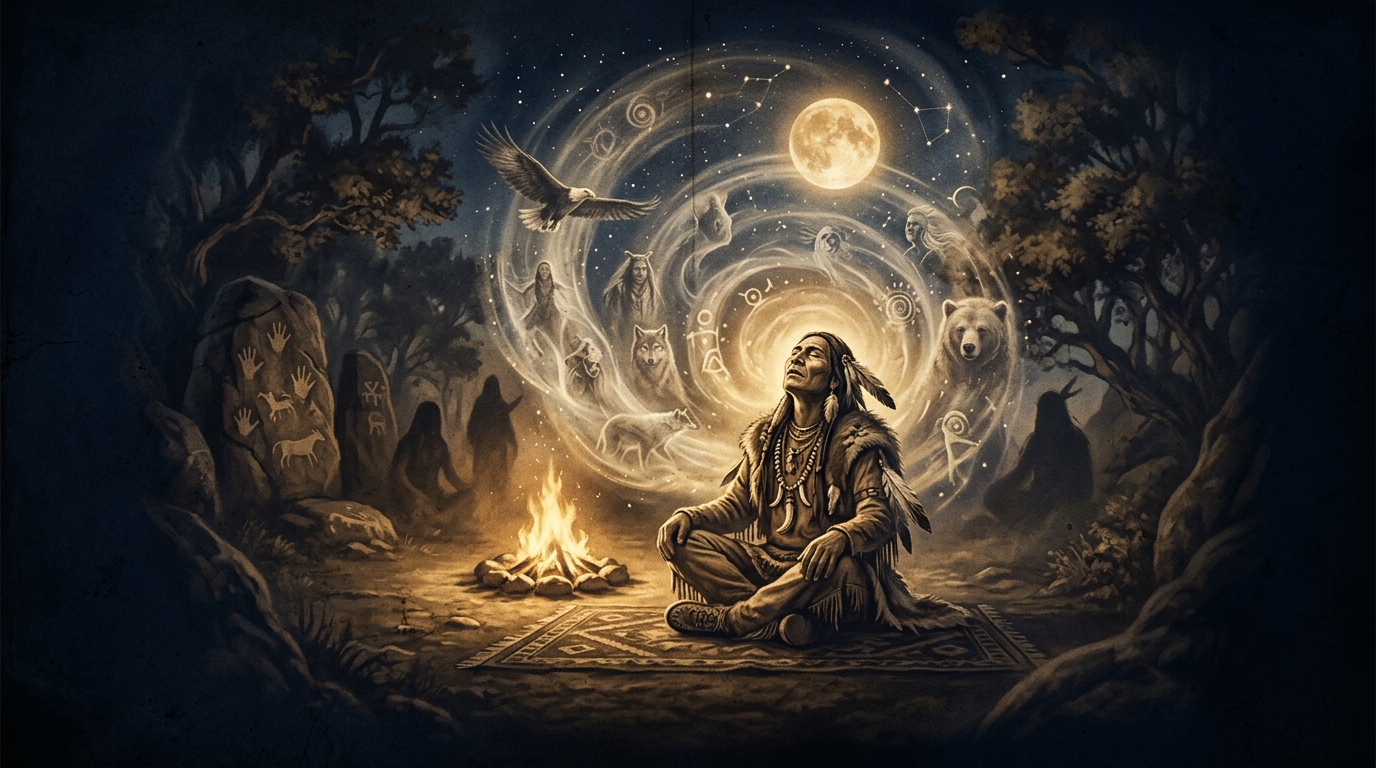
Across every inhabited continent and spanning tens of thousands of years, shamanic practitioners have entered altered states of consciousness to navigate unseen realms, communicate with spirits, and mediate between the human and divine. Whether understood as culturally conditioned psychology, genuine spiritual contact, or something stranger still, shamanism represents one of humanity's oldest and most persistent interfaces with the invisible world.
Overview
Shamanism is not a single religion but a cross-cultural complex of practices in which a specialist — the shaman — deliberately induces altered states of consciousness through drumming, fasting, plant medicines, sensory deprivation, or other techniques in order to journey into non-ordinary reality. Anthropologist Mircea Eliade, whose 1951 work 'Shamanism: Archaic Techniques of Ecstasy' remains foundational, defined the shaman primarily by the motif of the soul journey: a controlled, intentional departure from ordinary waking consciousness to engage spiritual realities on behalf of a community. This pattern appears with remarkable consistency from Siberia and Central Asia — where the word 'shaman' originates among the Evenki people — to the Amazon basin, the Arctic, sub-Saharan Africa, and prehistoric Europe.
The altered states at the core of shamanic practice have drawn intense scholarly interest from multiple disciplines. Neurologist and ethnobotanist disciplines alike have noted that trance states, whether induced by rhythmic drumming, hallucinogenic plant compounds such as ayahuasca and psilocybin, or extreme physical ordeals, produce measurable changes in brain activity including reduced default-mode-network activity, heightened pattern recognition, and what researchers describe as ego dissolution. Rock art from the Upper Paleolithic period — notably at Lascaux, Altamira, and South African sites studied by David Lewis-Williams — has been interpreted as visual records of shamanic trance experience, suggesting the practice predates writing by many millennia. Archaeological evidence from sites like Göbekli Tepe has prompted speculation among some scholars that ritual specialists wielding cosmological knowledge may have organized the earliest monumental constructions.
The phenomenological content of shamanic experience is strikingly consistent across cultures: encounters with spirit helpers or guides, journeys through layered cosmologies (typically an upper world, middle world, and lower world or underworld), combat with malevolent entities, acquisition of hidden knowledge, and return bearing healing or prophetic information. This cross-cultural consistency is interpreted in radically different ways: cognitive scientists such as Pascal Boyer and Harvey Whitehouse locate it in the architecture of the human brain and evolved social cognition; Jungian analysts see it as access to archetypal structures in the collective unconscious; practitioners and many indigenous scholars insist the consistency reflects genuine contact with an objectively real spiritual domain. No scholarly consensus has resolved this fundamental disagreement.
In contemporary Western contexts, shamanism has been adapted, commercialized, and in some cases trivialized through the New Age movement, the 'core shamanism' methodology popularized by Michael Harner, and the global proliferation of ayahuasca ceremony tourism. This has generated serious ethical and cultural critiques from indigenous scholars and communities who regard these practices as sacred, community-embedded traditions rather than portable spiritual technologies. Meanwhile, academic psychiatry and clinical psychology have taken renewed interest in the therapeutic mechanisms of ego-dissolving states, with institutions such as Johns Hopkins and Imperial College London conducting peer-reviewed trials on psilocybin and other psychedelics, effectively returning Western science to questions that shamanic cultures never stopped asking.
Timeline
Evidence
Multiple Perspectives
Biblical Lens
Scripture Threads
Sources & Further Study
Questions to Explore
Follow the Thread
Continue the Investigation
You’ve reached the Full Archive portion of this Case File.
Ask the Archivist
about this fileSign in to ask the Archivist
Create a free account to ask the Archivist 1 grounded question each day, cited straight from the CODEX case files.
Discussion
0Share findings, questions, and evidence with fellow Seekers. Be respectful and cite sources where you can.
No comments yet. Be the first to open this thread.