
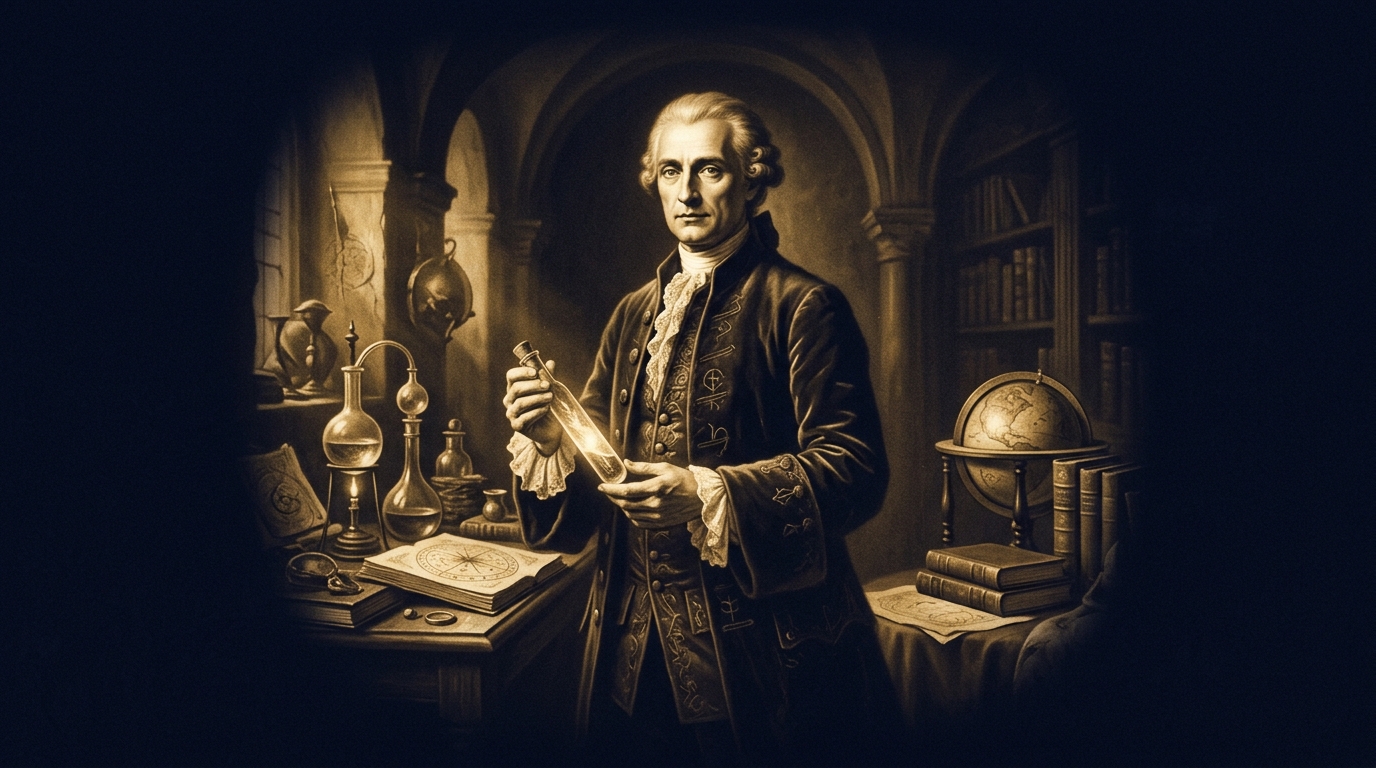
 Codex Illustration
Count of Saint Germain
A figure of extraordinary historical ambiguity, the Count of Saint Germain appeared repeatedly across eighteenth-century European courts, reportedly possessing ageless features, encyclopedic knowledge, alchemical mastery, and a conspicuous reluctance to discuss his origins — inspiring legends of immortality that have never been fully extinguished.
Overview
The man who called himself the Count of Saint Germain first surfaces in reliable historical documentation around 1743, in the correspondence of Horace Walpole, who encountered him in London. Over the following four decades, he reappeared in the courts of France, Prussia, Russia, and the Netherlands — always impeccably dressed, speaking several languages with native fluency, demonstrating uncommon skill in chemistry and music, and declining to eat in company. Contemporaries including Louis XV, Madame de Pompadour, and Voltaire remarked upon him in letters and memoirs; the latter, with characteristic wit, called him "a man who never dies and who knows everything." No consensus exists among historians regarding his actual birth, nationality, or family origins, though plausible theories include Transylvanian, Portuguese-Jewish, or Alsatian backgrounds. What is genuinely documented is that he was a real historical person who moved at the highest levels of European society during the mid-to-late eighteenth century, apparently aging little if at all across the decades of his documented activity.
The Count's activities were not merely social. He served on what appear to have been diplomatic missions — some sanctioned, some of dubious authorization — and was engaged by multiple European powers during the delicate years surrounding the Seven Years' War. French foreign minister Choiseul allegedly regarded him as a spy, and he was expelled from France in 1760 following what may have been an unauthorized peace overture to England. He later appeared in Russia during the Orlov Coup of 1762, reportedly playing some role in the events that brought Catherine the Great to power, though the precise nature of his involvement remains historically unclear. He is said to have died in Eckernförde, Schleswig, in 1784, under the patronage of Prince Charles of Hesse-Kassel — yet credible reports of his subsequent appearances continue through the early nineteenth century, fueling the central legend.
The claims most closely associated with Saint Germain that venture beyond the historically plausible include his alleged possession of the Philosopher's Stone — the alchemical substance said to transmute base metals into gold and confer physical immortality — his memory of events centuries past described in the first person, and his acquisition and modification of gems through processes he never fully disclosed. These accounts come primarily from memoirs, letters, and court gossip, making them historically interesting but evidentially weak. The Countess de Adhémar claimed in her memoirs that she encountered Saint Germain multiple times after his recorded death, including during the French Revolution, the aftermath of Napoleon's fall, and as late as 1821 — though these memoirs were published posthumously and their reliability is disputed by historians who note their sensational character and the considerable time elapsed before publication.
In the nineteenth and twentieth centuries, Saint Germain was adopted wholesale by Theosophical and New Age traditions, transformed from a historical eccentric into an Ascended Master — a spiritually perfected being said to guide human evolution from beyond ordinary existence. Helena Blavatsky, Annie Besant, and later Guy Ballard's I AM Activity movement all incorporated him as a central figure of cosmic significance. This process of mythological elaboration, well-documented in the history of Western esotericism, has made it progressively more difficult to recover the actual historical figure beneath the accumulated legend. Historians of the occult, including scholars such as Manly P. Hall and, more critically, historians like Wouter Hanegraaff, have carefully distinguished between the documented historical person and the elaborate esoteric persona constructed around him.
Key Claims
Timeline
Evidence
Multiple Perspectives
Biblical Lens
Scripture Threads
Sources & Further Study
Questions to Explore
Go Deeper Path
Follow the Thread
Continue the Investigation
You’ve reached the Full Archive portion of this Case File.
Ask the Archivist
about this fileSign in to ask the Archivist
Create a free account to ask the Archivist 1 grounded question each day, cited straight from the CODEX case files.
Discussion
0Share findings, questions, and evidence with fellow Seekers. Be respectful and cite sources where you can.
No comments yet. Be the first to open this thread.