
 Codex Illustration
The Rephaim
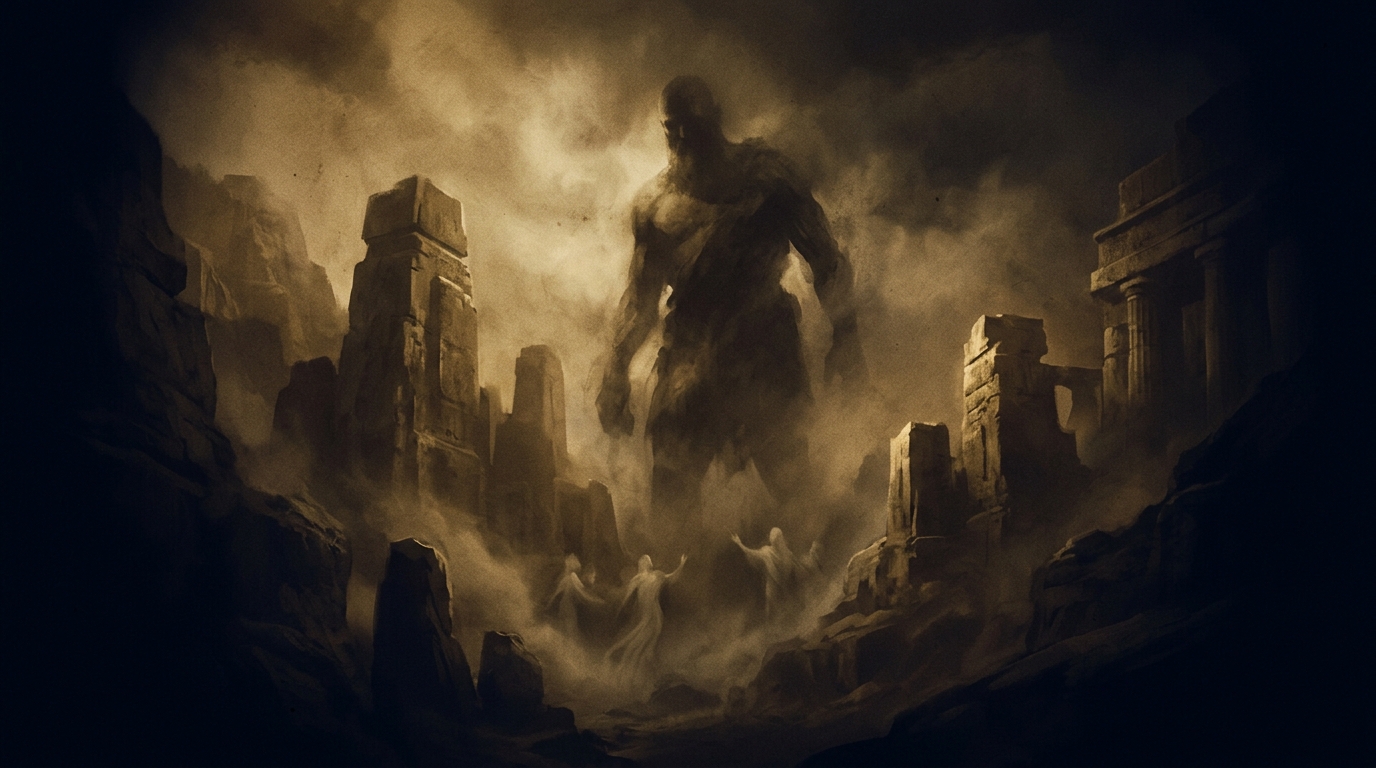
The Rephaim are among the most enigmatic figures of the Hebrew Bible — a shadowy race of giants associated with ancient Canaan, the underworld, and the dispossessed dead, whose identity has fascinated scholars, theologians, and mythologists alike. Their name echoes across both the battlefield and the grave, suggesting a people at once formidably physical and hauntingly chthonic.
Overview
The term 'Rephaim' (Hebrew: רְפָאִים, rəphāʾîm) appears in the Hebrew Bible in two distinct but related contexts that have long puzzled interpreters. In historical-geographical passages, the Rephaim are described as a pre-Israelite people of great stature inhabiting Canaan and Transjordan — appearing alongside the Anakim, Emim, and Zamzummim as populations encountered or displaced during Israel's settlement of the land (Deuteronomy 2–3; Genesis 14–15). In poetic and wisdom literature, however, the same term designates the shades of the dead dwelling in Sheol, the underworld — a usage found in Job 26:5, Psalm 88:10, Proverbs 2:18, and Isaiah 14:9. Whether these two usages reflect a single unified concept or a convergent homonym remains a live debate in biblical scholarship.
In the historical sense, the Rephaim are explicitly connected to figures of enormous physical stature. Og of Bashan — whose iron bed measured nine cubits in length — is identified as 'the last of the Rephaim' in Deuteronomy 3:11, a detail the narrative presents as worthy of memorialization. The Anakim, who terrified the Israelite spies in Numbers 13, are described in Joshua 11:22 and Deuteronomy 9:2 as a subgroup whose remnants survived in Gaza, Gath, and Ashdod. Later, the 'descendants of the giant' (Hebrew: yəlidê hārāphāh) appear in 2 Samuel 21 as Philistine warriors slain by David's champions, suggesting the tradition of Rephaim-lineage warriors persisted into the early monarchic period. These accounts form the backbone of what scholars identify as a coherent literary tradition of giant-clans in the Deuteronomistic and related historiographies.
The Ugaritic texts discovered at Ras Shamra (ancient Ugarit) beginning in 1929 dramatically illuminated the Rephaim's Ancient Near Eastern context. In Ugaritic mythology, the rpum (cognate to Hebrew rəphāʾîm) are a class of divine warriors or heroic dead — semi-divine shades who are invoked in funerary and cultic contexts and who feast in the presence of the chief deity El. Ugaritic texts such as KTU 1.20–22 describe the rpum traveling to El's threshing floor and vineyards, suggesting a ritual context in which the honored dead maintained an active role in the cosmic order. This evidence has led scholars like John Day, Michael Heiser, and Mark Smith to argue that the Rephaim of the Hebrew Bible carry an ideological freight rooted in Canaanite religion: they are not merely historical giants but beings whose very memory is coded in the language of the otherworldly and the pre-human.
From the perspective of Michael Heiser's Divine Council framework, the Rephaim occupy a theologically significant position as evidence of a deliberate biblical polemic. The displacement and destruction of Rephaim populations in Deuteronomy 2–3 is framed not as mere ethnic conquest but as Yahweh's decisive reversal of a supernatural incursion — the culmination of a cosmic conflict initiated in Genesis 6. The Israelite campaigns against Og and the Anakim thus function, within this interpretive lens, as acts of divine reclamation of territory held by beings associated with the corrupt lineage descended from the 'sons of God' episode. Whether one accepts this theological reading or approaches the texts historically and anthropologically, the Rephaim remain one of the most textured and multilayered phenomena in all of biblical literature.
Timeline
Evidence
Multiple Perspectives
Biblical Lens
Scripture Threads
Sources & Further Study
Questions to Explore
Follow the Thread
Continue the Investigation
You’ve reached the Full Archive portion of this Case File.
Ask the Archivist
about this fileSign in to ask the Archivist
Create a free account to ask the Archivist 1 grounded question each day, cited straight from the CODEX case files.
Discussion
0Share findings, questions, and evidence with fellow Seekers. Be respectful and cite sources where you can.
No comments yet. Be the first to open this thread.