
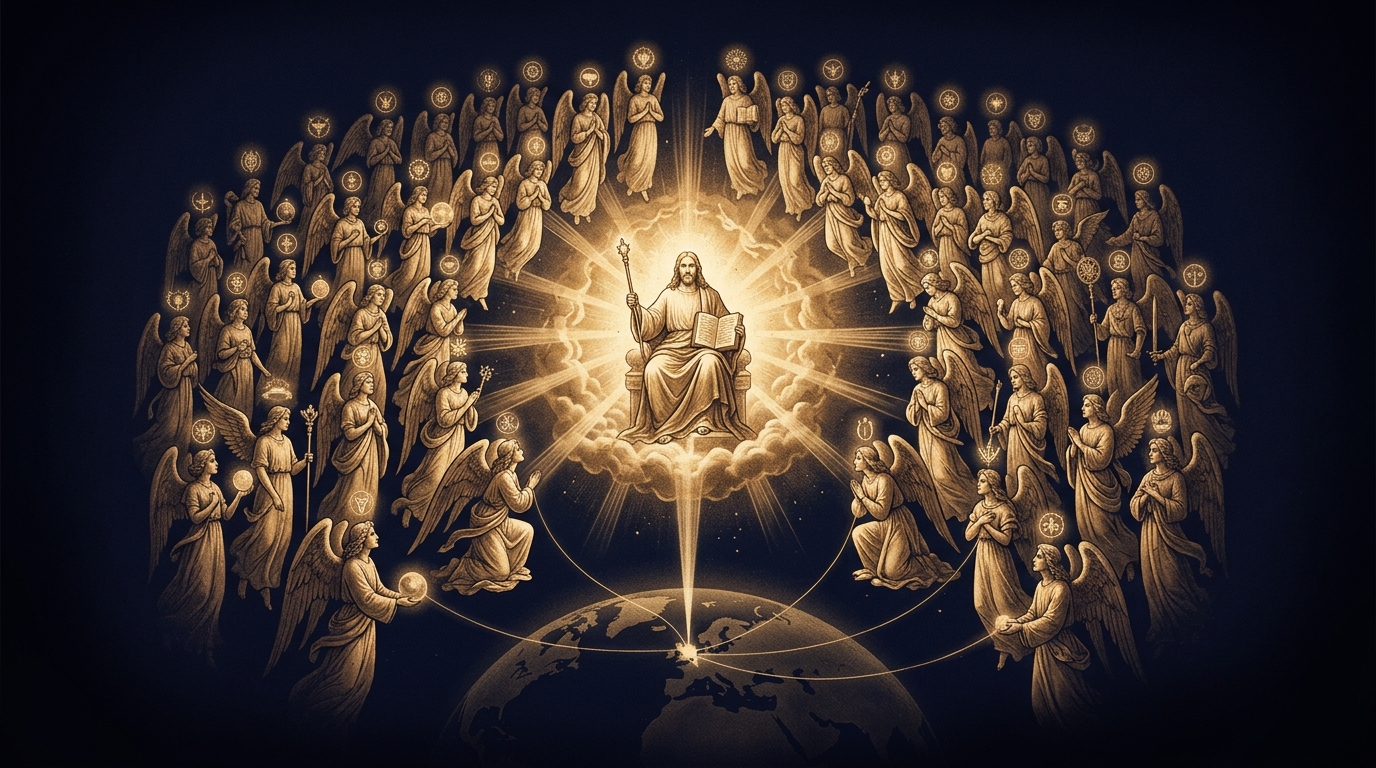
 Codex Illustration
The Seventy Nations & Territorial Spirits
A cosmic political theology embedded in the Hebrew Bible suggests that at Babel, the one God of Israel assigned seventy rebellious divine beings as territorial overseers of the nations, reserving Israel for himself — a framework that illuminates Paul's language of 'principalities and powers' and echoes across Second Temple Judaism, ancient Near Eastern cosmology, and early Christian demonology.
Overview
The concept of territorial spirits in the Hebrew Bible is not a peripheral curiosity but a structural pillar of its cosmic geography. The critical passage is Deuteronomy 32:8–9, where the Masoretic Text reads 'sons of Israel' but the Septuagint and the Dead Sea Scrolls text (4QDeut) read 'sons of God' (bene elohim), indicating that the Most High divided the nations 'according to the number of the divine sons,' each receiving a nation as an allotment while Yahweh retained Jacob as his own portion. This textual variant, preserved in manuscript tradition predating the Common Era, provides the exegetical foundation for understanding Babel not merely as a story of linguistic confusion but as a judicial act of divine disinheritance: the nations were handed over to lesser divine beings, setting the cosmological stage for Israel's election as a counter-narrative.
The Table of Nations in Genesis 10 lists seventy descendants of Noah — a number that carries deliberate symbolic weight across the ancient Near East and Second Temple Jewish literature. Ugaritic texts from Ras Shamra reveal that the Canaanite high god El presided over a council of seventy divine sons, and the number seventy appears in Hittite, Mesopotamian, and Egyptian cosmic ordering as a marker of totality and completeness. Within the Hebrew framework, the seventy elders of Israel, the seventy members of Jacob's household who descended into Egypt, and Jesus' later appointment of seventy disciples in Luke 10 all resonate with this cosmic numerology. Scholars in the tradition of Michael Heiser argue that this is not coincidence but deliberate intertextual theology: Israel's sacred institutions were constructed as a heavenly mirror and counter-claim to the cosmic order established at Babel.
Psalm 82 provides the most direct confrontation with these territorial powers. God stands in the divine assembly and pronounces judgment on the elohim who have 'judged unjustly' and 'shown partiality to the wicked.' The verdict — 'You shall die like men, and fall like any prince' — implies that these beings, though divine, are not immortal by nature and that their corruption of the nations under their stewardship has earned them a death sentence. This passage, read within its ancient Near Eastern context, is not an anomalous polytheistic intrusion but a polemical assertion of Yahweh's supreme sovereignty. The nations' gods are real but subordinate, corrupt, and condemned — a theology that bridges the gap between strict monotheism and the undeniable presence of divine plurality in the Hebrew Bible.
In the New Testament and Second Temple literature, the framework becomes explicitly christological and eschatological. The Book of Enoch elaborates the rebellion of the Watchers at Mount Hermon as a precursor event that compounds the problem of corrupted divine stewardship. Paul's language of 'principalities, powers, and rulers of the darkness of this age' in Ephesians 6 and Colossians 1–2 maps directly onto this worldview. The mission of Jesus, in this theological reading, is the reclamation of the nations from their corrupt divine overseers — a cosmic reversal of Babel — which is why the Great Commission is explicitly universal (all nations) and why Pentecost's reversal of linguistic division carries such structural theological force. The framework remains debated but is increasingly taken seriously in academic biblical studies as a coherent ancient cosmological system rather than an embarrassing pre-critical relic.
Timeline
Evidence
Multiple Perspectives
Biblical Lens
Scripture Threads
Sources & Further Study
Questions to Explore
Follow the Thread
Continue the Investigation
You’ve reached the Full Archive portion of this Case File.
Ask the Archivist
about this fileSign in to ask the Archivist
Create a free account to ask the Archivist 1 grounded question each day, cited straight from the CODEX case files.
Discussion
0Share findings, questions, and evidence with fellow Seekers. Be respectful and cite sources where you can.
No comments yet. Be the first to open this thread.