
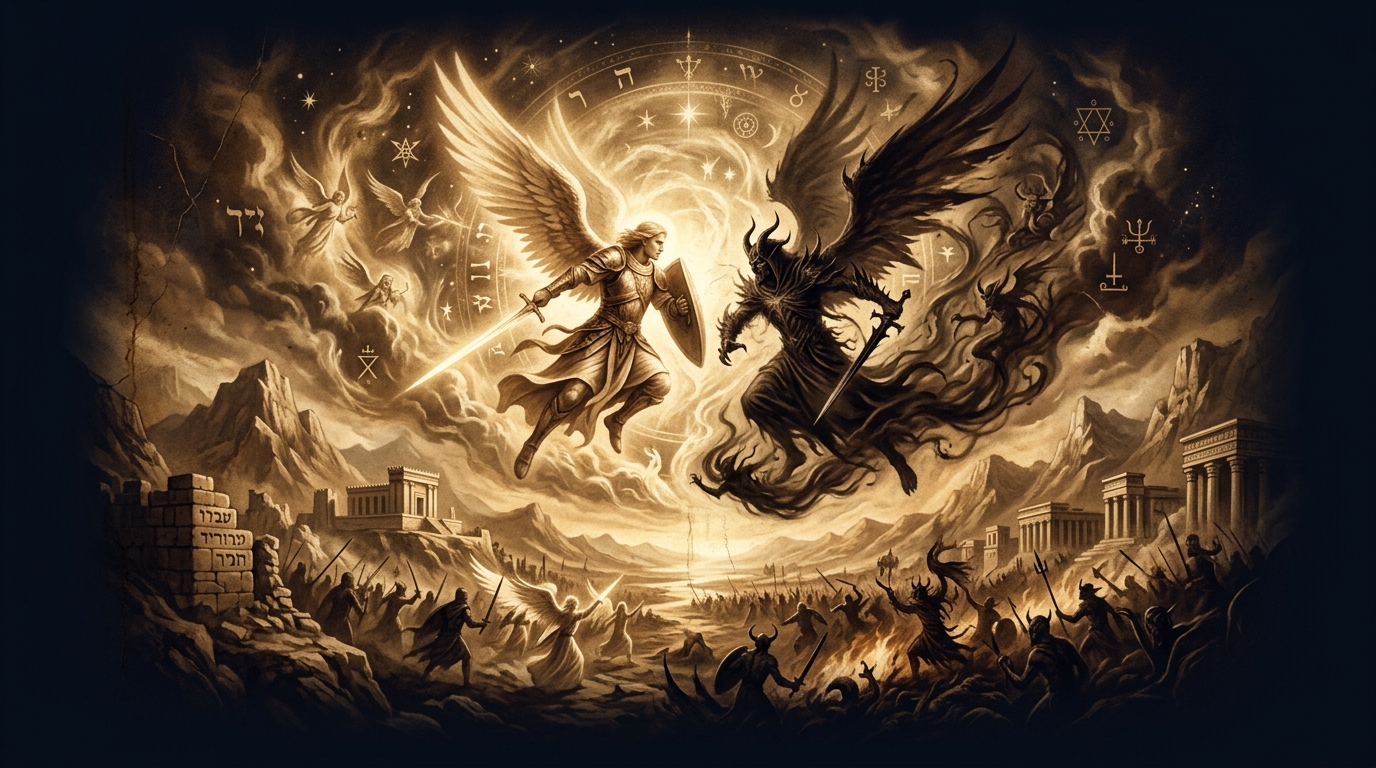
 Codex Illustration
Spiritual Warfare
Across millennia and cultures, human beings have understood existence as a battleground between unseen powers — a conviction embedded in the Hebrew scriptures, ancient Near Eastern cosmology, early Christian theology, and countless mystical traditions. Spiritual warfare names the contested terrain between divine and hostile spiritual forces, with humanity caught at the intersection.
Overview
The concept of spiritual warfare is not a late Christian invention but is deeply rooted in the cosmological framework of the ancient Near East. In the biblical tradition, the universe is populated by a layered hierarchy of spiritual beings — described in Hebrew as elohim, bene elohim, mal'akim, and more — who possess genuine agency, including the capacity for rebellion. The scriptural narrative, interpreted through the lens of scholars such as Michael S. Heiser, presents cosmic history as a story of divine conflict: the original rebellion of certain heavenly beings, their corrupting influence over humanity and nations, and Yahweh's long campaign to reclaim what was lost. This framework is not peripheral but structural to the biblical worldview, woven through texts from Genesis to Revelation.
The New Testament intensifies this cosmological drama. The Apostle Paul's language in Ephesians 6:12 — 'our struggle is not against flesh and blood, but against the rulers, against the authorities, against the powers of this dark world and against the spiritual forces of evil in the heavenly realms' — presupposes a detailed understanding of tiered spiritual governance. These 'powers' and 'principalities' carry specific Greco-Roman administrative terminology (archai, exousiai, kosmokratores) that Paul repurposes to describe hostile spiritual entities. Early Christian interpreters, including Origen and Tertullian, took this framework with full cosmological seriousness, drawing on both Jewish apocalyptic sources and their own exegetical traditions.
The historical development of spiritual warfare theology proceeded along several tracks. Jewish sources, especially the Dead Sea Scrolls' War Scroll (1QM) and the Book of Enoch's Watchers narrative, present cosmic warfare in vivid, detailed terms — angelic hosts arrayed against demonic armies, with human communities either aligned with or opposed to Yahweh's purposes. The Church Fathers incorporated these streams while debating the precise nature and origin of demonic beings, the degree of their power, and the mechanisms by which the faithful could resist them. Medieval scholasticism, through figures like Thomas Aquinas, systematized demonology within Aristotelian categories, while popular piety expressed warfare through exorcism rites, hagiographic tales of saintly struggle, and the rich iconography of saints binding dragons.
In contemporary scholarship and practice, spiritual warfare occupies an unusual position. Charismatic and Pentecostal Christianity has renewed interest in territorial spirits, deliverance ministry, and strategic intercession — ideas that often draw, sometimes uncritically, on figures such as C. Peter Wagner and Frank Peretti's influential fiction. Academic biblical scholars like Heiser, Gregory Boyd, and Clinton Arnold have sought to ground the discussion in rigorous exegesis and ancient Near Eastern context, separating textually defensible claims from later theological accretions and popular sensationalism. Meanwhile, comparative religion scholars note structural parallels with shamanic worldviews, Zoroastrian cosmic dualism, and Mesopotamian mythological traditions — raising questions about cultural diffusion, shared human intuition, or something more.
Timeline
Evidence
Multiple Perspectives
Biblical Lens
Scripture Threads
Sources & Further Study
Questions to Explore
Follow the Thread
Continue the Investigation
You’ve reached the Full Archive portion of this Case File.
Ask the Archivist
about this fileSign in to ask the Archivist
Create a free account to ask the Archivist 1 grounded question each day, cited straight from the CODEX case files.
Discussion
0Share findings, questions, and evidence with fellow Seekers. Be respectful and cite sources where you can.
No comments yet. Be the first to open this thread.