
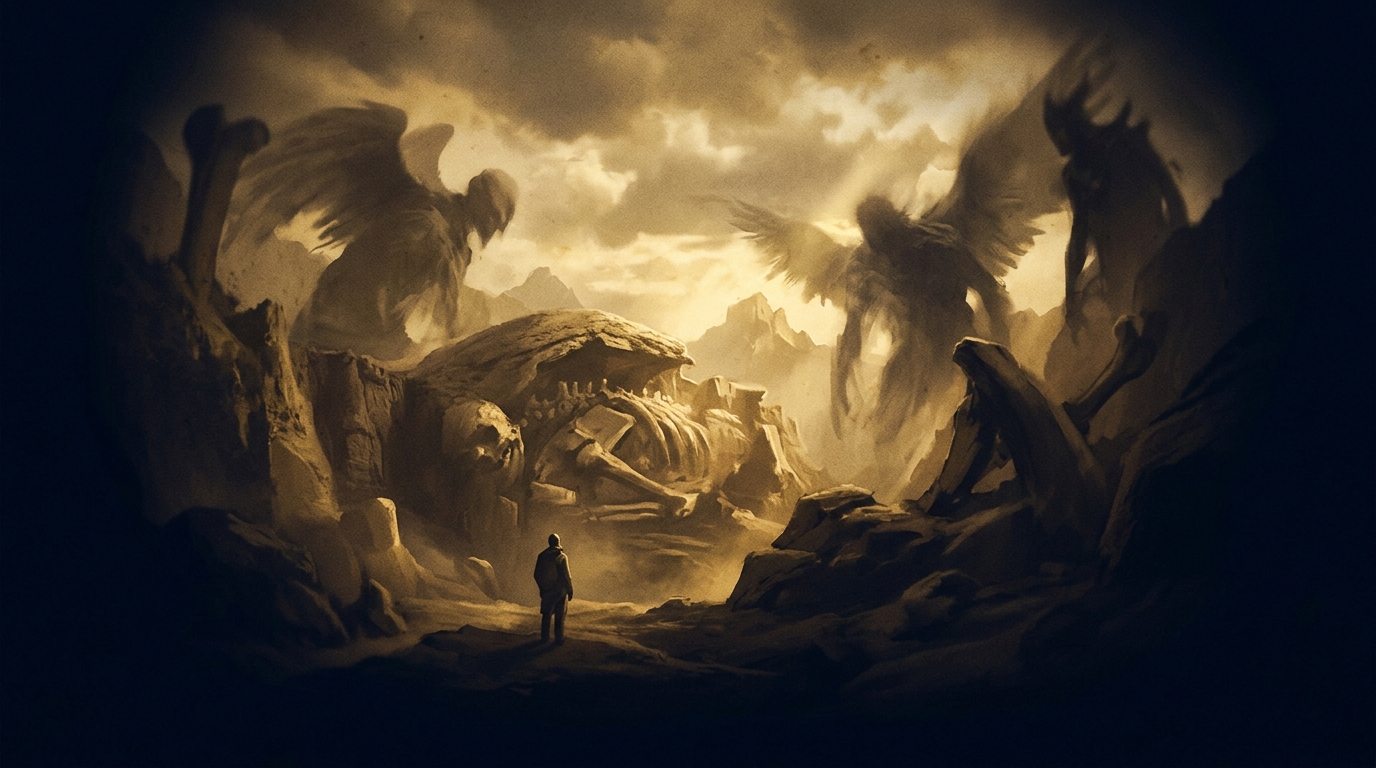
 Codex Illustration
Andrew Dawson Giant Claims
A figure known online as Andrew Dawson has made recurring claims — circulated primarily through social media and alternative media platforms — of personally encountering, photographing, or possessing knowledge of giant humanoid remains allegedly suppressed by government or institutional actors. These claims sit at the intersection of Nephilim theology, conspiracy culture, and digital folklore, and have attracted both credulous audiences and sharp scrutiny.
Overview
The name 'Andrew Dawson' surfaces periodically in corners of the internet devoted to the study of alleged giant remains, Nephilim theology, and suppressed archaeological discoveries. Unlike figures such as L.A. Marzulli or the late Steve Quayle — who have built identifiable public platforms with named publications and verifiable speaking engagements — Dawson's profile remains notably diffuse. His claims, as they circulate in forum posts, YouTube comment sections, and alternative media podcasts, typically involve firsthand encounters with skeletal remains of extraordinary size, assertions that photographs or physical evidence were confiscated by authorities or scientific institutions, and the broader narrative that a coordinated global effort exists to suppress evidence of giant humanoids from the archaeological record. The evidentiary chain behind these claims is, by any standard of scrutiny, extremely thin: the claims are attributed to him rather than documented by him in verifiable media, and the primary 'sources' tend to be repostings of repostings, a structural feature common to digital folklore.
The broader cultural substrate into which Dawson's claims flow is well-documented even if his personal story is not. The 'giant cover-up' narrative has circulated in alternative archaeology and Christian prophecy communities since at least the early twentieth century, gaining significant momentum with the rise of the internet and accelerating sharply after the Smithsonian Institution became a recurring villain in these stories. A widely circulated satirical article published by World News Daily Report — a site explicitly operating as a satirical source — claiming the Smithsonian had destroyed giant skeletons was taken as fact by enormous numbers of readers after 2014, and became a foundational data point for the genre. Whether the Dawson claims draw directly from this tradition or represent an independent emergence of the same narrative template is unclear, but the structural parallels are precise.
From a scholarly perspective, the claims attributed to Andrew Dawson belong to what folklorists and internet researchers might categorize as 'personal legend' — a first-person narrative of extraordinary encounter that serves social and ideological functions within a believing community regardless of its verifiable truth. Scholars such as Jan Harold Brunvand, who mapped the transmission dynamics of urban legend, and more recently Whitney Phillips and Ryan Milner, who have studied digital folklore and media manipulation, provide analytical tools for understanding why such claims propagate and what needs they meet. The theological dimension is equally significant: for audiences shaped by a literalist reading of Genesis 6, Numbers 13, and related texts, the giant claims function as confirmation of suppressed biblical truth, which dramatically raises the emotional and social stakes of believing or disbelieving.
Critical engagement with the Dawson claims requires holding two things simultaneously: the genuine scholarly debate about giant stature in ancient populations (which is a real, if frequently distorted, area of physical anthropology) and the very different question of whether specific sensational claims made by named individuals online have any verifiable basis. The former has produced real academic literature; the latter has produced, so far, no peer-reviewed study, no verified photograph, no physical specimen, and no corroborating institutional record. This does not constitute proof that all such claims are fabricated — absence of evidence is not evidence of absence — but it does mean that the responsible investigator must hold the claims at considerable epistemic distance while remaining open to the possibility that some kernel of genuine anomaly might exist beneath layers of amplified folklore.
Key Claims
Timeline
Evidence
Multiple Perspectives
Biblical Lens
Scripture Threads
Sources & Further Study
Questions to Explore
Go Deeper Path
Follow the Thread
Continue the Investigation
You’ve reached the Full Archive portion of this Case File.
Ask the Archivist
about this fileSign in to ask the Archivist
Create a free account to ask the Archivist 1 grounded question each day, cited straight from the CODEX case files.
Discussion
0Share findings, questions, and evidence with fellow Seekers. Be respectful and cite sources where you can.
No comments yet. Be the first to open this thread.