
 Codex Illustration
Modern Giant Cover-Up Stories
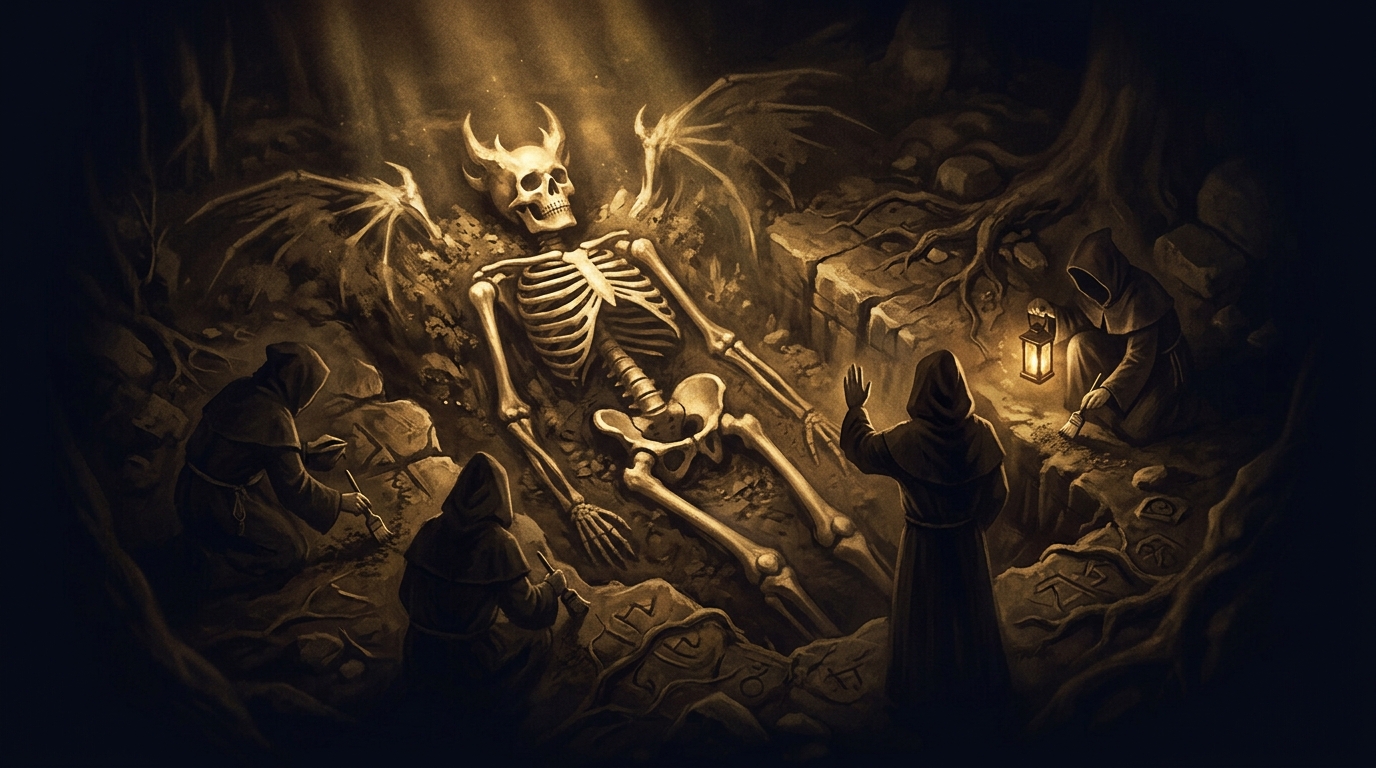
Since at least the early 2000s, a persistent and widely circulated body of claims holds that skeletal remains of giants — some allegedly measuring eight to twelve feet or more — have been repeatedly discovered, documented, and then systematically suppressed by institutions such as the Smithsonian Institution and major universities. These narratives occupy a peculiar intersection of biblical tradition, archaeological speculation, and conspiratorial imagination, demanding careful examination of what is actually known against what is merely asserted.
Overview
The modern giant cover-up narrative is, at its core, a claim about institutional suppression: that physical evidence of anomalously large human or humanoid remains has been discovered across North America, the Middle East, and elsewhere, only to be confiscated, reclassified, or quietly destroyed by government agencies, academic institutions, or shadowy organizations with a vested interest in maintaining an orthodox view of human prehistory. Proponents frequently cite nineteenth-century newspaper accounts — particularly from publications like the New York Times and Scientific American — describing the unearthing of giant skeletons at mound sites, coastal digs, and rural farmsteads. These reports are real in the sense that they exist in historical archives, but historians of science and archaeologists note that nineteenth-century newspaper journalism operated under virtually no editorial standards for sensationalism, and that many such accounts were acknowledged fabrications, misidentifications of animal bones, or promotional stunts even at the time of publication.
The claim that the Smithsonian Institution has actively suppressed giant skeletal evidence became especially prominent after the satirical website World News Daily Report published a story in 2014 purporting to show a Supreme Court ruling ordering the Smithsonian to release such evidence. The article — including the photographs it featured, which were digitally manipulated — was entirely fabricated. Nevertheless, it spread across social media with extraordinary velocity and continues to circulate as though it represented a documented event. This episode illustrates a recurring pattern within this genre: a satirical or fictional account is reposted without attribution, the satirical framing is stripped away, and the story acquires the appearance of suppressed reportage. No documented court case, no credible witness testimony, and no peer-reviewed archaeological record supports the claim of systematic institutional confiscation of giant remains.
Yet the narrative does not exist in a complete vacuum. There is a genuine and well-documented historical record of unusual skeletal finds — some involving individuals of notable stature — and of early American antiquarians making exaggerated claims about mound-builder remains as part of broader debates about Native American origins. The legitimate scholarly questions surrounding gigantism in ancient populations, the true dimensions of some Neanderthal or archaic Homo sapiens specimens, and the undeniable existence of pathological gigantism in modern humans provide a thin but real substrate onto which a much larger mythological structure has been built. The Mound Builder controversy of the nineteenth century, ably examined by historians such as Terry A. Barnhart in his work on American antiquities, reveals a genuine scientific debate that was later distorted and mythologized. Similarly, scholars in the field of biblical studies — including Michael S. Heiser — have noted that the biblical tradition does preserve accounts of anomalously large human lineages (Nephilim, Anakim, Rephaim) that were understood by ancient Israelites as biologically and spiritually significant, and that these traditions likely informed later Jewish and Christian speculation about the fate of such beings.
The modern cover-up narrative thus functions as a kind of popular theological argument dressed in the language of suppressed archaeology: if giants existed, as the Bible claims, and if institutions are hiding the evidence, then mainstream science and academia are complicit in concealing a truth that would vindicate a literal reading of scripture. This framing appeals powerfully to communities already skeptical of establishment institutions, and it has been amplified considerably by YouTube channels, alternative history podcasts, and social media ecosystems that reward engagement over accuracy. What is intellectually honest to say is this: the biblical record does attest to giant lineages; ancient Near Eastern tradition does preserve memory of anomalously large beings; certain nineteenth-century accounts of unusual skeletal finds are historically real even if routinely exaggerated; but the specific modern claims of systematic institutional suppression of giant skeletal evidence are, to date, entirely unsupported by documented, verifiable, peer-reviewed evidence.
Key Claims
Timeline
Evidence
Multiple Perspectives
Biblical Lens
Scripture Threads
Sources & Further Study
Questions to Explore
Go Deeper Path
Follow the Thread
Continue the Investigation
You’ve reached the Full Archive portion of this Case File.
Ask the Archivist
about this fileSign in to ask the Archivist
Create a free account to ask the Archivist 1 grounded question each day, cited straight from the CODEX case files.
Discussion
0Share findings, questions, and evidence with fellow Seekers. Be respectful and cite sources where you can.
No comments yet. Be the first to open this thread.