
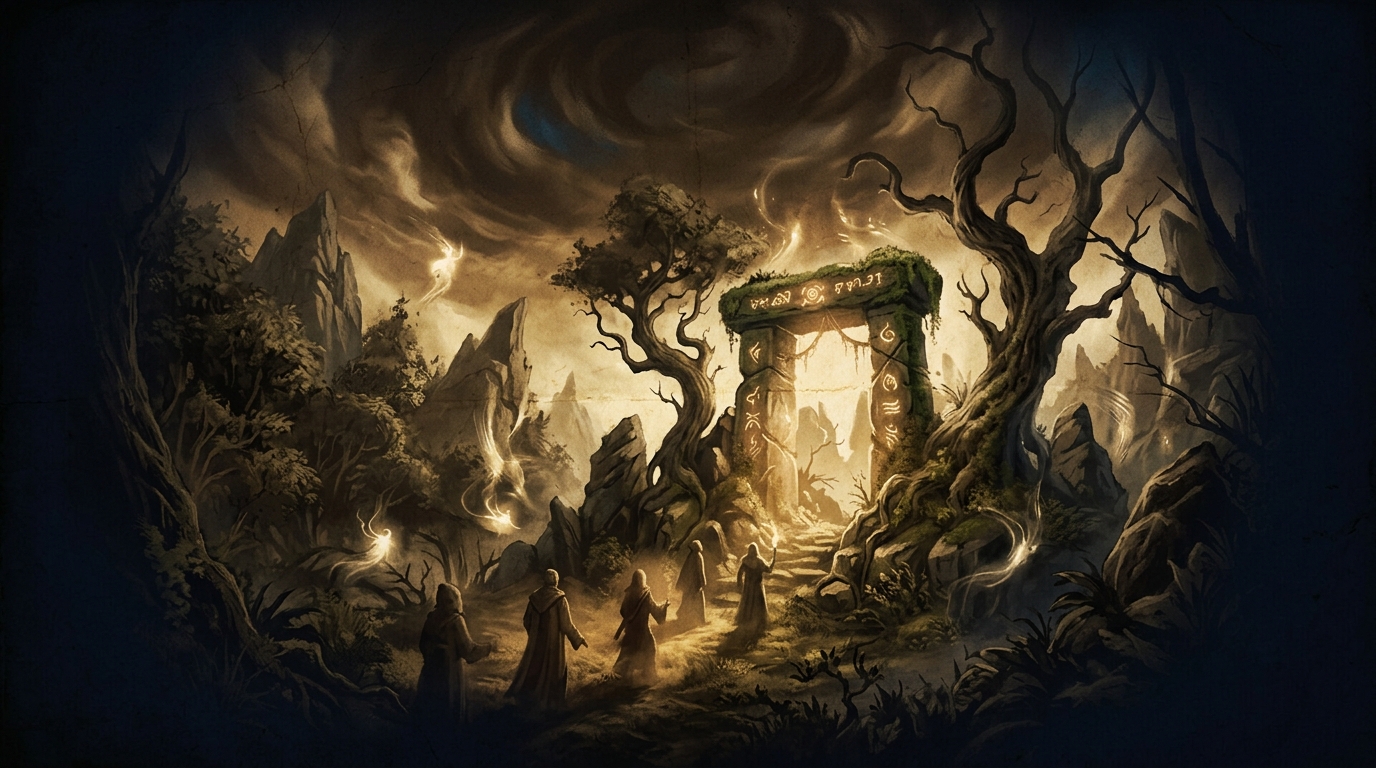
 Codex Illustration
Dangerous Places and Forbidden Locations
Across every culture and era, certain places have been marked as forbidden — avoided by locals, shunned by priests, and circled on no map — yet their prohibitions reveal something surprisingly consistent: a universal human intuition that geography itself can be charged, contaminated, or guarded by forces beyond ordinary reckoning.
Overview
The phenomenon of forbidden and dangerous places is one of the oldest continuous threads in human cultural history. From the volcanic fissures where Greek oracles spoke to the desolate Exclusion Zone surrounding Chernobyl's reactor four, human societies have repeatedly designated specific locations as off-limits — not merely for pragmatic safety reasons, but often for reasons that blend the environmental, the psychological, and the numinous in ways that resist easy untangling. Geographers, anthropologists, and folklorists have documented hundreds of such sites globally, noting that the prohibitions surrounding them tend to share a structural grammar: a warning against entry, a named guardian or resident danger, and a category of person — usually the ritually unprepared, the spiritually uninitiated, or the morally compromised — most at risk. The consistency of this grammar across unconnected cultures is itself a datum worth taking seriously.
Some of the world's most studied forbidden zones carry verifiable physical hazards that scholarship can confirm. The Alnwick Poison Garden in Northumberland, England, is documented to contain lethal specimens including Atropa belladonna and Ricinus communis, its locked gates a matter of public health as much as theater. The Zone Rouge in northeastern France — roughly 170 square kilometers of land still officially forbidden to habitation — remains contaminated by unexploded ordnance, heavy metal toxins, and human remains from World War I battlefield saturation, a documented governmental classification. Iceland's highlands near the volcanic caldera systems carry genuine geological hazards, and indigenous Icelandic tradition long warned against disturbing certain elf-inhabited stones (huldufólk lore), a prohibition that received unexpected scrutiny in 2013 when road construction near Reykjavik was temporarily rerouted following protests citing the risk of disturbing a consecrated stone believed to house hidden folk — an event reported by mainstream Icelandic and international news outlets. These cases demonstrate that the boundary between pragmatic prohibition and supernatural interpretation is frequently porous, with one idiom often encoding the other.
At the more contested end of the spectrum lie sites whose dangerous reputations rest primarily on anomalous reported phenomena. The Skinwalker Ranch in Utah's Uinta Basin has been the subject of both sensational television programming and, more carefully, the documented interest of the U.S. Defense Intelligence Agency (DIA) through its Advanced Aerospace Weapon Systems Applications Program (AAWSAP), as reported in investigative journalism by George Knapp and Matthew Grain in their 2005 book 'Hunt for the Skinwalker.' The Hoia-Baciu Forest near Cluj-Napoca in Romania has accumulated decades of reported anomalous photographs, compass deviations, and physiological effects on visitors — phenomena documented by biologist Alexandru Sift and later investigated by parapsychologist Ion Hobana in the 1960s and 1970s — though no controlled scientific study has replicated or confirmed these effects. The Bennington Triangle in Vermont and the Bridgewater Triangle in Massachusetts represent American regional folklore traditions that have organized clusters of disappearances, sightings, and anomalous events around loosely defined geographic areas. What is documented is the clustering of reported cases; what remains contested is whether any unifying physical or metaphysical mechanism explains the clustering, or whether selective attention and confirmation bias account for the pattern.
The philosophical and theological dimensions of forbidden places add a layer that purely materialist analysis cannot easily dissolve. Virtually every major religious tradition includes a category of sacred or impure space: the Holy of Holies in the Jerusalem Temple, entry to which was restricted by Levitical law to the High Priest on one day per year; the Buddhist concept of beyul — hidden valleys described in Tibetan tradition as spiritually protected refuge spaces; the Aboriginal Australian concept of sacred sites whose disturbance brings consequence not merely to the individual but to the community; and the Shinto tradition of mountain summits restricted to certain practitioners. What unites these traditions is not primitive irrationality but a coherent cosmological framework in which geography participates in a moral and spiritual order. Whether one evaluates such frameworks as revealed truth, accumulated ecological wisdom encoded in religious language, or projection of human psychology onto neutral terrain depends substantially on prior philosophical commitments — a fact that warrants intellectual honesty from investigators on all sides.
Key Claims
Timeline
Evidence
Multiple Perspectives
Biblical Lens
Scripture Threads
Sources & Further Study
Questions to Explore
Go Deeper Path
Follow the Thread
Continue the Investigation
You’ve reached the Full Archive portion of this Case File.
Ask the Archivist
about this fileSign in to ask the Archivist
Create a free account to ask the Archivist 1 grounded question each day, cited straight from the CODEX case files.
Discussion
0Share findings, questions, and evidence with fellow Seekers. Be respectful and cite sources where you can.
No comments yet. Be the first to open this thread.