
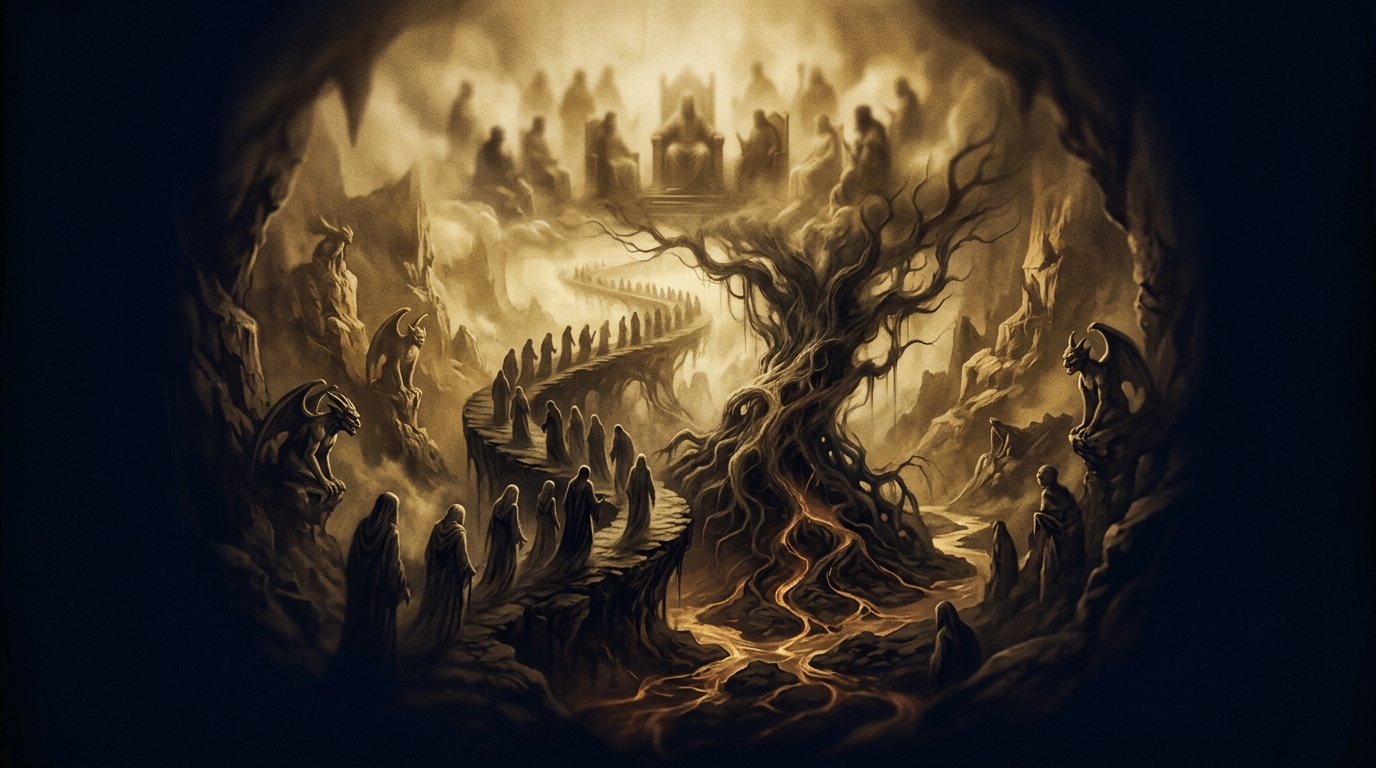
 Codex Illustration
Sheol and the Underworld
Sheol, the Hebrew underworld, is one of the most theologically complex and frequently misunderstood concepts in the Old Testament — a shadowy realm of the dead that intersects cosmology, divine council imagery, demonology, and eschatological hope. Understanding it requires engaging both the biblical text on its own terms and the rich Ancient Near Eastern world that shaped its language.
Overview
In the Hebrew Bible, Sheol (שְׁאוֹל) appears approximately sixty-five times as the destination of the dead — a subterranean realm of shadows, silence, and diminished existence. Unlike the Greek Hades or the later Christian concept of Hell, Sheol in its earliest biblical usage is not primarily a place of punishment but rather a cosmic 'holding place' for all the dead, both righteous and wicked. The word's etymology remains disputed among scholars: proposed derivations range from the root sha'al ('to ask' or 'to inquire') to connections with Akkadian terms for the netherworld. Whatever its linguistic origins, the concept is deeply embedded in a three-tiered cosmological worldview — heavens above, earth in the middle, and the watery deep or underworld below — shared across the ancient Levant.
The biblical portrait of Sheol is remarkably consistent: it is described as a pit (bor), a land of darkness and deep shadow (Job 10:21–22), a place where the 'shades' (Rephaim) dwell in a weakened, insubstantial state. Key texts such as Isaiah 14 and Ezekiel 32 present dramatic 'descent' narratives in which proud kings are brought low into Sheol's depths, mocked by its existing inhabitants. Psalm 88 captures a raw lament from someone who feels already swallowed by Sheol's grip, while Psalm 139 insists that even there God's presence cannot be escaped — a profound theological statement that subordinates the underworld to Yahweh's sovereignty. The figure of the Rephaim in Sheol is particularly significant, as these shades appear to carry associations with the ancient warrior dead and with the Rephaim of Canaan's mythological traditions.
Ancient Near Eastern parallels illuminate the biblical material without reducing it to mere borrowing. The Mesopotamian Kur and Irkalla, the Ugaritic realm of Mot (the god of death), and the Egyptian Duat all reflect a broadly shared cultural imagination of an underworld realm governed by its own powers and populated by the dead. At Ugarit, the god Mot ('Death') is explicitly a rival to Baal, consuming him into his gullet — imagery that resonates with the biblical personification of Sheol as a ravenous, ever-hungry entity (Proverbs 27:20; Habakkuk 2:5; Isaiah 5:14). Michael Heiser and other scholars working within the Divine Council framework have noted that Sheol functions as an important background for understanding certain supernatural entities — rebellious divine beings, including figures like Azazel and the imprisoned 'sons of God' of 1 Enoch and the New Testament, are associated with confinement in underworld spaces (cf. 2 Peter 2:4; Jude 6), giving Sheol a role in the cosmic drama of divine rebellion and judgment.
By the Second Temple period, Jewish thought underwent significant development regarding the afterlife and the underworld. Influenced partly by Persian and Hellenistic thought, and partly by internal biblical trajectories, writers began differentiating Sheol into compartments — places of torment versus places of consolation (cf. 1 Enoch 22; Luke 16:19–31). The term 'Gehenna' emerged as a distinct locus of punishment, while 'Paradise' or 'Abraham's Bosom' designated a place of rest for the righteous dead. The Dead Sea Scrolls community at Qumran reflects a robust engagement with these themes, as do the intertestamental books of Jubilees and 1 Enoch. Early Christianity inherited and further transformed these traditions, culminating in the New Testament's teaching on resurrection, Hades, the lake of fire, and the New Creation — a theological arc in which the power of death itself is ultimately undone.
Timeline
Evidence
Multiple Perspectives
Biblical Lens
Scripture Threads
Sources & Further Study
Questions to Explore
Follow the Thread
Continue the Investigation
You’ve reached the Full Archive portion of this Case File.
Ask the Archivist
about this fileSign in to ask the Archivist
Create a free account to ask the Archivist 1 grounded question each day, cited straight from the CODEX case files.
Discussion
0Share findings, questions, and evidence with fellow Seekers. Be respectful and cite sources where you can.
No comments yet. Be the first to open this thread.