
 Codex Illustration
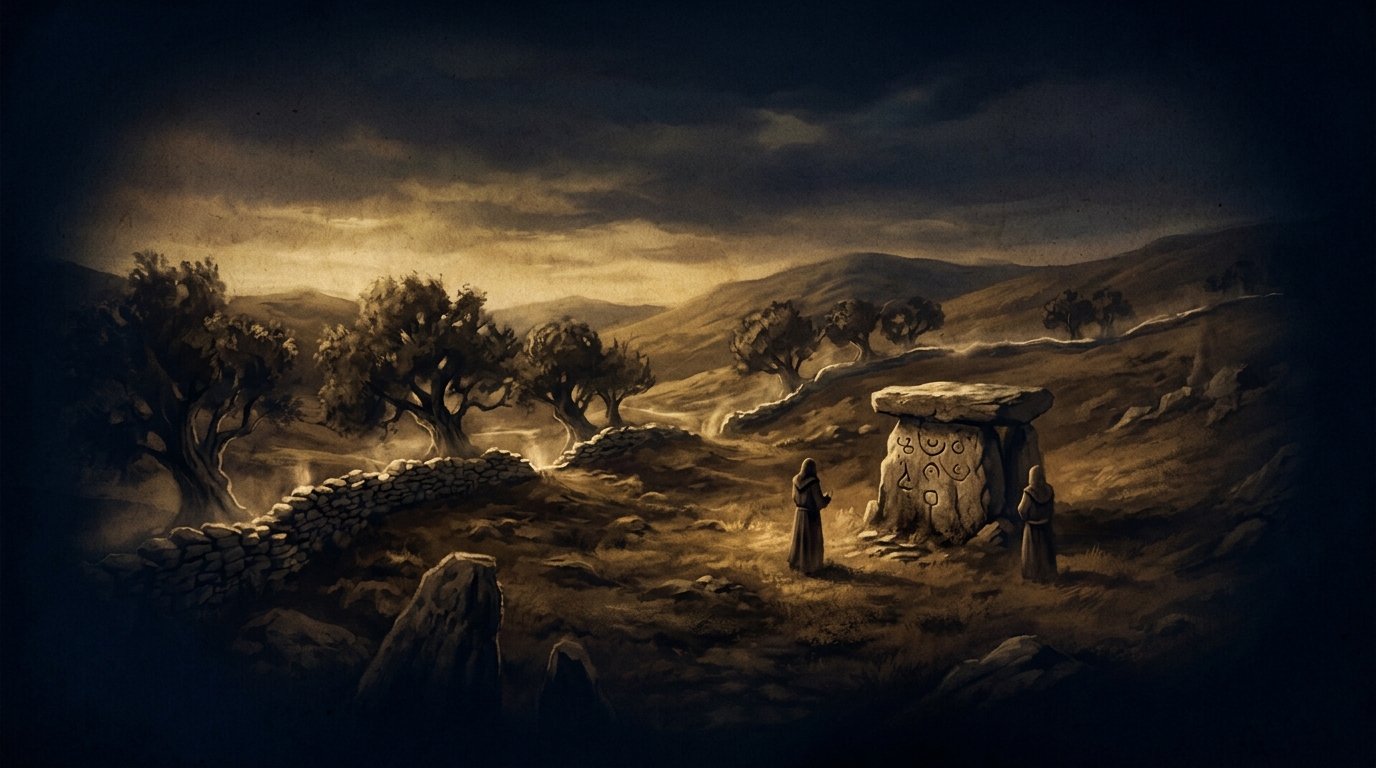
Hidden Sacred Boundaries
Across ancient Israel, rabbinic Judaism, and the broader ancient Near East, sacred boundaries functioned not merely as architectural or legal conveniences but as cosmologically charged demarcations — invisible lines separating the holy from the profane, the permitted from the forbidden, and in some interpretations, the realm of the divine from the realm of the human.
Overview
The concept of hidden or non-obvious sacred boundaries pervades the Hebrew scriptures and their ancient Near Eastern context in ways that modern readers frequently overlook. In the Mosaic legislation, the gradations of sanctity surrounding the Tabernacle — and later the Temple — created nested zones of permitted access: outer courts, inner courts, the Holy Place, and the Holy of Holies. These were not simply architectural arrangements but ontological claims about the structure of reality itself. To cross the wrong boundary at the wrong moment was potentially fatal, as the sudden deaths of Nadab and Abihu (Leviticus 10) and the later account of Uzzah (2 Samuel 6) dramatically illustrate. The boundaries were real, operative, and largely invisible to the naked eye.
The rabbinic tradition extended and systematized this logic in ways that are simultaneously more mundane and more philosophically interesting. The eruv — a legal boundary construct of string or wire demarcating a shared domain — translates an ancient category of sacred spatial distinction into urban legal practice. Within the eruv, acts normally forbidden on the Sabbath in a public domain become permissible in what is reclassified as a shared private domain. What is striking is that the eruv is, by design, nearly invisible: a wire stretched between utility poles, a fishing line above a street. The boundary is real in religious law; it is hidden to secular perception. This is not evasion of the law but an architectural enactment of the law's underlying logic — that sanctified space is categorically different from ordinary space, and that human beings possess limited but real agency in its definition.
From the perspective of Michael Heiser's Divine Council framework, sacred spatial boundaries carry a further, cosmological dimension. In the ancient Near Eastern imagination shared by the Hebrew scriptures, mountains, temples, and high places were understood as cosmic axes — points where the divine realm and the human realm intersected or overlapped. The boundaries around Sinai during the theophany of Exodus 19 — where the people are explicitly commanded not to touch the mountain on pain of death — instantiate precisely this logic: the mountain has become, temporarily, a sacred zone of divine presence, and unauthorized crossing of its boundary would be a category violation with lethal consequences. The boundary is less a rule imposed from outside and more a description of what the space has become.
A broader comparative survey reveals that the instinct to mark, guard, and sometimes conceal sacred boundaries appears across a remarkably wide range of cultures and periods. Ancient Egyptian temple complexes, Mesopotamian ziggurat precincts, and pre-Columbian ceremonial centers all exhibit graduated spatial sanctity enforced by physical and ritual means. What distinguishes the biblical material is its insistence that such boundaries are not ultimately human creations — they are revelatory responses to a prior divine reality. Whether one approaches this through the lens of historical anthropology, comparative religion, or confessional theology, the phenomenon of the hidden sacred boundary poses a serious and still-unresolved question: if such boundaries are real in any meaningful sense, what does it mean that most of the modern world has entirely ceased to perceive them?
Key Claims
Timeline
Evidence
Multiple Perspectives
Biblical Lens
Scripture Threads
Sources & Further Study
Questions to Explore
Go Deeper Path
Follow the Thread
Continue the Investigation
You’ve reached the Full Archive portion of this Case File.
Ask the Archivist
about this fileSign in to ask the Archivist
Create a free account to ask the Archivist 1 grounded question each day, cited straight from the CODEX case files.
Discussion
0Share findings, questions, and evidence with fellow Seekers. Be respectful and cite sources where you can.
No comments yet. Be the first to open this thread.