
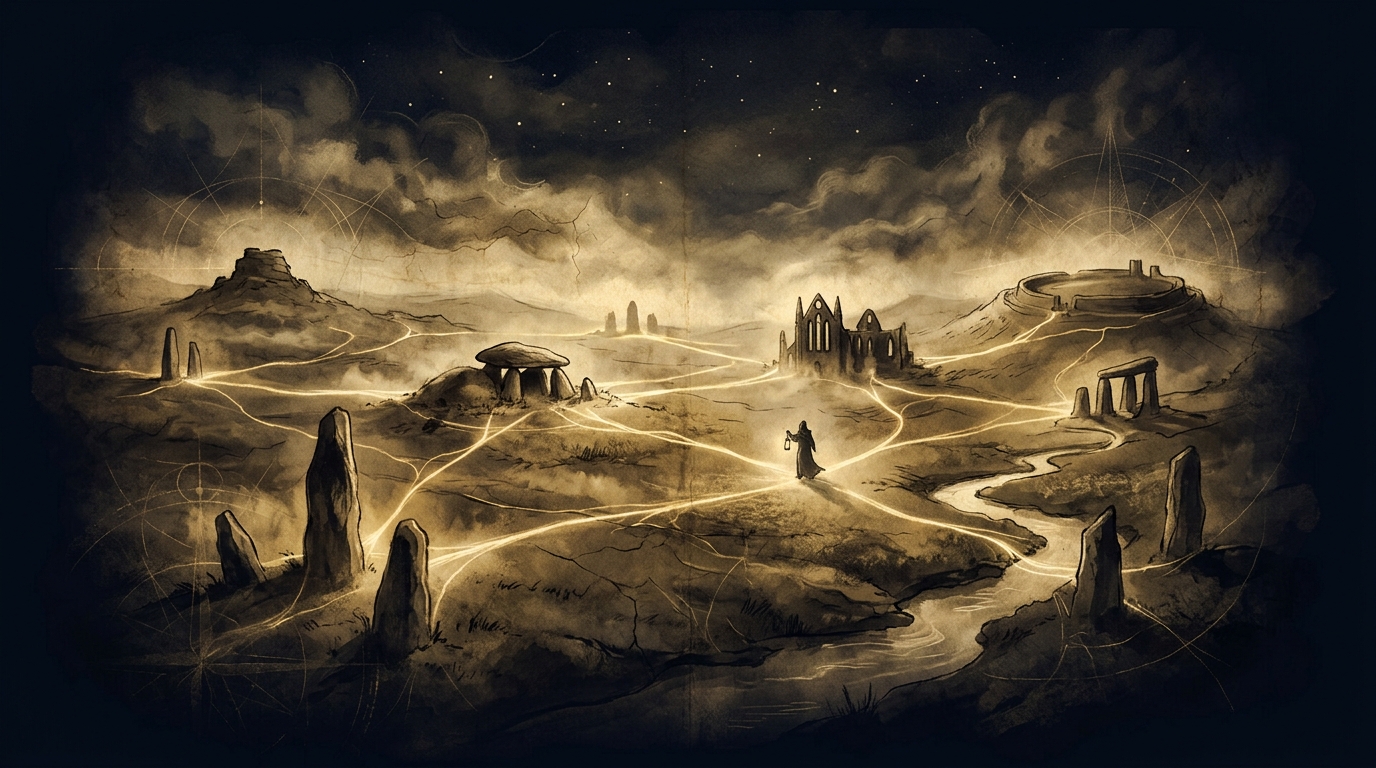
 Codex Illustration
Ley Lines
Ley lines are proposed alignments of ancient monuments, sacred sites, and geographical features across landscapes—a concept born in early twentieth-century Britain that has since migrated from antiquarian curiosity to occult cosmology and New Age spirituality. Whether they represent genuine prehistoric surveying practice, natural energy currents, or a compelling modern myth reveals as much about human pattern-recognition as it does about the ancient world.
Overview
The concept of ley lines was formally introduced in 1921 by Alfred Watkins, a Herefordshire businessman and amateur archaeologist, who noticed that ancient standing stones, hilltop earthworks, churches, crossroads, and natural landmarks in the English countryside appeared to form straight alignments when plotted on Ordnance Survey maps. Watkins proposed in his 1925 book The Old Straight Track that these alignments were the remnants of prehistoric trading and trackway routes, marked out by early surveyors using simple sighting methods. He coined the term 'ley' after the Old English suffix found in place-names along the alignments. In his original conception, leys were entirely physical and utilitarian—no mystical energy was implied. This is a critical historical distinction that later popular usage has largely obscured.
The idea lay relatively dormant in mainstream archaeology—where it met sustained skepticism—until the 1960s and 1970s, when writers such as John Michell recast ley lines as channels of geomantic or telluric energy flowing through the earth, linking this framework to Chinese feng shui, Arthurian legend, and esoteric traditions. Michell's 1969 work The View Over Atlantis was enormously influential in fusing Watkins's alignments with metaphysical speculation about earth energies, sacred geometry, and the spiritual significance of sites like Glastonbury Tor and Stonehenge. This fusion transformed the concept into a cornerstone of New Age spirituality, where ley lines are now understood by many enthusiasts as literal power conduits, UFO flight paths, or nodes in a planetary grid. These claims exist at the speculative or folkloric end of the evidence spectrum and are not supported by archaeology, physics, or geology.
From a mainstream scholarly perspective, archaeologists and statisticians have argued compellingly that straight alignments among ancient sites are statistically predictable given the sheer density of monuments in the British Isles and elsewhere. A landscape as saturated with prehistoric features as southern England will inevitably produce apparent alignments by chance. David Fontana, Tom Brooks, and particularly the statistician R. F. Hind have noted that random point distributions of similar density consistently produce comparable 'alignments' without any intentional design. This does not entirely foreclose the possibility that some alignments were intentional—archaeoastronomy has established that certain Neolithic monuments were deliberately oriented toward solstice sunrises or notable celestial events—but the explanatory leap from intentional astronomical orientation to a global network of energy lines is not supported by evidence.
What the ley line phenomenon does illuminate, even in its most speculative forms, is the enduring human instinct to find hidden order in sacred landscapes, to detect meaning in geographical coincidence, and to seek a unified, enchanted account of ancient human achievement. Across many cultures, there are traditions of sacred roads, spirit paths, and cosmological axes—the Roman decumanus, the Andean ceque system radiating from Cuzco, the Chinese lung mei or dragon lines—which suggests a genuine cross-cultural impulse to organize sacred space along linear or geometrically meaningful pathways. Whether these traditions reflect a shared spiritual perception, independent parallel development, or post-hoc interpretive projection is a question that serious archaeology, anthropology, and religious studies continue to examine carefully.
Timeline
Evidence
Multiple Perspectives
Biblical Lens
Scripture Threads
Sources & Further Study
Questions to Explore
Follow the Thread
Continue the Investigation
You’ve reached the Full Archive portion of this Case File.
Ask the Archivist
about this fileSign in to ask the Archivist
Create a free account to ask the Archivist 1 grounded question each day, cited straight from the CODEX case files.
Discussion
0Share findings, questions, and evidence with fellow Seekers. Be respectful and cite sources where you can.
No comments yet. Be the first to open this thread.