
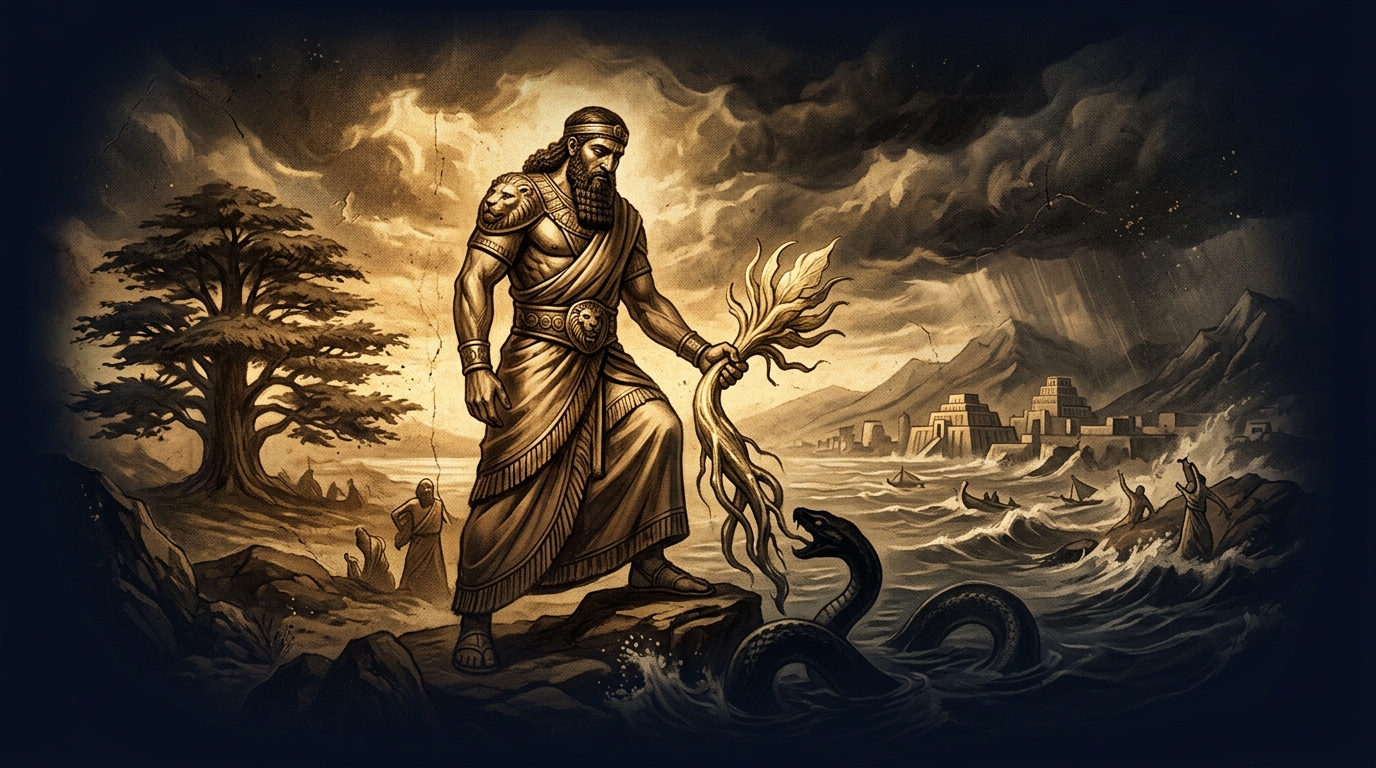
 Codex Illustration
The Epic of Gilgamesh
The Epic of Gilgamesh, among humanity's oldest surviving works of literature, recounts the adventures of a semi-divine Sumerian king whose desperate quest for immortality culminates in one of antiquity's most striking flood narratives—raising enduring questions about the relationship between ancient myth and biblical memory.
Overview
Composed in ancient Mesopotamia and preserved primarily on twelve cuneiform tablets recovered from the library of the Assyrian king Ashurbanipal at Nineveh, the Epic of Gilgamesh chronicles the reign and wanderings of Gilgamesh, king of Uruk, whom tradition describes as two-thirds divine and one-third human. The standard Babylonian version, compiled around 1200 BC by the scholar-priest Sîn-lēqi-unninni, synthesizes earlier Sumerian poems that circulated as far back as the Third Dynasty of Ur (c. 2100–2000 BC). The epic's narrative arc moves from Gilgamesh's tyrannical rule and his transformative friendship with the wild man Enkidu, through heroic exploits including the slaying of the forest guardian Humbaba and the Bull of Heaven, toward a profound reckoning with human mortality following Enkidu's death. This existential dimension distinguishes the epic from mere hero tales, rendering it a meditation on what it means to be human in a cosmos ruled by capricious gods.
The flood narrative contained in Tablet XI stands as the text's most discussed episode in comparative religious scholarship. The figure of Utnapishtim—commanded by the god Ea to build a great boat, load it with living creatures, and survive a divinely sent deluge—parallels the Genesis account of Noah with a specificity that has provoked scholarly debate for over 150 years. George Smith's 1872 announcement to the Society of Biblical Archaeology that he had identified these parallels caused a sensation in Victorian England and permanently altered the field of biblical studies. Scholars continue to debate the direction of literary dependence, the degree to which both texts draw on a common oral tradition, and the possibility that both reflect memory of actual catastrophic flooding in the ancient Near East, perhaps associated with events in the Persian Gulf or Black Sea region documented by geologists.
Beyond the flood, the epic resonates theologically and anthropologically at multiple levels. The divine council of gods who decree both the flood and Gilgamesh's ultimate mortality reflects a polytheistic cosmology that scholars such as Thorkild Jacobsen and more recently Michael Heiser have argued provides the essential cultural matrix within which to read the early chapters of Genesis. The gods of the Gilgamesh epic quarrel, weep, and compete—a portrait of divine plurality that illuminates why the Hebrew scriptures so consistently polemicize against rival divine beings rather than simply denying their existence. Additionally, the figure of Enkidu—created from clay and destined for death, yet capable of civilization and love—mirrors Adamic anthropology in striking ways, raising questions about shared conceptual frameworks for human origins in the ancient world.
The epic's afterlife in scholarship, theology, and popular culture has been substantial. Assyriologists such as Andrew George (University of London) have produced critical editions establishing the text's philological foundation. Theologians and biblical scholars, including John Walton and Tremper Longman III, have wrestled with its implications for biblical authority and historicity. Meanwhile, popular writers and fringe theorists have frequently overextended the parallels, either dissolving biblical uniqueness into mere mythology or, conversely, treating Mesopotamian myth as garbled history of extraterrestrial intervention. The responsible scholarly task is to hold the comparisons firmly while attending to the equally significant dissimilarities—particularly the Genesis account's insistence on a single, morally sovereign deity and its grounding of the flood in ethical judgment rather than divine caprice or noise.
Timeline
Evidence
Multiple Perspectives
Biblical Lens
Scripture Threads
Sources & Further Study
Questions to Explore
Follow the Thread
Continue the Investigation
You’ve reached the Full Archive portion of this Case File.
Ask the Archivist
about this fileSign in to ask the Archivist
Create a free account to ask the Archivist 1 grounded question each day, cited straight from the CODEX case files.
Discussion
0Share findings, questions, and evidence with fellow Seekers. Be respectful and cite sources where you can.
No comments yet. Be the first to open this thread.