
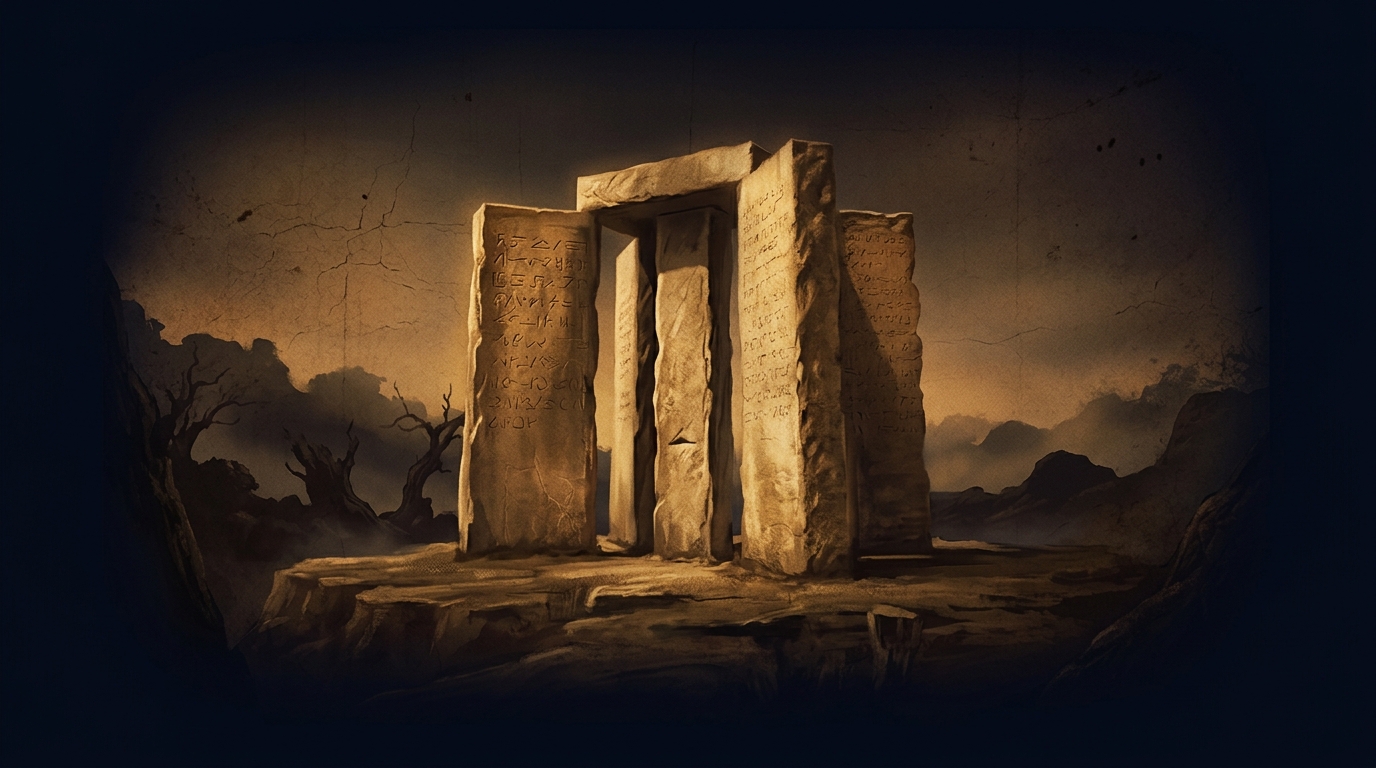
 Codex Illustration
Georgia Guidestones
Erected in 1980 in rural Elbert County, Georgia, by an anonymous patron using the pseudonym 'R.C. Christian,' the Georgia Guidestones were a granite monument inscribed with ten precepts for humanity in eight languages — a peculiar, polarizing artifact that stood at the intersection of Enlightenment rationalism, population ethics, and conspiratorial imagination until its partial destruction by explosion in July 2022.
Overview
In the summer of 1979, a well-dressed man of unknown identity approached the Elberton Granite Finishing Company in Georgia, identified himself only as 'R.C. Christian,' and commissioned a monument of considerable engineering ambition. The resulting structure, completed and dedicated on March 22, 1980, consisted of four massive granite slabs arranged around a central column, capped by a horizontal capstone, and precisely aligned with solar and astronomical cycles. Inscribed on its faces in English, Spanish, Swahili, Hindi, Hebrew, Arabic, Chinese, and Russian were ten guidelines for what the anonymous patron called an 'Age of Reason': population limits, world courts, international governance, personal liberties, and a kind of ecological stewardship. The monument stood at approximately nineteen feet tall, weighed nearly 240,000 pounds, and included a small aperture through which the noonday sun illuminated the date on the central gnomon — a detail suggesting astronomical sophistication well beyond a casual project. No credible identification of 'R.C. Christian' was ever officially confirmed in the patron's lifetime.
The ten guidelines inscribed on the monument are perhaps the most documented and least disputed aspect of the Guidestones affair. They read, in the English text, as directives to maintain global population 'under 500 million in perpetual balance with nature,' to guide reproduction 'wisely,' to unite humanity under a 'living new language,' to resolve personal disputes through 'a world court,' and to avoid 'petty laws and useless officials.' Whether one reads these as the utopian vision of an anonymous idealist, as a coded manifesto of a secret society, or as something more ominous, the text itself is factually recoverable — scholars and journalists have reproduced it accurately since 1980. The monument also contained a time capsule buried beneath it, with the date of opening left blank, a detail that attracted sustained curiosity. The Elbert County government maintained the site as a tourist attraction for over four decades.
The Guidestones generated interpretive controversy almost immediately upon completion. Researchers and journalists, most notably journalist Will Hurt of the Elberton Star who maintained a professional relationship with the anonymous patron, documented the commission with care; Hurt later co-authored a pseudonymous book, 'Common Sense Renewed,' attributed to 'R.C. Christian,' which expanded on the philosophical framework behind the monument. Some researchers, notably in popular-press investigations conducted decades later, proposed that 'R.C. Christian' was Dr. Herbert Hinie Kersten, a physician from Iowa, though this identification was not definitively confirmed before Kersten's death. Others connected the Rosicrucian initials 'R.C.' to the historical Christian Rosenkreuz — a deliberately provocative association that may well have been intended as symbolic rather than confessional. Freemasonry and the New World Order were perennial suspects in conspiracy literature, though no credible documentary link was established.
On July 6, 2022, an explosive device destroyed one of the monument's four upright slabs and damaged the capstone. Elbert County officials subsequently demolished the remaining structure citing structural instability and safety concerns, and the rubble was cleared within days — a pace that some observers found surprisingly rapid and that intensified conspiratorial speculation. Georgia gubernatorial candidate Kandiss Taylor had made demolition of the Guidestones a campaign platform in 2022, framing the monument as a 'Satanic' structure, which gave the destruction a charged political context. The bombing has not, as of this writing, resulted in a publicly identified perpetrator charged in open court. The Georgia Bureau of Investigation released surveillance footage, and the investigation continued. What had stood for forty-two years as a granite enigma was thus removed from the landscape, leaving behind the documented inscription text, a body of journalism, and an intensified folklore.
Key Claims
Timeline
Evidence
Multiple Perspectives
Biblical Lens
Scripture Threads
Sources & Further Study
Questions to Explore
Go Deeper Path
Follow the Thread
Continue the Investigation
You’ve reached the Full Archive portion of this Case File.
Ask the Archivist
about this fileSign in to ask the Archivist
Create a free account to ask the Archivist 1 grounded question each day, cited straight from the CODEX case files.
Discussion
0Share findings, questions, and evidence with fellow Seekers. Be respectful and cite sources where you can.
No comments yet. Be the first to open this thread.