
 Codex Illustration
Freemasonry
Freemasonry is the world's most widely recognized fraternal organization, tracing its symbolic heritage to medieval stonemason guilds and encoding layers of ritual, moral philosophy, and esoteric symbolism that have fascinated, alarmed, and captivated scholars, theologians, and conspiracy theorists alike for three centuries.
Overview
Freemasonry in its modern organized form emerged with the founding of the Grand Lodge of England in London in 1717, though the fraternity's own mythology reaches far deeper into antiquity—claiming symbolic descent from the builders of Solomon's Temple, the legendary architect Hiram Abiff, and even the ancient mysteries of Egypt and Babylon. Historians generally distinguish between the operative stonemasonry guilds of medieval Europe, which were craft organizations with practical trade secrets, and the speculative Freemasonry that developed in the seventeenth and eighteenth centuries, which adopted the tools and language of the mason's trade as vehicles for moral allegory and philosophical inquiry. The transition from operative to speculative masonry likely occurred gradually in Scotland and England during the 1600s, as non-craftsmen, intellectuals, and gentlemen began to be initiated into lodge culture.
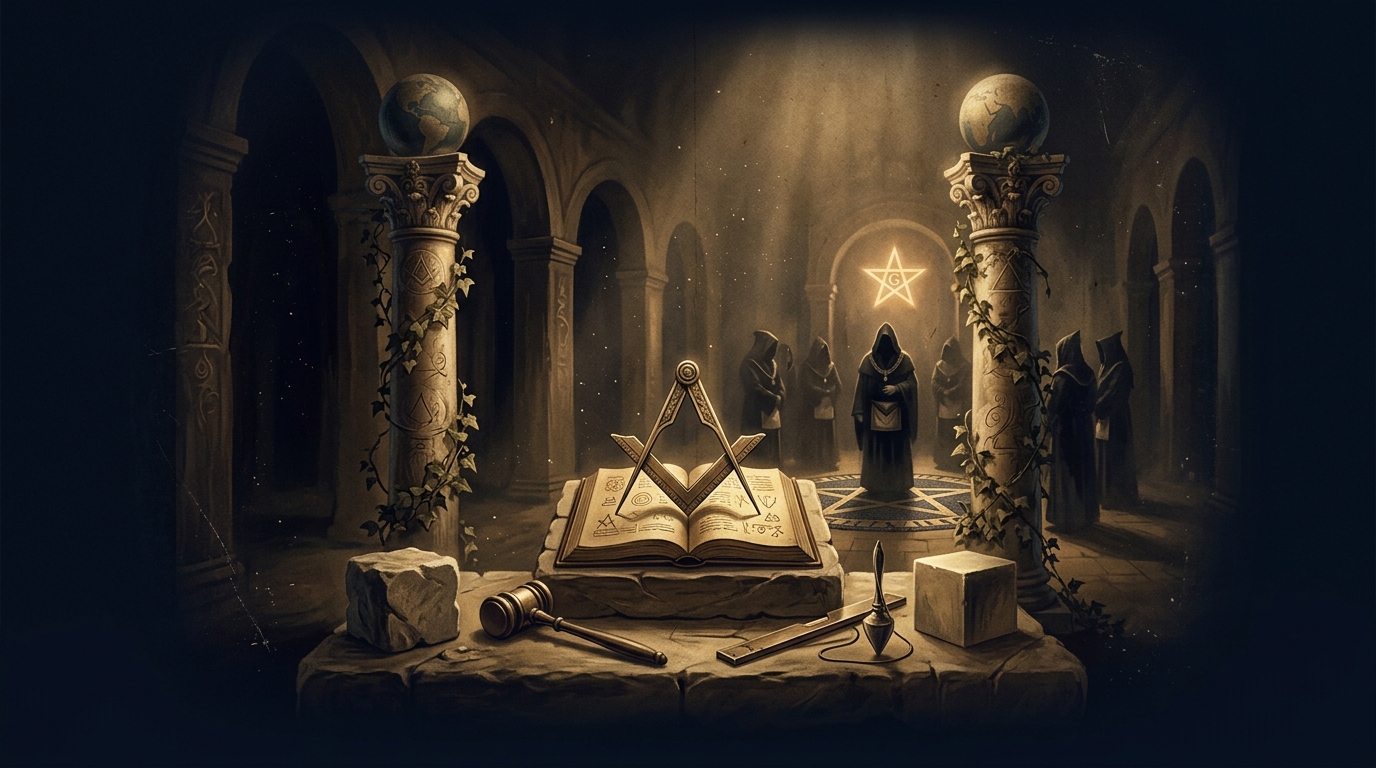
The organizational structure of Freemasonry centers on a degree system. The three degrees of the 'Blue Lodge'—Entered Apprentice, Fellow Craft, and Master Mason—constitute the foundational rites. Higher elaborations such as the Scottish Rite (reaching the 33rd degree) and the York Rite offer additional ceremonial layers rich in Solomonic, Kabbalistic, Rosicrucian, and Hermetic imagery. Each degree employs allegory, symbol, and drama to convey teachings about morality, the immortality of the soul, and the search for hidden knowledge. The Square and Compass, the All-Seeing Eye, the Letter G, and the Pillars of Jachin and Boaz are among the most recognizable of Masonic symbols, each carrying multiple interpretive layers that have been analyzed by both enthusiastic members and critical outsiders.
The fraternity's influence on the political and intellectual landscape of the Enlightenment era was substantial and historically documented. Many of the founding figures of the American Republic—including George Washington, Benjamin Franklin, and Paul Revere—were confirmed Masons. The ideals of liberty, fraternity, and rational governance that animated Enlightenment Freemasonry mapped closely onto Revolutionary-era political thought. In France, Masonic lodges served as venues for philosophical debate prior to the Revolution. This proximity to transformative political events has fed centuries of speculation, ranging from measured academic analysis to elaborate conspiratorial narratives alleging Masonic orchestration of world history. The Roman Catholic Church formally condemned Freemasonry beginning with Pope Clement XII's papal bull In Eminenti (1738), a condemnation reiterated in multiple subsequent pronouncements and remaining a feature of Catholic canon law.
Academically, Freemasonry is a well-documented historical phenomenon whose inner symbolism draws on real traditions: Renaissance Hermeticism, Neoplatonism, the Kabbalah, Rosicrucianism, and the allegorical interpretation of biblical architecture. Scholars such as David Stevenson, Margaret Jacob, and John Michael Greer have produced serious historical and analytical treatments distinguishing demonstrable Masonic history from the vast mythology that has grown around it. The fraternity's membership has declined significantly in the late twentieth and early twenty-first centuries, yet Freemasonry retains cultural prominence far exceeding its present size, functioning as a template onto which societies project anxieties about hidden power, esoteric knowledge, and the boundaries between religious orthodoxy and alternative spirituality.
Timeline
Evidence
Multiple Perspectives
Biblical Lens
Scripture Threads
Sources & Further Study
Questions to Explore
Follow the Thread
Continue the Investigation
You’ve reached the Full Archive portion of this Case File.
Ask the Archivist
about this fileSign in to ask the Archivist
Create a free account to ask the Archivist 1 grounded question each day, cited straight from the CODEX case files.
Discussion
0Share findings, questions, and evidence with fellow Seekers. Be respectful and cite sources where you can.
No comments yet. Be the first to open this thread.