
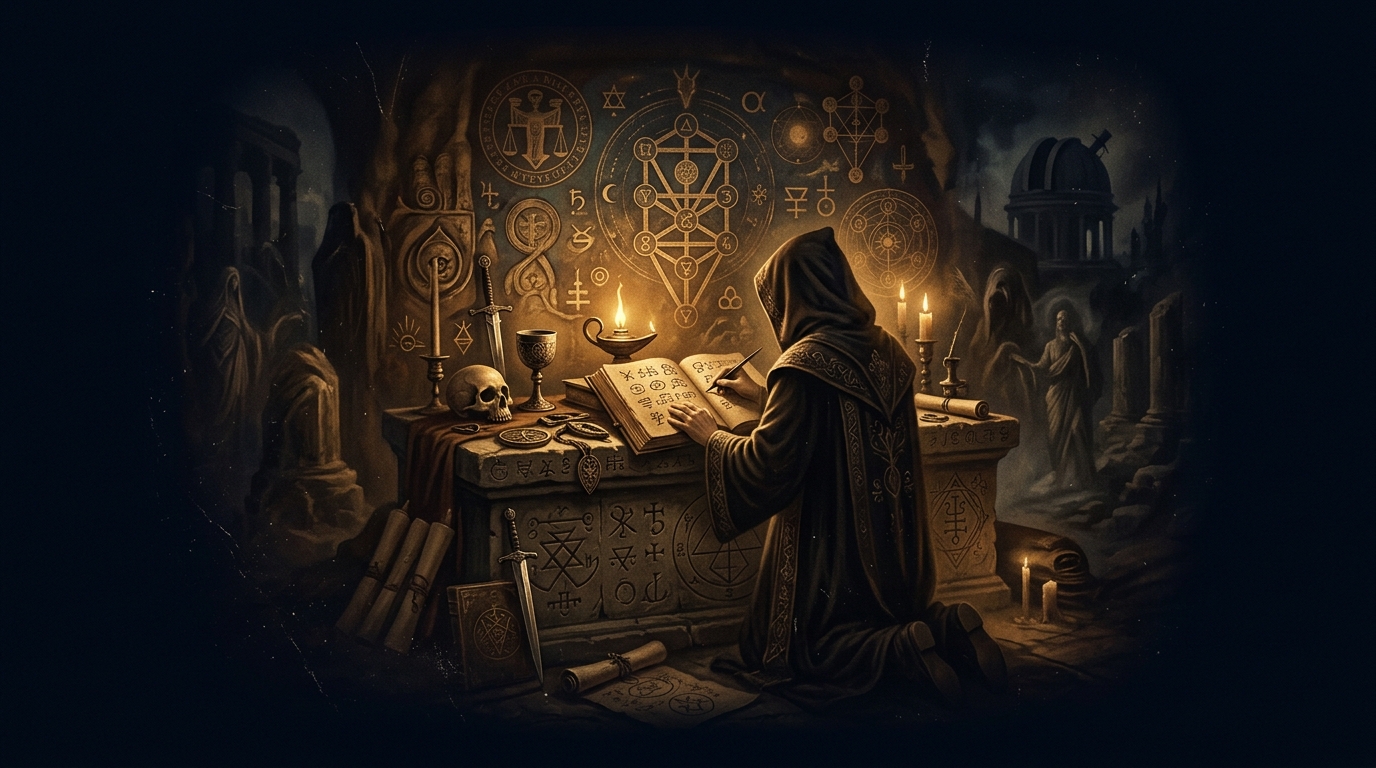
 Codex Illustration
Occult History
From the mystery cults of ancient Greece to the ceremonial magic lodges of Victorian England, the history of occultism traces humanity's persistent attempt to access hidden knowledge, manipulate unseen forces, and commune with non-human intelligences. This archive entry surveys that vast, contested terrain with scholarly rigor and historical honesty.
Overview
The word 'occult' derives from the Latin occultus, meaning 'hidden' or 'concealed,' and historically referred to a body of knowledge held to be inaccessible to ordinary perception — encompassing astrology, alchemy, divination, ritual magic, and mystical cosmology. Far from being a unified tradition, occultism is better understood as a loose family of interlocking practices and philosophies that recur across cultures and centuries, frequently absorbing elements of Neoplatonism, Gnosticism, Jewish Kabbalah, Hermeticism, and indigenous shamanic traditions. Scholars such as Wouter Hanegraaff (University of Amsterdam) have argued that 'Western esotericism' constitutes a legitimate academic field of study, distinct from theology and philosophy, with traceable intellectual lineages running from late antiquity through the Renaissance into modernity.
The Renaissance saw a decisive crystallization of Western occult thought. The translation of the Corpus Hermeticum by Marsilio Ficino in 1463 — commissioned by Cosimo de' Medici after manuscripts arrived from Macedonia — introduced the Greek-Egyptian figure of Hermes Trismegistus as the supposed author of ancient theological and magical wisdom. This ignited a flowering of 'natural magic' among humanist scholars, including Giovanni Pico della Mirandola, Heinrich Cornelius Agrippa (whose Three Books of Occult Philosophy, 1531, remains a foundational text), and later John Dee, the Elizabethan mathematician and astrologer who claimed to receive angelic communications through his scryer Edward Kelley. These figures were not marginal cranks but educated courtiers and scientists engaging, as they understood it, with the deepest structure of reality.
The 19th and early 20th centuries witnessed an extraordinary efflorescence of organized occultism in Europe and America. The founding of the Theosophical Society by Helena Petrovna Blavatsky and Henry Steel Olcott in New York in 1875 reframed Eastern religious concepts — karma, reincarnation, astral planes — for Western audiences, while simultaneously claiming access to hidden Masters or Mahatmas who guided human evolution. From Theosophy emerged countless derivative movements. The Hermetic Order of the Golden Dawn (founded c. 1888 in London) produced figures such as William Butler Yeats, Aleister Crowley, and Arthur Machen, systematizing ceremonial magic into elaborate initiatory hierarchies. Crowley's subsequent development of Thelema and his prolific magical writings made him the most notorious occultist of the modern era, and his influence permeates everything from rock music to internet subcultures.
The academic study of occult history has matured considerably since the late 20th century. Scholars including Antoine Faivre, Kocku von Stuckrad, and Gary Lachman have moved the field beyond sensationalism toward careful philological and historical analysis. From a biblical-theological perspective, the tradition raises profound questions about the nature of spiritual reality, the identity of the 'principalities and powers' addressed in Pauline letters, and the warnings against forbidden knowledge embedded throughout the Hebrew Bible. Michael Heiser's Divine Council framework highlights that the biblical authors inhabited a world in which the existence of powerful non-human intelligences was simply assumed — the question was never whether such beings existed, but how humanity should rightly relate to them. The persistent attraction of occultism may thus reflect a genuine intuition about the multi-layered nature of reality, even where its methods and orientations diverge sharply from biblical revelation.
Timeline
Evidence
Multiple Perspectives
Biblical Lens
Scripture Threads
Sources & Further Study
Questions to Explore
Follow the Thread
Continue the Investigation
You’ve reached the Full Archive portion of this Case File.
Ask the Archivist
about this fileSign in to ask the Archivist
Create a free account to ask the Archivist 1 grounded question each day, cited straight from the CODEX case files.
Discussion
0Share findings, questions, and evidence with fellow Seekers. Be respectful and cite sources where you can.
No comments yet. Be the first to open this thread.