
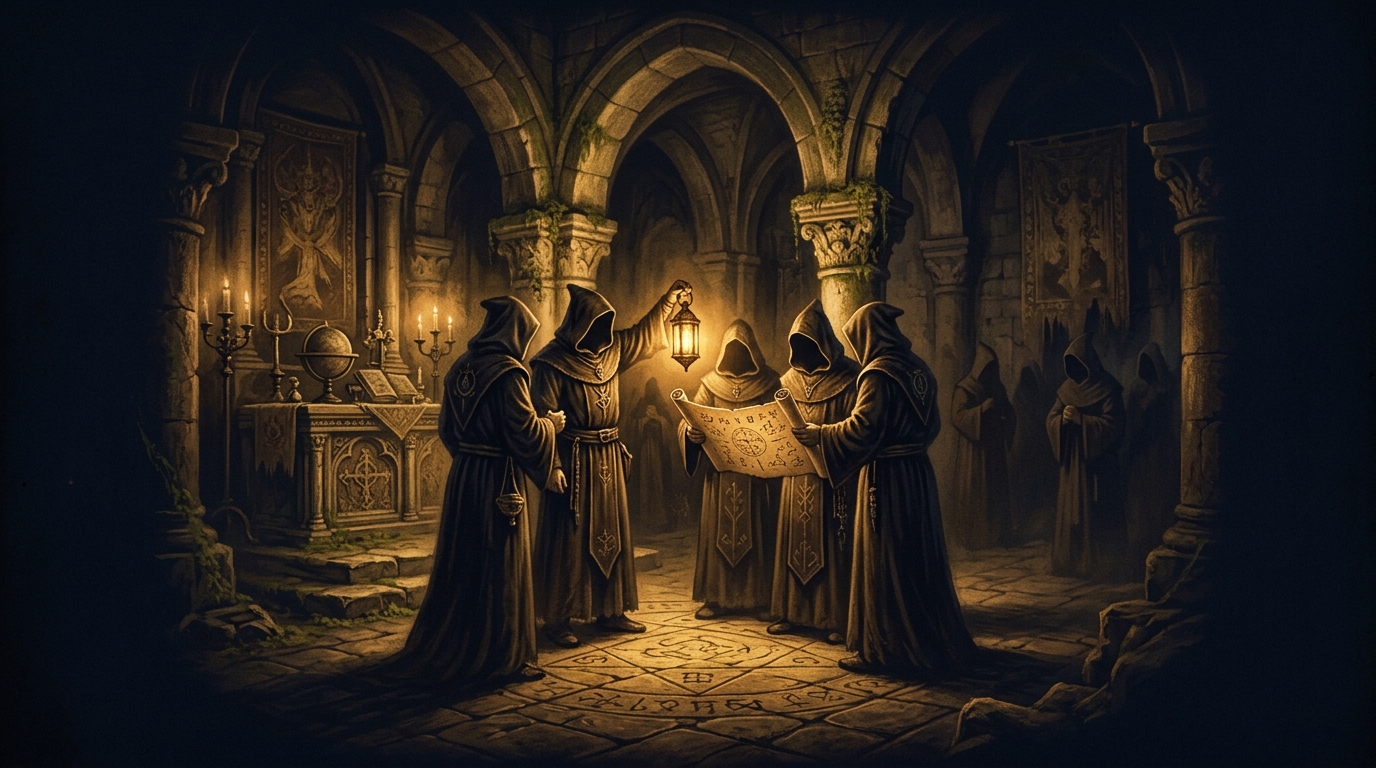
 Codex Illustration
Secret Societies
Across millennia, initiatory brotherhoods and hidden fraternities have promised their members forbidden knowledge, mutual protection, and power over the visible world — raising perennial questions about who truly governs human civilization and what secrets they guard.
Overview
The phenomenon of the secret society is as old as organized religion itself. From the mystery cults of ancient Greece and Rome — the Eleusinian Mysteries, the Orphic brotherhoods, the rites of Mithras — to the medieval confraternities of cathedral builders, human beings have consistently organized themselves into hierarchical, oath-bound communities that jealously guard esoteric knowledge from the uninitiated. These groups share structural DNA: degrees of initiation, symbolic ritual, an inner circle privy to doctrines concealed from lower members, and the claim that their traditions preserve wisdom of immense antiquity. Whether this preservationist narrative is literally true, mythologically constructed, or deliberately fabricated for social cohesion is one of the central questions serious scholarship must confront.
The High Middle Ages and Renaissance produced the most historically consequential secret societies in Western memory. The Knights Templar (founded c. 1119) accumulated extraordinary wealth and influenced the nascent banking system of Europe before their brutal suppression in 1307 under Philip IV of France and Pope Clement V. The subsequent legends surrounding the Templars — hidden treasure, the Holy Grail, Gnostic or Cathar sympathies, Solomonic secrets — became the seedbed for later fraternal mythology. Freemasonry, which emerged in early eighteenth-century Britain from the operative stonemason guilds and speculative Renaissance Hermeticism, became arguably the most globally influential of all secret societies, counting among its members kings, presidents, philosophers, and generals. The Bavarian Illuminati, founded in 1776 by Adam Weishaupt, exists as a documented historical organization that lasted barely a decade but has generated centuries of conspiratorial literature far exceeding any verified record of its actual influence.
The nineteenth and early twentieth centuries witnessed an explosion of esoteric fraternities drawing on Kabbalah, Hermeticism, Rosicrucianism, Theosophy, and Eastern mysticism. Organizations such as the Hermetic Order of the Golden Dawn (founded 1887) attracted intellectuals including W.B. Yeats and Aleister Crowley, producing sophisticated magical systems that influenced modern occultism profoundly. Crowley's later Thelemic order, the A∴A∴, and his leadership of the Ordo Templi Orientis (O.T.O.) marked a decisive turn toward transgressive ritual and the deliberate inversion of religious norms. Scholars such as Wouter Hanegraaff, Kocku von Stuckrad, and Antoine Faivre have produced rigorous academic frameworks for studying esotericism as a coherent intellectual tradition rather than mere superstition, situating secret societies within the broader history of Western thought.
The sociological and political dimensions of secret societies remain genuinely complex. At their most benign they function as social networks, mutual aid organizations, and vehicles for philosophical exploration. At their most troubling, documented cases — from P2 Lodge in Italy (a Masonic deviation implicated in political corruption trials) to the documented CIA recruitment networks — demonstrate that oath-bound secrecy can enable real abuses of institutional power. The scholar Nesta Webster represents an older, polemical tradition of anti-secret-society historiography that blends genuine research with unfounded conspiratorial synthesis; modern scholars distinguish sharply between documented organizational history and speculative claims about shadowy global control. The honest answer is that secret societies have wielded real, if circumscribed, influence on politics, culture, and religion — while claims of omnipotent world domination rest on evidence that does not survive critical scrutiny.
Timeline
Evidence
Multiple Perspectives
Biblical Lens
Scripture Threads
Sources & Further Study
Questions to Explore
Follow the Thread
Continue the Investigation
You’ve reached the Full Archive portion of this Case File.
Ask the Archivist
about this fileSign in to ask the Archivist
Create a free account to ask the Archivist 1 grounded question each day, cited straight from the CODEX case files.
Discussion
0Share findings, questions, and evidence with fellow Seekers. Be respectful and cite sources where you can.
No comments yet. Be the first to open this thread.