
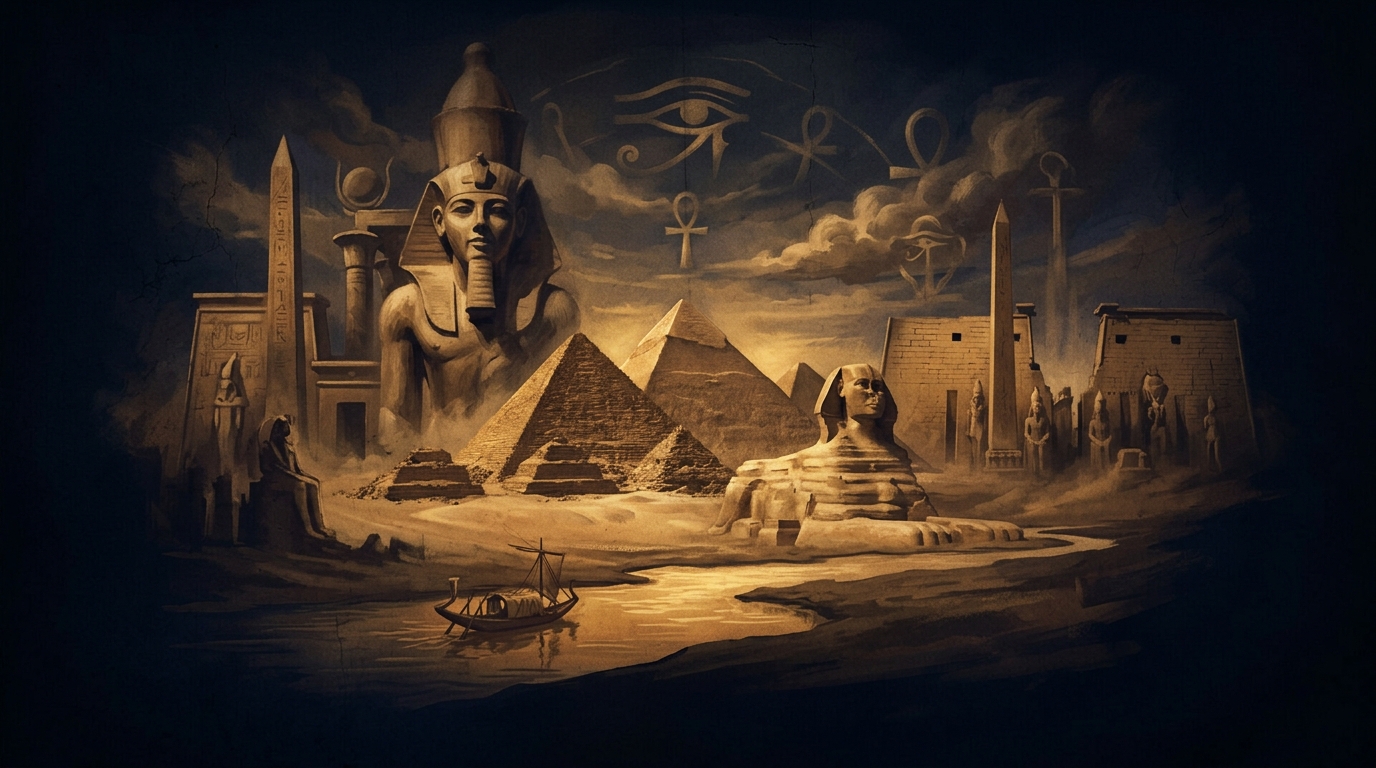
 Codex Illustration
Ancient Egypt
One of humanity's most enduring and sophisticated civilizations, Ancient Egypt flourished along the Nile for over three millennia, producing monumental architecture, complex theology, and a bureaucratic state whose origins and achievements continue to provoke both rigorous scholarship and bold speculation.
Overview
Ancient Egypt emerged as a unified political entity around 3100 BC under the legendary first pharaoh Narmer, though its cultural roots extend centuries earlier into the Predynastic period. Situated along the fertile banks of the Nile in northeastern Africa, Egypt developed writing (hieroglyphics), monumental construction, elaborate funerary traditions, and a stratified religious worldview centered on divine kingship. The pharaoh was not merely a political ruler but the living embodiment of Horus and, in death, Osiris—a theological framework that permeated every dimension of Egyptian public and private life. Over roughly thirty dynastic periods spanning the Old, Middle, and New Kingdoms, Egypt rose to become one of the ancient world's preeminent powers, projecting influence across the Levant, Nubia, and the broader Mediterranean world.
Egyptian religion was polytheistic, featuring a vast and sometimes fluid pantheon of gods including Ra, Amun, Osiris, Isis, Horus, Seth, and Thoth. The cosmological system was not monolithic; regional theological traditions competed and merged, producing documents such as the Memphite Theology and the Heliopolitan creation accounts. Temples were understood as earthly homes of the gods, and their rites—performed by a priestly class largely opaque to ordinary Egyptians—were conceived as maintaining cosmic order (Ma'at) against the encroachment of chaos (Isfet). This robust divine-human institutional framework offers meaningful comparative material for scholars studying ancient Near Eastern religion, including the biblical traditions that developed in adjacent cultures.
Egypt's relationship to biblical history is substantial and contested. The Hebrew sojourn in Egypt, the Exodus narrative, and Israel's repeated military and political entanglements with Egyptian power are documented within the biblical text across Genesis, Exodus, Kings, Isaiah, and Jeremiah, among others. Mainstream Egyptology has yet to identify a direct extrabiblical attestation of the Exodus as narrated in scripture, though scholars such as James K. Hoffmeier and Kenneth Kitchen have marshaled circumstantial archaeological and textual evidence situating the narrative within plausible historical contexts. The relationship between Egyptian religion and Israelite theology—whether as polemical contrast, cultural borrowing, or apologetic reframing—remains a productive area of comparative religious scholarship.
Beyond mainstream archaeology and biblical studies, Ancient Egypt attracts enormous popular and alternative-historical interest. Theories range from the serious (debates over pyramid construction methods, the identity of the Exodus pharaoh) to the speculative (lost advanced civilizations, esoteric hidden knowledge, extraterrestrial assistance). While these popular claims rarely survive critical historical scrutiny, they reflect a genuine and widespread fascination with the gap between Egypt's extraordinary achievements and our incomplete understanding of the precise social, technological, and intellectual mechanisms that produced them. The archive approaches these questions with the same rigor applied to all evidence: distinguishing what is documented, what is plausible, and what remains imagination.
Timeline
Evidence
Multiple Perspectives
Biblical Lens
Scripture Threads
Sources & Further Study
Questions to Explore
Follow the Thread
Continue the Investigation
You’ve reached the Full Archive portion of this Case File.
Ask the Archivist
about this fileSign in to ask the Archivist
Create a free account to ask the Archivist 1 grounded question each day, cited straight from the CODEX case files.
Discussion
0Share findings, questions, and evidence with fellow Seekers. Be respectful and cite sources where you can.
No comments yet. Be the first to open this thread.