
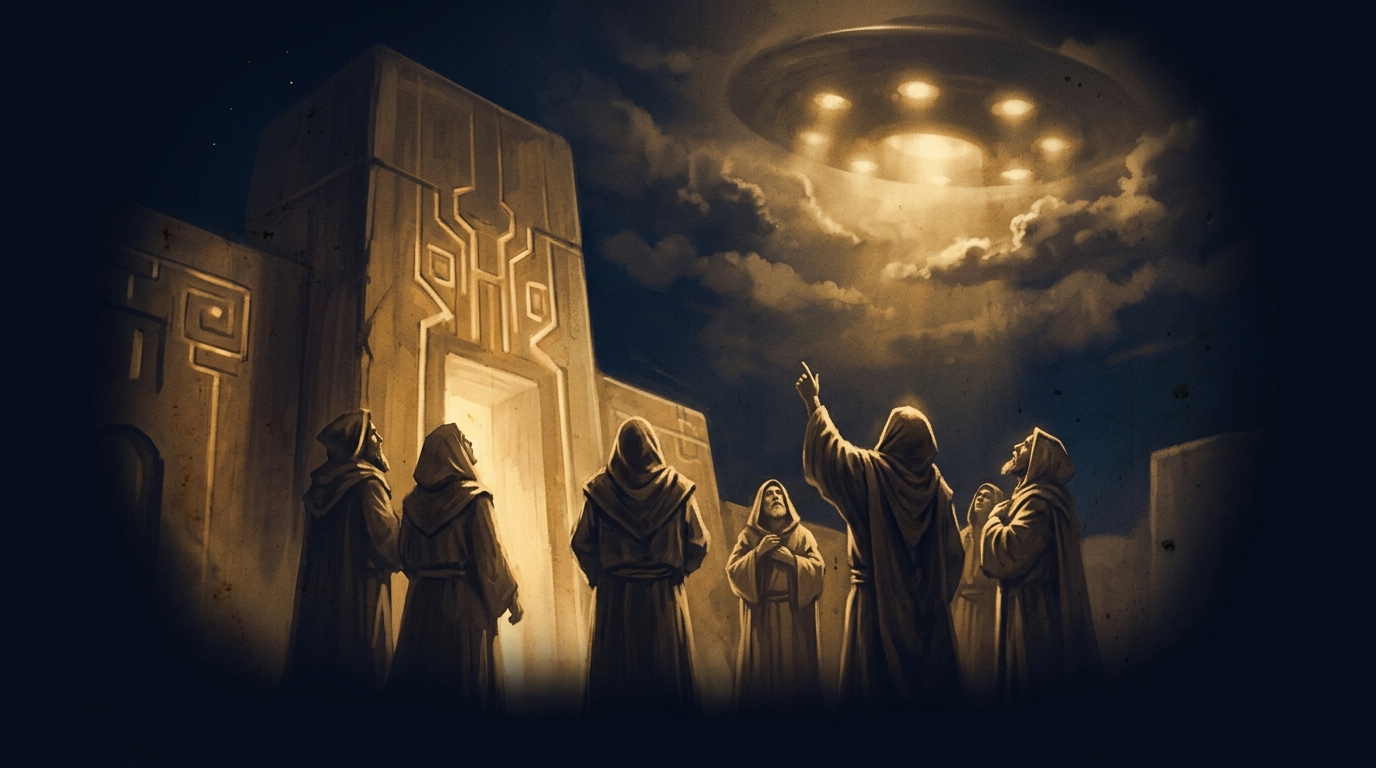
 Codex Illustration
Ancient Astronaut Theory
Ancient Astronaut Theory proposes that extraterrestrial beings visited Earth in prehistoric and ancient times, influencing the rise of civilization, religion, and monumental architecture — a hypothesis that commands enormous popular appeal while receiving near-universal rejection from mainstream archaeology, history, and theology.
Overview
Ancient Astronaut Theory (AAT) holds that intelligent beings from beyond Earth visited humanity in antiquity, that ancient myths and religious texts encode memories of these encounters, and that megalithic structures such as the Pyramids of Giza, Göbekli Tepe, and Puma Punku could not have been built without extraterrestrial assistance. The theory gained its modern form in the late 1960s through the writings of Erich von Däniken, whose 1968 book Chariots of the Gods? became a global bestseller. Earlier iterations appeared in the work of Soviet writers Matest Agrest and Alexandr Kazantsev in the 1950s, and the idea has antecedents in the speculative writings of Charles Fort in the early twentieth century. The theory is not a single coherent hypothesis but a broad cultural movement encompassing dozens of competing sub-claims.
Proponents point to a range of alleged evidence: anomalous engineering feats in ancient construction, iconographic images in Mesoamerican and Egyptian art interpreted as depicting helmeted astronauts or spacecraft, Mesopotamian cuneiform texts about the Anunnaki read as literal accounts of alien intervention, and biblical passages such as Genesis 6 and Ezekiel 1 reinterpreted as describing physical encounters with extraterrestrial craft. Zecharia Sitchin's Earth Chronicles series (1976–2007) elaborated this Mesopotamian angle extensively, arguing that the Anunnaki were an alien race from a hypothetical twelfth planet called Nibiru who genetically engineered Homo sapiens as a slave species. Sitchin's claims rest on idiosyncratic translations of Sumerian and Akkadian texts that Assyriologists across the discipline have decisively rejected.
The mainstream scholarly consensus — across archaeology, ancient history, Assyriology, Egyptology, and biblical studies — is that AAT systematically underestimates ancient human capability, misreads primary sources, and applies a fundamentally Eurocentric and condescending logic: that non-Western civilizations could not have achieved great things without outside help. Experimental archaeology has demonstrated repeatedly that the engineering feats attributed to alien intervention are achievable with period-appropriate tools, labor organization, and accumulated indigenous knowledge. The iconographic evidence dissolves under close art-historical analysis; ancient images require interpretation within their own symbolic systems before being compared to modern aerospace equipment.
From a biblical and theological standpoint, AAT represents a category error of significant proportions. The divine, angelic, and supernatural beings described in the Hebrew Bible and cognate Ancient Near Eastern literature are not meaningfully reducible to extraterrestrial biological entities. Scholars such as Michael Heiser have argued at length that the Genesis 6 'sons of God,' the Watchers of 1 Enoch, and the members of the divine council are properly understood as members of a supernatural hierarchy — spiritual beings belonging to the domain Heiser calls 'the unseen realm' — which is a fundamentally different ontological category than flesh-and-blood aliens piloting spacecraft. AAT's appropriation of biblical and ANE material is treated by scholars not as a serious theological engagement but as a selective, literalizing misreading that strips texts of their original cultural and literary context.
Timeline
Evidence
Multiple Perspectives
Biblical Lens
Scripture Threads
Sources & Further Study
Questions to Explore
Follow the Thread
Continue the Investigation
You’ve reached the Full Archive portion of this Case File.
Ask the Archivist
about this fileSign in to ask the Archivist
Create a free account to ask the Archivist 1 grounded question each day, cited straight from the CODEX case files.
Discussion
0Share findings, questions, and evidence with fellow Seekers. Be respectful and cite sources where you can.
No comments yet. Be the first to open this thread.