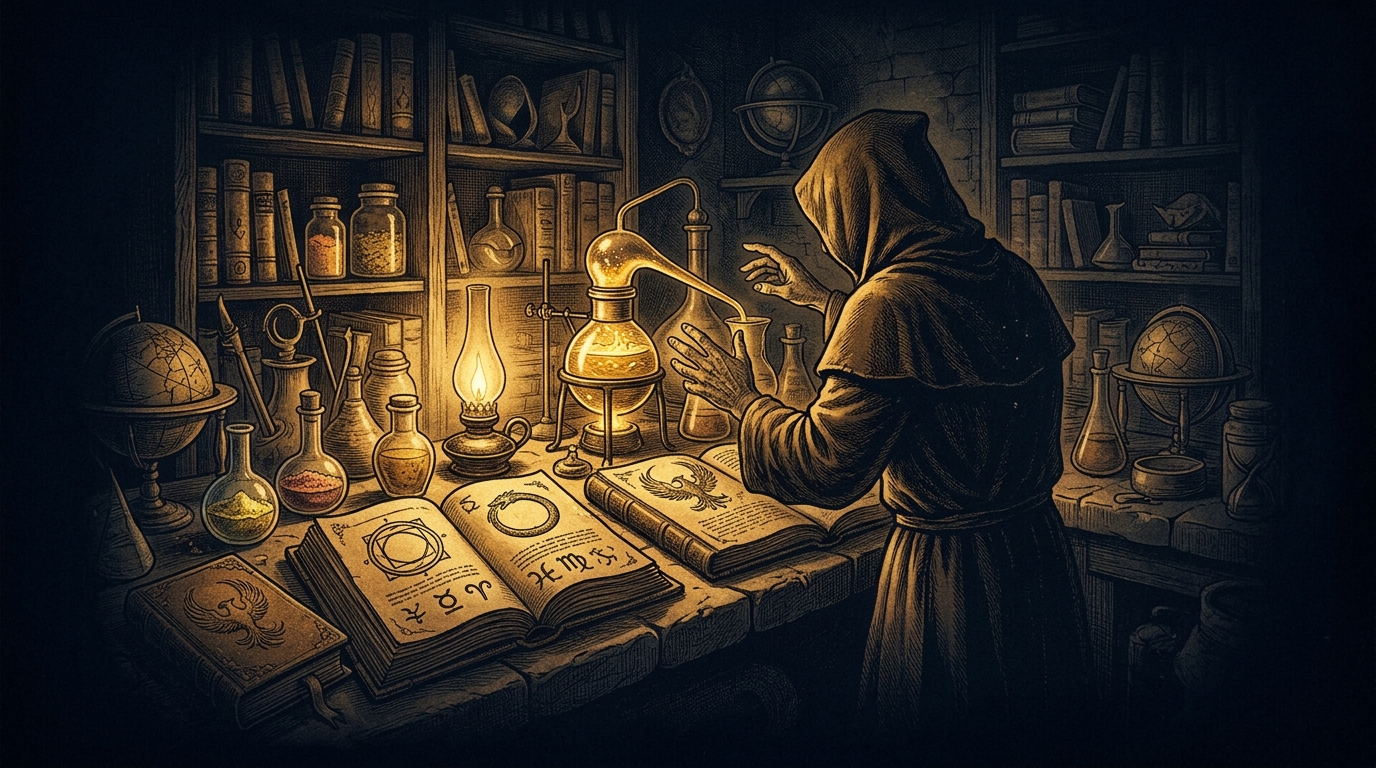
 Codex Illustration
Alchemy and Hidden Knowledge
For more than two millennia, alchemy has occupied a peculiar borderland between proto-chemistry, mystical philosophy, and encoded secret tradition — promising initiates not merely the transmutation of base metals into gold, but the transformation of the human soul itself. Whether understood as a laboratory science, a spiritual discipline, or a deliberately obscured corpus of forbidden knowledge, alchemy remains one of history's most enduring and least fully decoded intellectual traditions.
Overview
Alchemy as a coherent body of practice and theory appears to have emerged from at least three converging streams: Hellenistic Egyptian craft traditions centered in Alexandria, Mesopotamian metallurgical lore, and early Greek philosophical speculation about the nature of matter. The earliest extant alchemical texts, preserved in Greek and associated with figures like Zosimos of Panopolis (fl. c. 300 CE), already exhibit the characteristic dual register that would define the tradition for centuries — a simultaneous concern with material operations (distillation, calcination, sublimation) and with the purification of the practitioner's interior life. The Leiden and Stockholm papyri, genuine laboratory manuals from Greco-Roman Egypt, show that practical metallurgy and recipe-keeping existed alongside more mystical speculation, suggesting alchemy was never purely either.
Islamic scholars of the eighth through eleventh centuries, principally Jabir ibn Hayyan (often Latinized as Geber) and Abu Bakr al-Razi, translated, systematized, and substantially expanded alchemical knowledge. Their works introduced the sulphur-mercury theory of metals — the idea that all metals are composed of varying proportions of a philosophic sulfur and a philosophic mercury — and developed laboratory apparatus and methodologies that directly influenced European chemistry. When these Arabic texts were translated into Latin in the twelfth and thirteenth centuries, they ignited an alchemical renaissance in medieval Europe. Figures such as Albertus Magnus and Roger Bacon engaged seriously with alchemical questions, and the tradition attracted continued participation by individuals who were simultaneously respected natural philosophers. It is a documented historical fact that Isaac Newton devoted enormous private effort to alchemical study; his manuscripts, now largely held at Cambridge's King's College, run to approximately one million words on the subject.
The question of hidden or encoded knowledge within alchemy is historically substantiated rather than merely conspiratorial. Many alchemical authors explicitly state that they are deliberately obscuring their meaning from the unworthy — a practice called the 'Hermetic seal' or 'philosophical obscurity.' The Emerald Tablet, a short cryptic text attributed to the legendary Hermes Trismegistus, epitomizes this tendency: its famous maxim 'as above, so below' has been interpreted variously as a cosmological principle, a practical laboratory instruction, and a theological statement about the correspondence between divine and material realms. Whether alchemy's obscurity conceals genuine technical secrets, spiritual insight, or simply the desire of practitioners to maintain guild-like exclusivity remains genuinely debated among historians of science. Frances Yates, Lawrence Principe, and William Newman have each offered substantially different interpretations of what alchemists were actually doing and what, if anything, they successfully discovered.
By the early modern period, alchemy had become deeply entangled with emerging secret societies and esoteric fraternities. The Rosicrucian manifestos of 1614–1615 promised a reformation of human knowledge through a brotherhood possessing alchemical and spiritual secrets. Freemasonry absorbed alchemical symbolism into its ritual degrees. Figures like Paracelsus recast alchemy in explicitly theological terms, insisting that the true philosopher's stone was inseparable from divine illumination. The eventual emergence of modern chemistry from alchemical practice — acknowledged by historians including Robert Boyle, who was himself an alchemist — does not exhaust the tradition's significance. A substantial scholarly literature now argues that alchemy's persistent appeal lies in its encoding of a coherent, if heterodox, anthropology: the conviction that matter, consciousness, and the divine are not sealed in separate compartments but participate in a single transformative order.
Key Claims
Timeline
Evidence
Multiple Perspectives
Biblical Lens
Scripture Threads
Sources & Further Study
Questions to Explore
Go Deeper Path
Follow the Thread
Continue the Investigation
You’ve reached the Full Archive portion of this Case File.
Ask the Archivist
about this fileSign in to ask the Archivist
Create a free account to ask the Archivist 1 grounded question each day, cited straight from the CODEX case files.
Discussion
0Share findings, questions, and evidence with fellow Seekers. Be respectful and cite sources where you can.
No comments yet. Be the first to open this thread.