
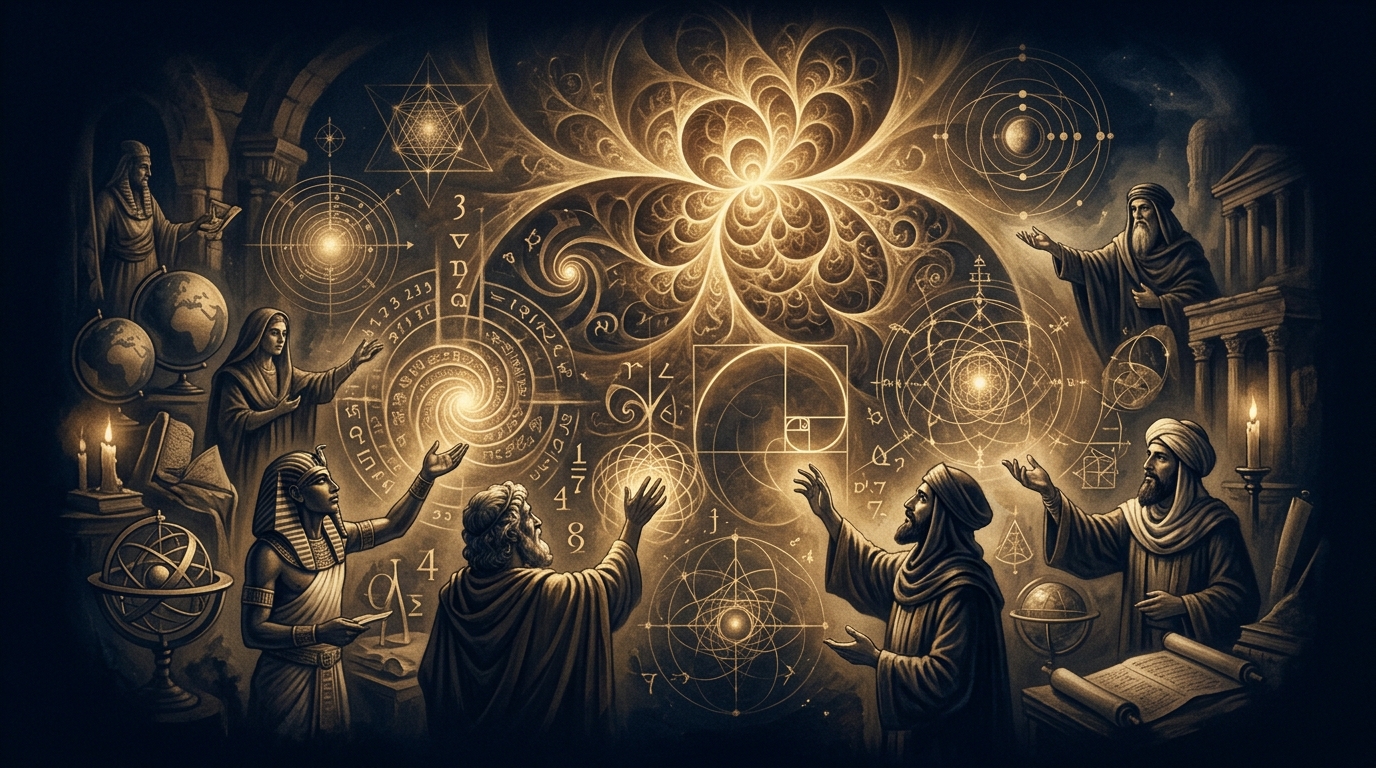
 Codex Illustration
Mathematical Mysteries
Across every civilization and era, mathematics has surfaced structures so elegant, so uncannily precise, and so inexplicably universal that scholars have long debated whether humanity discovers mathematical truth or invents it — a question that quietly implicates the nature of reality itself.
Overview
Mathematics occupies a peculiar position among human endeavors: it is the most rigorously certain of disciplines, yet it harbors within itself propositions that are true but unprovable, constants that appear in nature with no obvious reason for doing so, and structures that were developed in pure abstraction centuries before they found indispensable application in the physical world. The "unreasonable effectiveness of mathematics," as physicist Eugene Wigner famously described it in a 1960 paper of that title, remains genuinely unexplained by any consensus philosophical account. Differential geometry, invented by Bernhard Riemann in the 1850s as a pure exercise in abstract topology, became the indispensable language of Einstein's general relativity sixty years later — with no coordination between the two projects. Group theory, developed by Évariste Galois largely to settle questions about polynomial equations, became foundational to particle physics more than a century after Galois's death. These convergences are documented historical fact; their philosophical significance remains fiercely contested.
Certain mathematical constants occupy a position of special intrigue. Pi (π), the ratio of a circle's circumference to its diameter, is irrational and transcendental — its decimal expansion continues without repetition or termination, yet it appears not only in Euclidean geometry but in probability theory, complex analysis, thermodynamics, and quantum mechanics, often in contexts that have no obvious geometric interpretation. Euler's identity, e^(iπ) + 1 = 0, links five of the most fundamental constants in mathematics in a single equation so compact that the physicist Richard Feynman called it "the most remarkable formula in mathematics." The golden ratio φ ≈ 1.618 appears with genuine frequency in biological growth patterns and in classical architecture, though the extent of its prevalence is considerably overstated in popular literature. These constants are documented mathematical objects; the mystical significance sometimes attributed to them is an interpretive layer, not a mathematical finding.
Perhaps the most philosophically profound mystery within mathematics itself is Gödel's incompleteness theorems, published by Kurt Gödel in 1931. Gödel demonstrated, with full logical rigor, that any consistent formal system capable of expressing basic arithmetic must contain true statements that cannot be proved within that system. This was not a limitation of human ingenuity but a structural property of formal systems themselves. The implications cascade outward: mathematics cannot be fully axiomatized, certainty has built-in limits, and there exists a category of mathematical truth that transcends proof. Philosophers of mathematics remain divided between Platonism (mathematical objects exist independently of minds), formalism (mathematics is a human-constructed game of symbols), and various intermediate positions. This is not a fringe debate — it engages figures of the stature of Bertrand Russell, Ludwig Wittgenstein, Hilbert, and contemporary philosophers such as Penelope Maddy and Mark Balaguer.
Beyond foundational questions, mathematics surfaces unexplained empirical patterns that continue to resist full theoretical explanation. The Riemann Hypothesis, proposed in 1859 and still unproven, concerns the distribution of prime numbers and has been confirmed computationally for billions of cases without a single exception — yet no proof exists. The distribution of primes, though statistically predictable in aggregate, is locally irregular in ways that continue to generate active research. Ramanujan's notebooks, produced by the largely self-taught Indian mathematician Srinivasa Ramanujan in the early twentieth century, contained thousands of formulas — many of extraordinary depth — that mathematicians are still verifying and extending a century later, some appearing to have emerged from what Ramanujan himself described as divine inspiration. The convergence of rigorous mathematical certainty with these persistent mysteries makes the discipline uniquely positioned at the boundary between the known and the unknowable.
Key Claims
Timeline
Evidence
Multiple Perspectives
Biblical Lens
Scripture Threads
Sources & Further Study
Questions to Explore
Go Deeper Path
Follow the Thread
Continue the Investigation
You’ve reached the Full Archive portion of this Case File.
Ask the Archivist
about this fileSign in to ask the Archivist
Create a free account to ask the Archivist 1 grounded question each day, cited straight from the CODEX case files.
Discussion
0Share findings, questions, and evidence with fellow Seekers. Be respectful and cite sources where you can.
No comments yet. Be the first to open this thread.