
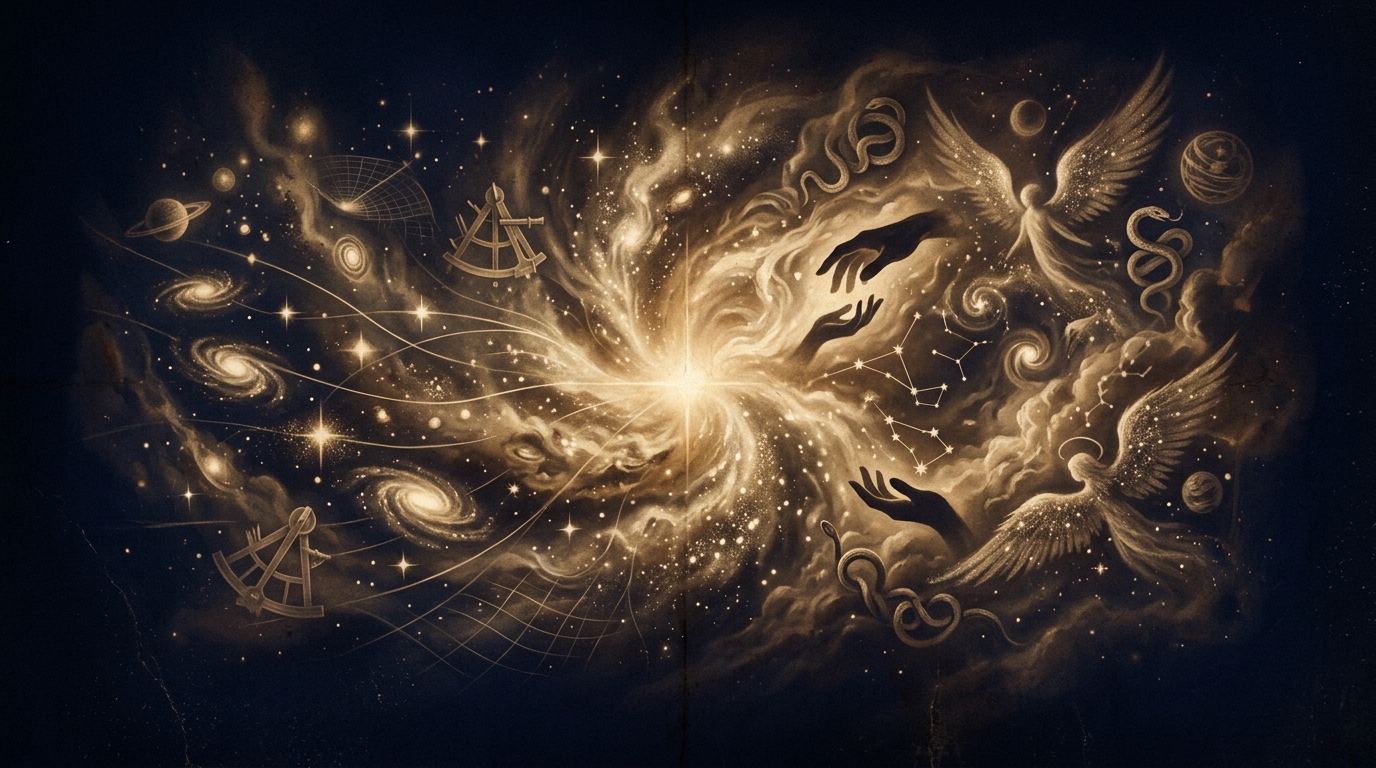
 Codex Illustration
Cosmology and the Origins of the Universe
From the Big Bang to the divine fiat of Genesis, the question of cosmic origins sits at the intersection of empirical science, ancient mythology, and theological conviction—a frontier where every answer generates deeper mysteries about time, matter, consciousness, and the nature of reality itself.
Overview
Modern cosmology rests on a foundation constructed over roughly a century of observation and theoretical physics. Edwin Hubble's 1929 confirmation that distant galaxies are receding from one another gave empirical weight to the idea that the universe is expanding—and that, run backward, all space, time, matter, and energy converge on a singularity of incomprehensible density and temperature. This moment, approximately 13.8 billion years ago, is designated the Big Bang, not an explosion within space but the very inception of space itself. The cosmic microwave background radiation, first detected accidentally by Arno Penzias and Robert Wilson in 1965 and later mapped in extraordinary detail by the WMAP and Planck satellite missions, constitutes the oldest observable light in the universe—a fossilized echo of the primordial fireball—and represents among the strongest lines of evidence supporting this cosmological model.
Yet the Standard Model of cosmology, despite its predictive successes, leaves profound lacunae. Dark matter and dark energy together constitute approximately 95 percent of the universe's total energy content, yet neither has been directly detected or identified. The precise conditions that gave rise to the matter-antimatter asymmetry—why matter dominated to produce the visible universe rather than mutual annihilation leaving only radiation—remains unresolved. The initial singularity itself sits beyond the reach of current physics; quantum gravity has not yet been achieved, meaning the universe's first Planck-time moments (roughly 10⁻⁴³ seconds) cannot be described by any extant theory. Proposals such as inflationary cosmology, string landscape multiverse hypotheses, and loop quantum cosmology each attempt to address different boundary conditions, with varying degrees of mathematical elegance and empirical testability.
Ancient civilizations developed sophisticated cosmological frameworks long before the telescope. Mesopotamian texts, including the Babylonian Enuma Elish, describe creation as an act of divine conflict—the god Marduk slaying the primordial sea-dragon Tiamat and fashioning the heavens and earth from her body. Egyptian cosmology spoke of the Ogdoad and Ennead, competing systems of primordial deities representing chaos, water, darkness, and boundlessness. Vedic cosmology proposed cyclic ages (yugas) and a universe of staggering temporal scale. Greek philosophers from Anaximander to Aristotle and later the Stoics proposed material and rational principles underlying cosmic structure. These frameworks were not merely poetic; they encoded observational astronomy, agricultural calendars, and priestly ritual into cosmological narrative. Scholars such as Wayne Horowitz (Mesopotamian Cosmic Geography) and John D. Walton (The Lost World of Genesis One) have demonstrated that ancient Near Eastern cosmology was primarily functional and temple-oriented rather than concerned with material origins in the modern scientific sense.
The relationship between scientific cosmology and theological accounts of creation is philosophically complex and historically contested. The medieval synthesis of Aristotelian cosmology with Christian theology, represented most systematically by Thomas Aquinas, was destabilized by the Copernican revolution and Galileo's telescopic discoveries, producing a crisis whose aftershocks persist in modern science-religion discourse. Contemporary theologians such as Alister McGrath and John Polkinghorne argue that the fine-tuning of cosmological constants—the anthropic principle—invites, though does not compel, a theistic interpretation. Atheist cosmologists such as Lawrence Krauss and Stephen Hawking have proposed models (quantum tunneling from nothing; the no-boundary proposal) in which the universe's origin requires no external cause, though philosophers of science, including David Albert, have critiqued these proposals for conflating 'nothing' with quantum vacuum states. The conversation between cosmology, philosophy, and theology remains genuinely open and irreducible to any single disciplinary framework.
Timeline
Evidence
Multiple Perspectives
Biblical Lens
Scripture Threads
Sources & Further Study
Questions to Explore
Follow the Thread
Continue the Investigation
You’ve reached the Full Archive portion of this Case File.
Ask the Archivist
about this fileSign in to ask the Archivist
Create a free account to ask the Archivist 1 grounded question each day, cited straight from the CODEX case files.
Discussion
0Share findings, questions, and evidence with fellow Seekers. Be respectful and cite sources where you can.
No comments yet. Be the first to open this thread.