
 Codex Illustration
Paul Is Dead
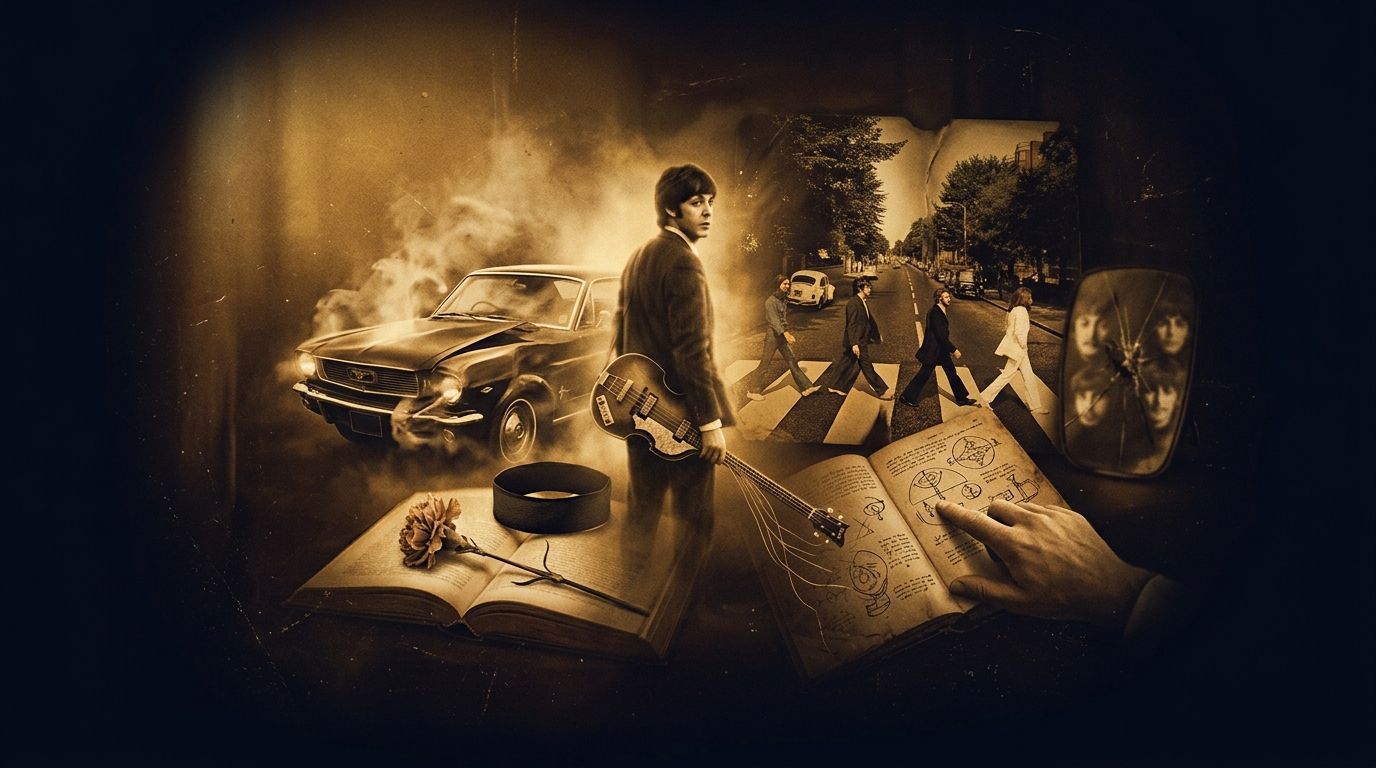
Beginning in 1969, a rumor spread across college radio and dormitory conversations that Beatle Paul McCartney had died in a 1966 car accident and been secretly replaced by a lookalike — a claim purportedly encoded in album artwork, lyrical fragments, and reversed audio. The legend endures as one of the most extensively documented case studies in apophenia, mass hysteria, and the human compulsion to find hidden meaning.
Overview
In October 1969, a caller to Detroit radio station WKNR-FM spoke with DJ Russ Gibb and outlined what he called a trail of clues embedded across recent Beatles albums pointing to the death and substitution of Paul McCartney. Within days, University of Michigan student Fred LaBour published a satirical article in the Michigan Daily elaborating the theory with mock-scholarly detail — an article he later admitted was largely fabricated for amusement. The story escaped its ironic origins almost immediately. Radio stations across the United States began broadcasting 'clue hunts,' and the rumor achieved national saturation by early November 1969, compelling McCartney to emerge from his Scottish farm and grant a cover interview to Life magazine demonstrating his continued existence. The episode is now regarded by media scholars as one of the earliest modern case studies in viral information transmission, predating the internet by two decades.
The alleged 'clues' range across the Beatles' catalogue in both directions chronologically, though most cluster around albums released between 1966 and 1969: Revolver, Sgt. Pepper's Lonely Hearts Club Band, Magical Mystery Tour, The White Album, and Abbey Road. Proponents catalogued perceived visual signals — Paul depicted barefoot on the Abbey Road cover, the phrase 'OPD' on a sleeve patch, the alleged presence of a hand raised above McCartney's head in group photographs — and sonic ones, including reversed audio on tracks such as 'Revolution 9' and 'I Am the Walrus,' from which phrases like 'Turn me on, dead man' and 'I buried Paul' were reportedly extracted. Mainstream musicologists and audio engineers have consistently found these backmasked phrases to be the result of selective listening and confirmation bias rather than intentional encoding, a phenomenon psychologists now call 'reverse speech pareidolia.'
The specific replacement figure was identified by enthusiasts as one 'William Campbell' or 'Billy Shears' — the name introduced in the Sgt. Pepper's opener — a Scottish lookalike who allegedly won a Paul McCartney lookalike contest and was recruited to preserve the band's commercial momentum. No credible biographical record of such a person exists. The Beatles themselves responded with a mixture of amusement, irritation, and deliberate mischief: John Lennon and others acknowledged that some of the album imagery was intentionally surreal or provocative, but denied any death conspiracy. Paul McCartney has addressed the rumor at various points across his career, most extensively in a 1993 documentary and subsequent interviews, consistently dismissing it while acknowledging its cultural staying power.
From a scholarly standpoint, 'Paul Is Dead' occupies a significant position in the study of media folklore, conspiracy cognition, and what researchers call apophenia — the perception of meaningful patterns in random or unrelated stimuli. Psychologist Klaus Conrad first described apophenia in a clinical context in 1958; subsequent researchers including Daniel Kahneman and the broader heuristics-and-biases tradition have formalized the cognitive mechanisms that make such pattern-finding compelling and nearly irresistible under certain social conditions. The 1969 rumor also anticipates the dynamics of internet-era conspiratorial communities: crowdsourced 'research,' the aggregation of superficially unrelated data points, the social reward of discovery, and the difficulty of definitively falsifying a claim whose goalposts can always be moved.
Key Claims
Timeline
Evidence
Multiple Perspectives
Biblical Lens
Scripture Threads
Sources & Further Study
Questions to Explore
Go Deeper Path
Follow the Thread
Ask the Archivist
about this fileSign in to ask the Archivist
Create a free account to ask the Archivist 1 grounded question each day, cited straight from the CODEX case files.
Discussion
0Share findings, questions, and evidence with fellow Seekers. Be respectful and cite sources where you can.
No comments yet. Be the first to open this thread.