 Codex Illustration
Symbolism and the Language of Signs
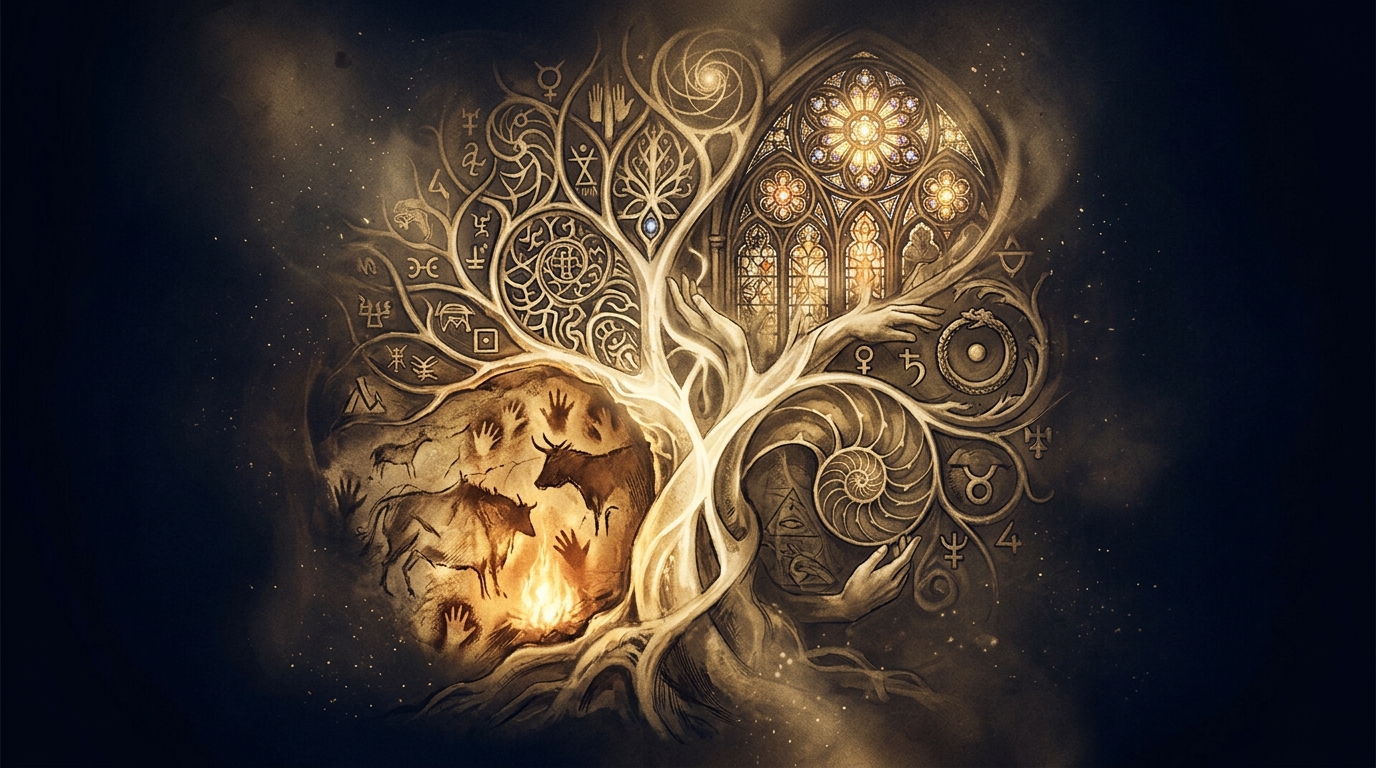
From the painted caves of Lascaux to the stained glass of Chartres, humanity has consistently encoded meaning into images, numbers, and forms that transcend ordinary language. Symbolism is not mere decoration—it is the architecture of how civilizations transmit the sacred, the political, and the cosmological across generations.
Overview
Symbolism, in its broadest sense, is the use of objects, images, gestures, or marks to represent ideas, values, or realities that exceed simple verbal description. The study of signs and their meanings—semiotics—was formalized in the twentieth century by scholars such as Ferdinand de Saussure and Charles Sanders Peirce, yet the practice it describes is as old as human cognition. Archaeological evidence from sites like Blombos Cave in South Africa (c. 75,000 BCE) and Lascaux in France (c. 17,000 BCE) suggests that symbolic thought predates writing by tens of millennia, raising profound questions about the relationship between symbol-making and consciousness itself.
Across ancient civilizations, symbols functioned as a shared grammar of the sacred. In Egypt, hieroglyphic writing was never merely phonetic—each sign carried cosmological weight. The ankh denoted life; the djed pillar, stability and resurrection; the Eye of Horus, divine protection. In Mesopotamia, celestial bodies were simultaneously symbols and divine agents: the moon was Sin, the sun Shamash, Venus was Ishtar. Ugaritic and broader Ancient Near Eastern traditions encoded cosmic realities into cultic objects, temple architecture, and ritual gesture. The ziggurats of Babylon were not simply buildings but cosmological maps, their ascending platforms representing the tiers of heaven and earth. Sacred geometry—the use of mathematical ratios thought to reflect divine order—unified symbolic vocabularies across Egypt, Greece, and the ancient Levant.
In the biblical tradition, symbolic language permeates both testaments. The menorah mirrors the cosmic tree; the tabernacle is a microcosm of Eden and the cosmos; the number seven signifies completeness; the number forty marks periods of trial and transition. New Testament texts such as Revelation are saturated with symbolic imagery drawn from the Hebrew prophetic tradition and Ancient Near Eastern cosmology. Early Christian iconography—the fish (ichthys), the chi-rho, the lamb—served as coded identification in a culture of persecution before becoming a rich visual theology. The Church Fathers, including Origen and Augustine, developed elaborate allegorical and typological frameworks for interpreting scriptural symbols, a tradition formalized in medieval exegetical fourfold method.
In the modern era, symbolism has migrated into psychology, political theory, and popular culture. Carl Jung's archetypal theory proposed that certain symbols—the shadow, the mandala, the great mother—arise universally from the collective unconscious, a claim that remains contested but enormously influential. Semiotics has become a rigorous academic discipline, applied to everything from advertising to religious ritual. Meanwhile, in esoteric and conspiratorial discourse, symbols are frequently interpreted as evidence of hidden agendas—Masonic imagery on currency, occult geometry in city planning, and so forth. Distinguishing the legitimate scholarly study of symbolic communication from speculative pattern-matching is an essential critical discipline.
Timeline
Evidence
Multiple Perspectives
Biblical Lens
Scripture Threads
Sources & Further Study
Questions to Explore
Follow the Thread
Continue the Investigation
You’ve reached the Full Archive portion of this Case File.
Ask the Archivist
about this fileSign in to ask the Archivist
Create a free account to ask the Archivist 1 grounded question each day, cited straight from the CODEX case files.
Discussion
0Share findings, questions, and evidence with fellow Seekers. Be respectful and cite sources where you can.
No comments yet. Be the first to open this thread.