
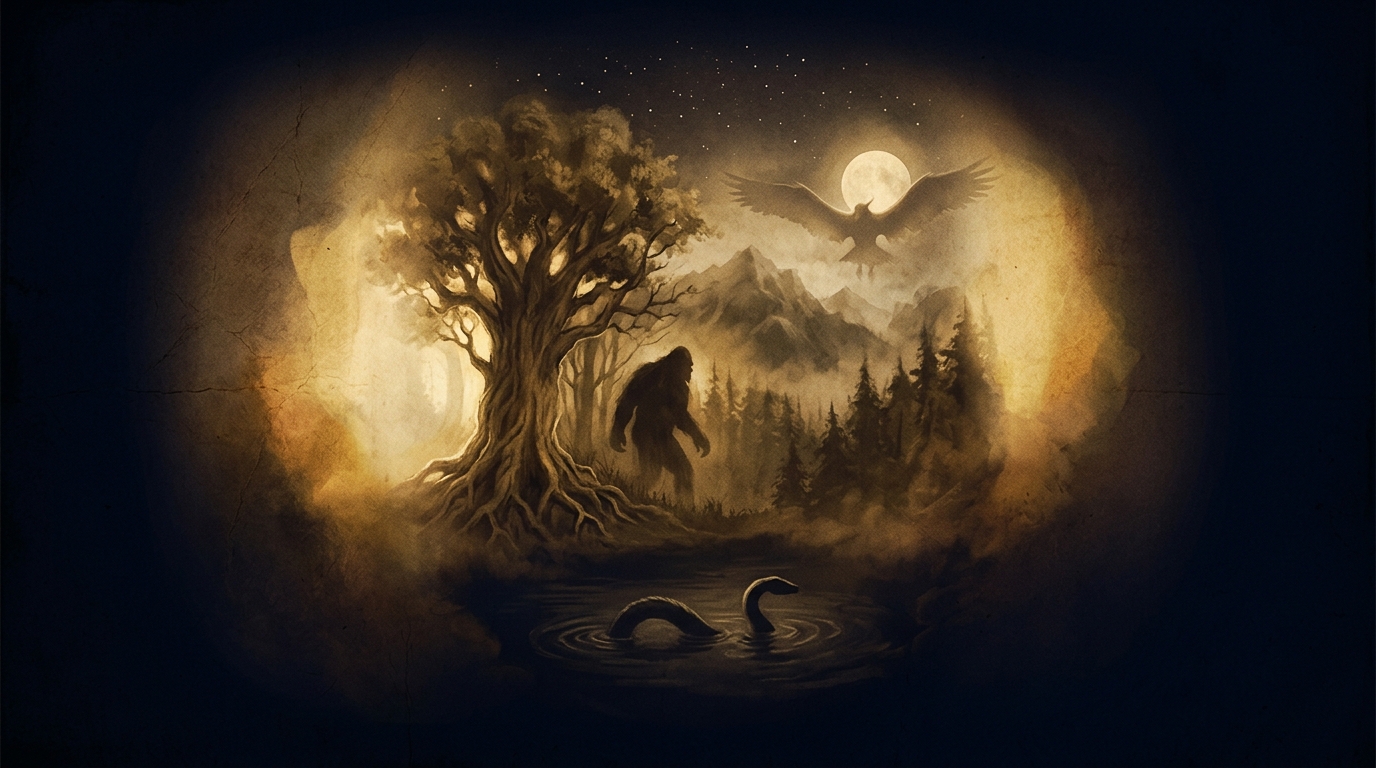
 Codex Illustration
Cryptids
Cryptids—creatures whose existence is reported but not confirmed by mainstream science—occupy a peculiar borderland between zoology, folklore, and the deep human instinct that the world harbors secrets larger than our catalogues. From the forests of the Pacific Northwest to the lochs of Scotland, these reported entities challenge the boundaries of the known and invite serious inquiry alongside necessary skepticism.
Overview
The term 'cryptid' was coined in 1983 by cryptozoologist John Wall, though the discipline of cryptozoology itself was pioneered by Belgian zoologist Bernard Heuvelmans, whose 1955 work 'On the Track of Unknown Animals' attempted to apply systematic methodology to reports of anomalous creatures. Cryptozoology occupies a contested space: its proponents argue it is a legitimate extension of zoological inquiry, noting that real discoveries—the okapi (1901), the coelacanth (1938), and the giant squid (confirmed via live specimen in 2004)—demonstrate that large, unknown animals can persist undetected. Critics, including most mainstream biologists, note that sustained ecosystems capable of supporting breeding populations of large creatures would leave far more physical evidence than the footprints, blurry photographs, and eyewitness testimony that constitute the bulk of cryptid evidence.
The most iconic cryptids cluster into several recurring archetypes: large, bipedal hominids (Bigfoot/Sasquatch in North America, the Yeti in the Himalayas, the Yowie in Australia); large aquatic or semi-aquatic animals (the Loch Ness Monster, Ogopogo, Mokele-mbembe); anomalous canids or felines (the Chupacabra, the Beast of Gévaudan); and winged creatures (Mothman, the Thunderbird). Each archetype has deep roots in regional folklore, and anthropologists have noted that indigenous oral traditions frequently predate modern cryptid reports by centuries, raising legitimate questions about whether cultural memory preserves genuine encounters or whether folklore shapes modern perception and reporting.
The quality of evidence varies dramatically across cases. Some reports rest on physical trace evidence—dermal ridge casts of alleged Bigfoot footprints have been analyzed by physical anthropologists such as Jeffrey Meldrum of Idaho State University, who argues they display biomechanical characteristics inconsistent with simple hoaxing. Other cases rest almost entirely on eyewitness testimony, which cognitive psychologists have extensively documented as unreliable under conditions of low light, stress, and cultural priming. Hoaxes have been definitively confirmed in multiple high-profile cases, including the 1972 'Minnesota Iceman' and the 2008 'Georgia Bigfoot body.' DNA analysis, increasingly applied to alleged cryptid samples, has consistently returned results attributable to known species—bears, humans, ungulates—though proponents argue contamination and poor sample preservation complicate conclusions.
Beyond the zoological question, cryptids function as powerful cultural and psychological phenomena. They embody collective anxieties about wilderness, the uncanny, and the limits of human knowledge. Cultural theorists have observed that cryptid reports spike during periods of social disruption and that the creatures themselves often mirror contemporary fears: the Chupacabra emerged in 1995 Puerto Rico amid anxieties about government experimentation, while the Mothman's 1966–1967 appearances in Point Pleasant, West Virginia coincided with industrial decline and preceded the Silver Bridge collapse. Whether these correlations reflect genuine paranormal activity, mass psychogenic events, or the retrospective narrative shaping of unrelated incidents remains an open and genuinely interesting scholarly question.
Timeline
Evidence
Multiple Perspectives
Biblical Lens
Scripture Threads
Sources & Further Study
Questions to Explore
Follow the Thread
Continue the Investigation
You’ve reached the Full Archive portion of this Case File.
Ask the Archivist
about this fileSign in to ask the Archivist
Create a free account to ask the Archivist 1 grounded question each day, cited straight from the CODEX case files.
Discussion
0Share findings, questions, and evidence with fellow Seekers. Be respectful and cite sources where you can.
No comments yet. Be the first to open this thread.