
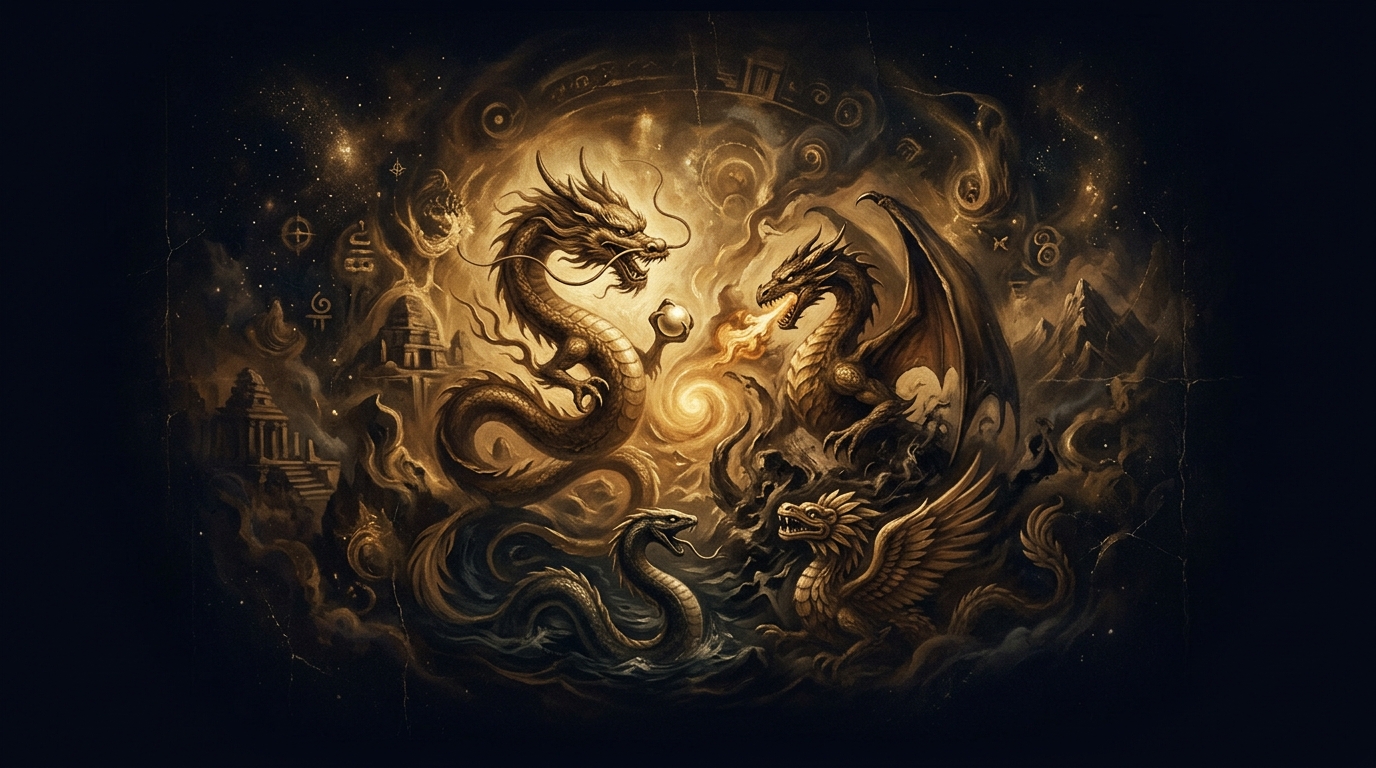
 Codex Illustration
Dragons in World Mythology
From the chaos-serpents of Mesopotamia to the benevolent lung dragons of China, the dragon stands as one of humanity's most universal and persistent mythological archetypes — a creature whose symbolic weight spans cosmology, sovereignty, evil, and sacred power across virtually every major civilization.
Overview
Few mythological creatures match the dragon in geographic breadth and cultural longevity. Dragon-like beings appear in the earliest recorded literatures: Tiamat, the primordial salt-water dragon of Babylonian cosmology, is slain by Marduk in the Enuma Elish; the serpent Apophis threatens the solar barque of Ra each night in Egyptian tradition; and the Vedic demon Vritra, a vast serpent, withholds the cosmic waters from the god Indra. These ancient precedents reveal that the dragon archetype is not a medieval European invention but a fixture of the oldest religious and cosmological imaginations. Scholars of comparative mythology have long noted that these figures cluster around themes of primordial chaos, cosmic order, water, and the boundaries between creation and destruction.
In the ancient Near East specifically, the sea-dragon motif — often called the chaoskampf, meaning 'chaos combat' — appears with striking consistency. Ugaritic texts recovered at Ras Shamra introduce Lotan, a coiling, multi-headed sea serpent defeated by the storm god Baal, a narrative pattern that scholars such as John Day and Michael Heiser have traced directly into the Hebrew Bible, where Leviathan and Rahab function as cognate cosmic opponents. These are not presented merely as physical creatures; they carry the theological weight of anti-creation forces opposed to divine order. The Ancient Near Eastern background is essential for understanding why biblical authors employ dragon imagery with such rhetorical and theological confidence, drawing on shared symbolic vocabulary already well-established in surrounding cultures.
Eastern traditions present a sharply different valuation of the dragon. In Chinese, Japanese, Korean, and Vietnamese cosmologies, the dragon (long or lung) is a benevolent, rain-bringing, regal creature associated with imperial power, water sources, and celestial harmony. These dragons do not oppose creation but sustain it, serving as guardians of rivers and bringers of agricultural fertility. This divergence raises one of comparative mythology's most interesting questions: does the dragon archetype originate from a single cultural diffusion event, from independent convergent symbolism arising from universal human cognitive architecture, or from some combination of the two? Scholars including David Jones, Joseph Fontenrose, and Adrienne Mayor have each weighed in with distinct methodological approaches, none yet achieving consensus.
Modern scholarship has also explored naturalistic hypotheses for dragon origins. Paleontologist Adrienne Mayor argues compellingly in Fossil Legends of the First Americans and The First Fossil Hunters that ancient peoples regularly encountered dinosaur and large vertebrate fossils and incorporated them into mythological frameworks. This does not reduce the mythology to mere misidentification — rather, it situates the dragon as a creative synthesis of observed natural evidence and deep cultural symbolism. Whatever its ultimate origins, the dragon remains a uniquely powerful lens for examining how human civilizations have conceptualized chaos, divinity, kingship, the natural world, and the boundary between the sacred and the monstrous.
Timeline
Evidence
Multiple Perspectives
Biblical Lens
Scripture Threads
Sources & Further Study
Questions to Explore
Follow the Thread
Continue the Investigation
You’ve reached the Full Archive portion of this Case File.
Ask the Archivist
about this fileSign in to ask the Archivist
Create a free account to ask the Archivist 1 grounded question each day, cited straight from the CODEX case files.
Discussion
0Share findings, questions, and evidence with fellow Seekers. Be respectful and cite sources where you can.
No comments yet. Be the first to open this thread.