
 Codex Illustration
Voynich Manuscript
A small, elaborately illustrated codex of unknown origin and undeciphered script, the Voynich Manuscript has resisted every systematic attempt at translation for over a century, making it simultaneously the most studied and least understood book in the world.
Overview
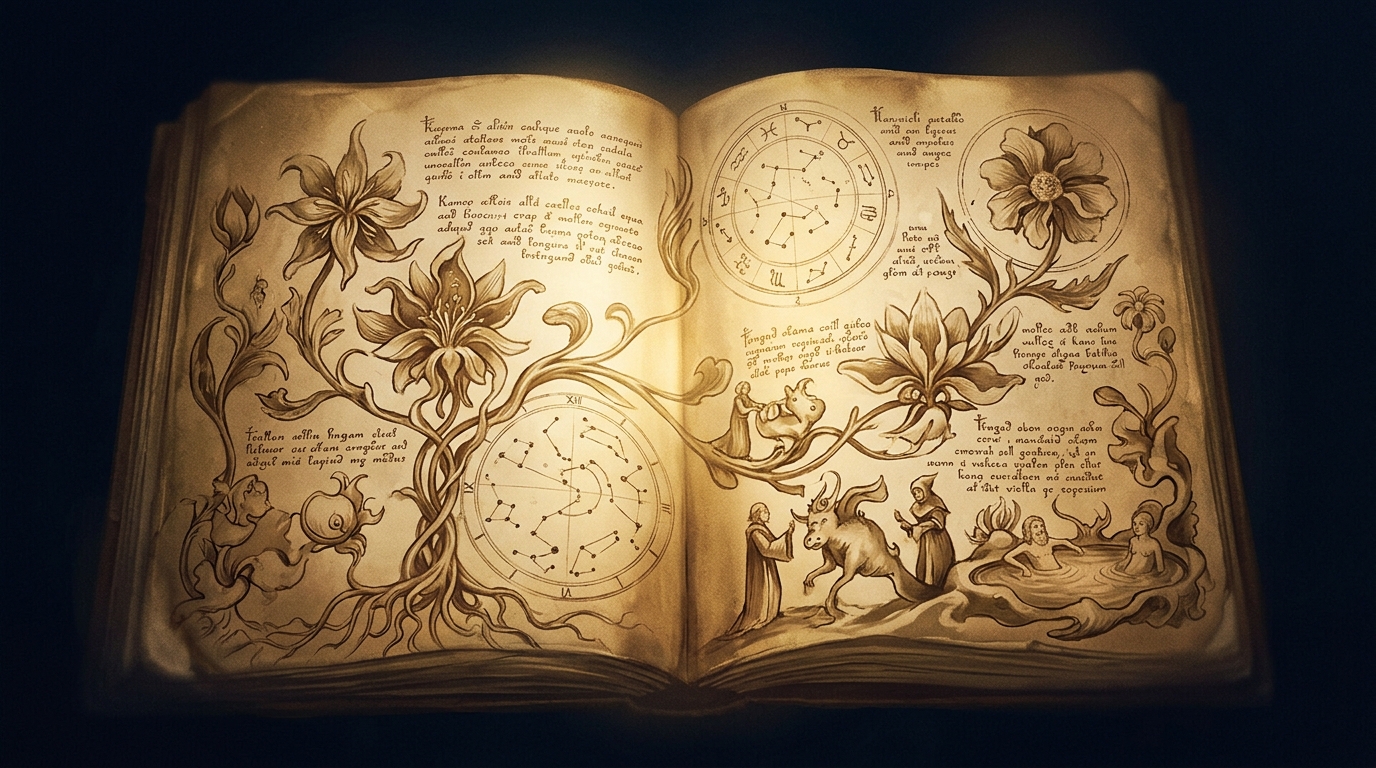
The Voynich Manuscript is a handwritten codex comprising approximately 240 vellum pages, covered in an unidentified script and accompanied by vivid illustrations of botanicals, astronomical diagrams, bathing figures, and what appear to be pharmaceutical or cosmological charts. Radiocarbon dating conducted in 2009 by the University of Arizona placed the vellum's creation between approximately 1404 and 1438, firmly situating the physical material in the early fifteenth century. The manuscript takes its modern name from Wilfrid Voynich, a Polish-American antiquarian book dealer who acquired it in 1912 from the Jesuit Villa Mondragone near Frascati, Italy. Prior to Voynich's acquisition, the manuscript's provenance can be partially traced through a letter attributed to Johannes Marcus Marci, a seventeenth-century Bohemian physician, who presented it to the Jesuit polymath Athanasius Kircher in 1666 with a note suggesting it had once been purchased by Holy Roman Emperor Rudolf II.
The script itself — commonly called Voynichese — displays characteristics consistent with a natural or constructed language: it has internal statistical regularities, apparent word-level grammar, and a vocabulary of several thousand distinct token types. Entropy analyses have shown that the text's informational structure differs from known ciphers of the period and bears some resemblance to natural language rather than random substitution. However, no linguist, cryptographer, or computational analyst has produced a translation that has achieved scholarly consensus. High-profile claimed decipherments have periodically attracted media attention — including claims of proto-Romance language, Hebrew anagram systems, and Nahuatl-based glossaries — but each has been critiqued on methodological grounds by independent reviewers, most fatally for failing to account for the full corpus in a consistent and generative way.
The manuscript's illustrations present a parallel interpretive challenge. The botanical section depicts plants that do not straightforwardly match any known species, though scholars including Sergio Toresella have suggested they may be stylized or composite representations of real herbs, possibly in the tradition of medieval herbal pharmacopoeias. The astronomical section includes circular diagrams with zodiacal imagery and naked female figures that parallel certain alchemical or cosmological traditions of the period. The so-called 'balneological' section, depicting women bathing in interconnected pools or conduits, has been linked to theories ranging from gynecological medicine to esoteric initiation ritual, though none of these readings has achieved broad acceptance. The manuscript's sheer visual peculiarity has made it a canvas for an unusually wide range of interpretive projections.
Scholarship on the Voynich Manuscript occupies an uncomfortable intersection of paleography, computational linguistics, cryptography, and history of science. The manuscript is held at Yale University's Beinecke Rare Book and Manuscript Library (MS 408), which has made high-resolution digital scans publicly available, enabling an unprecedented level of open scholarly and amateur engagement. The most rigorous conclusion the field can offer at present is this: the manuscript is a genuine artifact of early fifteenth-century northern Italy or central Europe, its text exhibits non-random structure suggestive of encoded or constructed meaning, and the nature of that meaning remains genuinely unknown. Whether it represents a natural language written in cipher, an artificial philosophical language, a deliberate hoax, or something else entirely remains one of the most durable unsolved problems in the history of written communication.
Key Claims
Timeline
Evidence
Multiple Perspectives
Biblical Lens
Scripture Threads
Sources & Further Study
Questions to Explore
Go Deeper Path
Follow the Thread
Continue the Investigation
You’ve reached the Full Archive portion of this Case File.
Ask the Archivist
about this fileSign in to ask the Archivist
Create a free account to ask the Archivist 1 grounded question each day, cited straight from the CODEX case files.
Discussion
0Share findings, questions, and evidence with fellow Seekers. Be respectful and cite sources where you can.
No comments yet. Be the first to open this thread.