
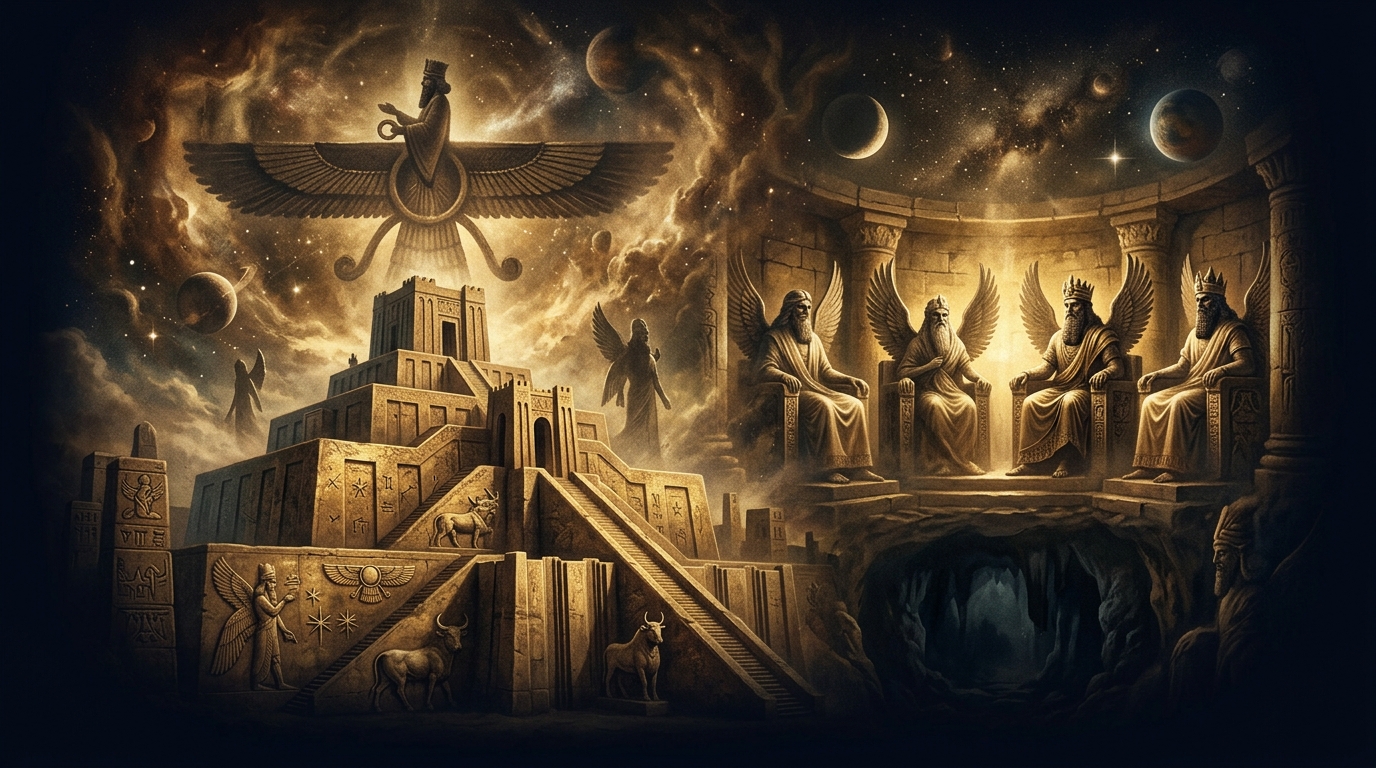
 Codex Illustration
The Anunnaki
The Anunnaki are a pantheon of principal deities in ancient Sumerian, Akkadian, Babylonian, and Assyrian religion, presiding over heaven, earth, and the underworld — and in modern popular culture, they have been controversially recast as extraterrestrial colonizers of prehistoric humanity.
Overview
In the textual and iconographic record of ancient Mesopotamia, the Anunnaki (Sumerian: 'those of princely blood' or possibly 'offspring of An and Ki') constitute the highest tier of the divine council — the great gods who determined the fates of humanity. Their chief figures include Anu (sky-god and patriarch), Enlil (lord of wind and earth, executive of the divine assembly), Enki/Ea (god of wisdom and fresh waters), and Inanna/Ishtar (goddess of love and war). In Sumerian theology, the Anunnaki gathered in a cosmic assembly called the Ubshukinna to deliberate and decree destinies, a portrait strikingly parallel to divine council imagery found throughout the ancient Near East and reflected in biblical texts such as Psalm 82 and Deuteronomy 32.
The primary literary evidence for the Anunnaki comes from cuneiform tablets recovered from sites such as Nippur, Ur, Lagash, and Nineveh, dating roughly from the third millennium BC onward. Key texts include the Sumerian King List, the Atrahasis Epic, the Enuma Elish (Babylonian creation myth), and the Epic of Gilgamesh — each presenting the Anunnaki as divine architects of civilization, flood-senders, and arbiters of human mortality. In the Atrahasis Epic, the Anunnaki and the lesser Igigi gods are described as organizing labor before humanity is created to relieve them of toil, a motif that has attracted both comparative mythologists and speculative interpreters. These are documented literary traditions; their theological meaning, historicity, and relationship to other ancient traditions remain subjects of active scholarly inquiry.
The Anunnaki entered modern popular consciousness primarily through the work of Zecharia Sitchin, whose 1976 book 'The 12th Planet' argued that the Anunnaki were extraterrestrial beings from a hypothetical planet called Nibiru who genetically engineered Homo sapiens as a slave race. This reading has been comprehensively rejected by Assyriologists and ancient Near Eastern scholars, who note that Sitchin's translations are idiosyncratic and unsupported by mainstream cuneiform scholarship. Nonetheless, Sitchin's framework has achieved enormous cultural reach through the ancient astronaut genre and internet mythology, making the Anunnaki one of the most misrepresented bodies of ancient textual material in popular discourse.
For biblical scholars working within an ancient Near Eastern comparative framework — particularly those employing Michael Heiser's divine council model — the Anunnaki tradition is legitimately illuminating as cultural context, not as a source of theological equivalence. The Mesopotamian picture of a divine assembly decreeing fates, assigning lesser gods as territorial administrators, and interacting with humanity through chosen intermediaries shares conceptual vocabulary with biblical texts while remaining theologically distinct. The God of Israel in the Hebrew Bible is not the Anunnaki pantheon's Anu; the bene elohim of Genesis 6 are not straightforwardly Anunnaki. Careful comparison enriches understanding of shared ancient intellectual environments without collapsing the boundaries between traditions.
Timeline
Evidence
Multiple Perspectives
Biblical Lens
Scripture Threads
Sources & Further Study
Questions to Explore
Follow the Thread
Continue the Investigation
You’ve reached the Full Archive portion of this Case File.
Ask the Archivist
about this fileSign in to ask the Archivist
Create a free account to ask the Archivist 1 grounded question each day, cited straight from the CODEX case files.
Discussion
0Share findings, questions, and evidence with fellow Seekers. Be respectful and cite sources where you can.
No comments yet. Be the first to open this thread.